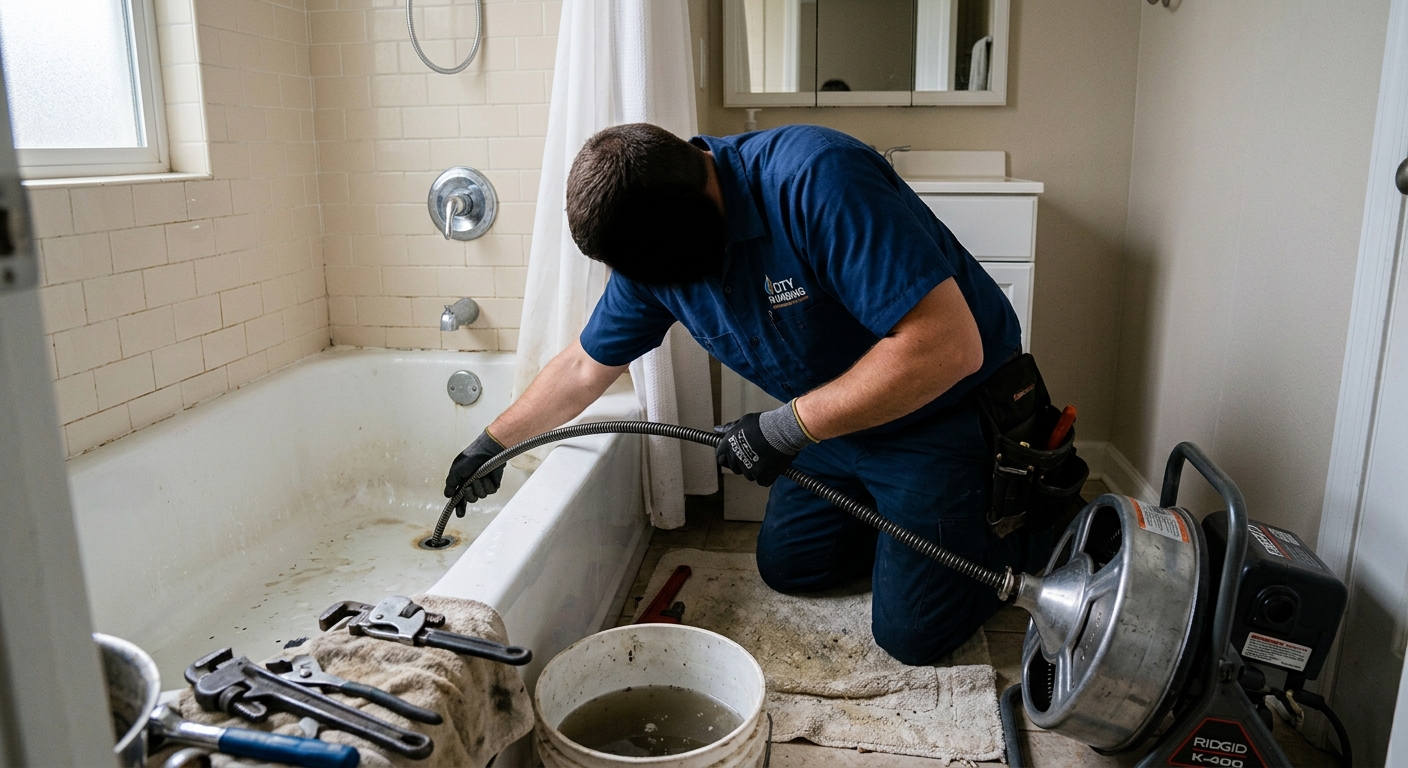
What plumbers charge in Lower Windsor
Plumbing costs in Lower Windsor are shaped by the area’s older homes—nearly 65% of houses here were built before 1980 (U.S. Census Bureau, ACS 2024). That history matters, because the era your home was built often determines your plumbing material, and those pipes predict what goes wrong and what you’ll pay. York City’s housing stock, for example, mostly dates to 1900–1950, which means plenty of old galvanized lines needing replacement with copper or PEX. That’s not just trivia: the older the pipe, the more likely for costly, urgent failures.
The other price lever is whether it’s an emergency. The same job—say, repairing a burst pipe—costs more on a Saturday night than on a Tuesday morning. Emergency rates cover after-hours labor, overtime, and the cost of getting someone out right now.
Most Lower Windsor homes are single-family houses (81.3%, U.S. Census Bureau, ACS 2024), so these numbers fit most projects you’ll encounter. Bigger homes, localized access problems, and older plumbing material will add cost. Here’s what you can expect:
| Service |
Scope |
Emergency rate |
Standard rate |
| Emergency repair — burst pipe |
locate, open, repair section, restore service |
$600–$1,200 |
$350–$1,200 |
| Water heater replacement (gas, 40–50 gal) |
remove old, install, test, haul away |
$1,900–$2,800 |
$1,200–$2,800 |
| Drain cleaning — main line |
augering or hydro-jet, camera if needed |
$350–$800 |
$200–$500 |
| Sewer line spot repair |
excavate or reline a failed section |
$2,000–$12,000 |
$2,000–$12,000 |
| Whole-house repipe |
replace supply lines throughout, patch and finish |
|
$3,500–$8,400 |
| Water service line replacement |
street to house, excavation and restoration |
|
$5,400–$12,000 |
Estimates for a typical Lower Windsor home. Access difficulty and pipe material move these figures more than anything else.
When to call now and when to wait until Monday
The line between an emergency plumbing call and a planned repair is about urgency—and price. When you call after hours in Lower Windsor, you’re not just paying for parts and labor. The bill carries a premium: overtime pay for the tech, an emergency trip charge, and usually a higher hourly rate because rapid diagnosis and immediate dispatch put extra strain on the crew. This can push the cost of a repair, like a burst pipe, from a regular $350–$1,200 to an emergency total of $600–$1,200.
Active water flooding, raw sewage backing up, a total water outage, or the smell of natural gas—all are emergencies. These aren’t just inconveniences; they risk real damage if not handled fast. For these, make the call even if it’s midnight.
But for other issues, you can often hold off. If you’ve got a slow drip under a kitchen sink, one sluggish drain, or a toilet that runs but isn’t overflowing, you can wait. You can save hundreds by scheduling those repairs for weekday business hours.
Here’s the most useful skill: know how to shut off water. Find your home’s main valve (it’s often where the water line enters, like in the basement or utility room). Shut it for whole-house issues. For isolated problems, like a leaking toilet or faucet, close the valve underneath that fixture. By doing this, you convert emergencies into manageable repairs.
- True emergencies: flooding, sewage backing up, no water anywhere, gas smell (call immediately)
- Can usually wait: leak at a fixture you can shut off, one slow drain, non-critical fixture failures
When you’re unsure, call a plumber for advice. A quick call can save you from a needless emergency charge.
Galvanized, copper, PEX, cast iron
Lower Windsor homes echo the plumbing material history of York City, where most houses were built between 1900 and 1950. That era predicts pipe material—galvanized steel was standard pre-1960, copper took over through the mid-century, and PEX is now the go-to for modern repipes. Knowing what’s in your walls tells you how likely you are to face low pressure, leaks, or a full-on failure, and what sort of costs are coming your way.
Here’s how to identify what you’ve got: Galvanized steel pipes are silver-gray and magnetic, often threaded at the joints. Copper shines reddish-brown when scratched, with soldered (not threaded) joints. PEX is flexible plastic in red, blue, or white—most common in newer work. Polybutylene is gray-blue, soft, and joined by clamps or metal bands. Cast iron drains are thick, heavy, dull-black, and ring when tapped. Clay tile sewer lines are only visible in the yard or with a camera—they’re reddish-brown and brittle.
As a rule of thumb: if your home is pre-1950s, it probably started life with galvanized or cast iron. If it was built after, copper supply lines and PVC or ABS drains are typical. Polybutylene was in use in the later 20th century but is uninsurable and should be replaced. For homes still on original supply pipes, expect replacement soon—by 60 years, galvanized pipe is near the end of its reliable life, and cast iron drains often start failing around the 50–75 year mark.
| Material |
Typical era |
Failure mode |
Service life |
| Galvanized steel supply |
pre-1960 |
internal corrosion, pressure loss |
40–60 yrs |
| Copper supply |
1950s–present |
pinhole leaks, joint failure |
50–70 yrs |
| Polybutylene supply |
late 1970s–1995 |
fitting failure, sudden bursts |
unreliable |
| PEX supply |
2000s–present |
fitting or UV degradation |
40–50 yrs |
| Cast iron drain |
pre-1975 |
corrosion, cracking, scale |
50–75 yrs |
| Clay tile sewer lateral |
pre-1980 |
root intrusion at joints, offset |
50–60 yrs |
| PVC / ABS drain |
1970s–present |
joint separation, crushing |
50+ yrs |
Choosing a plumbing contractor
If you’re hiring a plumber in Lower Windsor, you need to check credentials the right way—especially since licensing here is not handled at the state level but municipally, and Spring Garden Township keeps its own registry. Check whether the company is registered as a Home Improvement Contractor with the Pennsylvania Office of Attorney General for work over $500. Double-check that registration at hic.attorneygeneral.gov. For insurance, ask for a certificate naming your address, and confirm workers’ compensation through WCAIS (wcais.pa.gov), not just a verbal assurance. Companies should be upfront about their emergency rates, whether they send their own employees or subcontract, and clearly state what’s included.
- Verify HIC registration for jobs over $500
- Ask for proof of municipal licensing if required locally
- Request a certificate of insurance that names your property
- Check workers’ compensation coverage via WCAIS
- Confirm if crews are employees or subcontractors
- Request a written contract (required over $500)
- Ask to see camera footage for any sewer or repipe quote
- Demand a pressure test before major repipe work
- Clarify emergency and after-hours pricing in writing
- Check for detailed work scope and warranties in writing
- Read all cancellation, payment, and change order terms
- Review any utility shutoff and property protection plans
Red flags: In this market, a company rushing to sell you a whole-house repipe or sewer line replacement without camera evidence—or not offering a test—should always be doubted. With plumbing demand moderate here and many firms covering a wide area, get at least two detailed written quotes before hiring for big work.
Verifying a Lower Windsor plumber's credentials
Pennsylvania does not issue a statewide plumbing licence. Whether your Lower Windsor plumber is licensed depends on the municipality—in this county, Spring Garden Township maintains its own plumbing license registry. That means a plumber licensed in York City or another township might not be qualified to work in your neighborhood unless registered with your township or borough office. Always ask specifically, “Are you licensed to work here in Lower Windsor?” and require proof for your township if it maintains its own list.
State law does require Home Improvement Contractor (HIC) registration through the Pennsylvania Office of Attorney General for jobs over $500. You can verify that at hic.attorneygeneral.gov before signing anything. If you’re hiring a company rather than an individual, request their workers’ compensation status through WCAIS (wcais.pa.gov)—that system confirms legitimate coverage protecting both you and their employees.
In York City, you need a permit for any new or altered plumbing work beyond a direct fixture swap. Replacing a faucet or toilet in the same location usually doesn’t trigger a permit. Permit offices in York and surrounding townships manage their own inspections and approvals. Always ask your plumber: who pulls the permit? Who schedules the inspection? Make sure insurance policies actually list your address for proof of coverage during the job.
For homes built before 1978, the federal EPA Lead RRP Rule applies—your contractor should be certified if they disturb painted surfaces. Double-check their EPA certification at certifiedrenovatorsearch.epa.gov if your job involves opening up walls or ceilings.
Winter pipe failures in south-central Pennsylvania
Lower Windsor sits in a region where winter lows dip to a design temperature of 12 °F, with a frost depth of 30 inches. The pronounced freeze-thaw cycles here cause trouble: when water in a pipe freezes, the blockage increases pressure between the ice plug and closed faucet—so the pipe often bursts away from the icy spot. Uninsulated areas like exterior walls, crawlspaces, garages, and attic runs are first to fail. Garden hose lines (hose bibs) and pipes in unconditioned spaces are common trouble spots.
To protect your pipes, work from most to least expensive:
- Insulate exposed supply lines—especially those in attics and exterior walls
- Use approved electric heat tape for vulnerable sections
- On exceptionally cold nights, let a faucet drip to keep water moving
- Open cabinet doors beneath sinks to let home heat reach pipes
- Shut off and drain outdoor spigots before the first hard freeze
If a pipe does freeze, the safest way to thaw it is by using a hair dryer or heat gun—not an open flame. Apply gentle, even heat to the pipe, working toward the faucet. Never leave a heating device unattended. If you return from a winter trip and find a burst, the repair cost for a typical Lower Windsor home ranges from $600–$1,200 for an emergency, not counting drywall or flooring repairs after cleanup. Spending a little on prevention is money well spent in south-central Pennsylvania.
Choosing a water heater in Lower Windsor
When it’s time for a new water heater in Lower Windsor, most homeowners need to choose between a standard tank, a tankless unit, or a heat pump water heater. Each type suits a different house, budget, and set of expectations.
Standard gas or electric tank heaters are the least expensive to install—$1,200–$2,800—but they waste energy keeping water hot around the clock. They usually last 8–15 years, and failure is usually a leaking tank, not the controls. Tankless gas heaters offer endless hot water and a longer service life (up to 25 years), but the upfront cost is higher ($1,900–$2,800), and you might need to pay for a larger gas line or vent system—unexpected costs for many. Heat pump water heaters are the cheapest to operate but need space and warmth; they pull heat from room air (cooling your basement or utility area) and are too loud for some finished spaces. They run $1,900–$2,800 installed.
Get the right size for your home: use the first-hour rating, which measures how much hot water you’ll actually have at once. For code compliance and insurance, always install an expansion tank and a pan with a drain if the heater sits above finished spaces. Most failures are slow leaks that go unnoticed at first—so install where you can check for puddles, and consider leak alarms where possible.
| Type |
Installed cost |
Service life |
Operating cost |
Best when |
| Gas tank, 40–50 gal |
$1,200–$2,800 |
8–12 yrs |
moderate |
Standard option; gas available; baseline budget |
| Electric tank, 40–50 gal |
$1,200–$1,900 |
10–15 yrs |
high |
No gas; quick replacement; lowest upfront cost |
| Gas tankless |
$1,900–$2,800 |
18–25 yrs |
low-moderate |
Endless hot water; longer service life; room for vent upgrade |
| Heat pump water heater |
$1,900–$2,800 |
13–15 yrs |
lowest |
Big family; high electric bills; unfinished or utility room location |
Frequently asked questions — plumbing in Lower Windsor
Repair or replace a leaking water heater?
If you’ve discovered your water heater leaking in Lower Windsor, replacement is usually your best bet—especially for models over eight years old or ones showing corrosion at the bottom or around fittings. Tank leaks, in particular, can’t be effectively repaired; once the inner steel rusts through, patching won’t last. Control or valve leaks can sometimes be fixed for less money, but by the time a repair bill approaches even a fraction of the cost for replacement—$1,200–$2,800 installed—most homeowners choose a new unit. Quick tip: always check whether the leak is from a pipe or a fitting above the tank before declaring the heater itself dead. If it’s more than a decade old and the tank’s damp, replacement is the better investment.
How much does a water heater replacement cost in Lower Windsor?
In Lower Windsor, expect to pay between $1,200–$2,800 for standard gas or electric water heater replacement (40–50 gallon size), with most homeowners landing near $1,900. This includes removing the old tank, installing the new unit, and basic testing. The price goes up if you need a new expansion tank, pan, or code upgrades like venting and new shutoffs. Tankless and heat pump water heaters also fall into that price band but typically land at the top end because of additional work. If you’re quoted lower or much higher, make sure you’re comparing bids that include removal, permitting, and all code-required extras.
What does repiping a house cost in Lower Windsor?
Repiping—a total replacement of supply lines with copper or PEX—runs $3,500–$8,400 for most single-family homes in Lower Windsor. The final cost depends on your home’s layout, size, and whether access means opening a finished ceiling or wall. Older homes in the area, especially those built between 1900 and 1950, usually have original galvanized piping that restricts pressure and can leak at random points. If you’re considering a whole-house repipe because of repeated leaks or low pressure, get a bid that spells out patching and restoration too. Don’t pay for a repipe unless you get pressure test results or camera proof that the existing pipes have failed.
Which utility supplies water to Lower Windsor?
York Water Company is the primary public water supplier serving York City and many surrounding York County municipalities, including Lower Windsor. The good news for area homeowners: York Water Company has completed a full lead service line replacement in its coverage zone, so concerns about lead pipes from the street have been addressed. If you ever have to dig up your water service line—from the street to your house—costs are generally between $5,400–$12,000, depending on length and excavation needs. If you don’t already have a copy of your “tap card” or service schematic, the utility can provide one to your plumber.
Do I need a permit for plumbing work in Lower Windsor?
Whether you need a plumbing permit in Lower Windsor depends on the specific work and your municipality’s rules. In York City, for example, any new or altered plumbing system—other than a fixture swap in the same location—requires a permit, and the same applies in most surrounding townships. If you’re just replacing a toilet or faucet in the same spot, no permit is required. For larger jobs like repipes, water heaters, or moving fixtures, permits are not optional and should be obtained before work begins. Permit cost is included in most quotes for larger jobs, such as a new water heater ($1,200–$2,800), but always ask your contractor to confirm and see the permit before work starts.
What do I do if a pipe is frozen but not burst?
If you suspect a pipe has frozen in your Lower Windsor home—maybe you’ve lost water at one faucet, or nothing comes out when you turn it on—first, turn off the water supply to that area if you can. Then gently warm the pipe with a hair dryer or heat gun, starting at the faucet and moving toward the coldest spot. Never use an open flame, as it’s a major fire hazard and could damage the pipe. Open a nearby faucet to allow melted water to drip through. Once thawed, check for leaks before restoring normal flow. Prevention is always cheaper than repair: burst pipe repairs here run $600–$1,200 on emergency, so catching it early can save you a big bill.
What do I do if sewage is backing up?
If sewage is coming up anywhere in your Lower Windsor home—especially tubs, floor drains, or lower-level toilets—it’s a true emergency. Stop running water immediately and don’t flush anything further. If you know where your main sewer cleanout is, check for standing water there; sometimes you can relieve pressure by loosening the cap slightly (very carefully, as this can release a mess). Call an emergency plumber for immediate help—drain cleaning for a main line blockage runs $350–$800 on emergency, and time is money because raw sewage can quickly damage floors and walls. Don’t try store-bought chemicals, as they can make professional cleaning more dangerous and less effective.
What causes low water pressure in Lower Windsor homes?
Low water pressure in a Lower Windsor home often traces back to original galvanized steel pipes, which were common in houses built through the mid-20th century. These pipes corrode from the inside, slowly restricting flow. Other culprits might be a partially closed main shutoff valve, a water softener in need of maintenance, or debris stuck in aerators and showerheads. If the whole house has low pressure and your neighbors do not, a whole-house repipe may be on the horizon—costing $3,500–$8,400 depending on scope. Main line leaks or pressure reducing valves set too low are less common but possible. Always check with your water supplier for line repairs or hydrant flushes before investing in costly work.
Is a sewer line replacement covered by homeowner's insurance?
Most standard homeowner’s policies in Pennsylvania, including in Lower Windsor, do not automatically cover damage to or replacement of your sewer line—especially if the cause is normal wear and tear, corrosion, or root intrusion. Some policies offer an extra “service line coverage” endorsement for an added premium, but you must request it in advance. Sewer line spot repairs typically run from $2,000–$12,000, so this isn’t a minor expense. If you’re worried about aging clay or cast iron sewer lines (common in homes built before 1980), ask your insurance agent about available addons and always get camera evidence before investing in major work.