What plumbers charge in Coatesville
Coatesville’s plumbing costs are governed as much by when you call as by what needs doing. Daytime, scheduled work almost always costs less than emergency dispatch after hours or on weekends. For one of Coatesville’s 1,691 owner-occupied homes (U.S. Census Bureau, ACS 2024), the biggest price swings come with leaks or burst pipes—double the cost or more at 10 p.m. compared to Monday morning. If your home is in one of the large Chester County subdivisions built from 1960 to 2000, you’re likely to have copper or early PEX supply lines, with PVC or sometimes aging clay sewer laterals. These materials influence both what fails, and what a repair or replacement should cost.
Old copper is prone to pinholes, driving up the need for partial or whole-house repipes, while clay and early PVC laterals see root intrusion or cracks. Sewer fixes and supply repipes are among the more costly repairs, often driven up further by access or excavation difficulty. Here’s what homeowners can expect for common jobs—emergency rates versus standard scheduled service:
| Service |
Scope |
Emergency rate |
Standard rate |
| Emergency repair — burst pipe |
locate, open, repair section, restore service |
$650–$1,300 |
$375–$1,300 |
| Water heater replacement (gas, 40–50 gal) |
remove old, install, test, haul away |
$2,100–$3,100 |
$1,300–$3,100 |
| Drain cleaning — main line |
augering or hydro-jet, camera if needed |
$350–$800 |
$200–$500 |
| Sewer line spot repair |
excavate or reline a failed section |
$2,200–$13,000 |
$2,200–$13,000 |
| Whole-house repipe |
replace supply lines throughout, patch and finish |
$3,800–$9,300 |
$3,800–$9,300 |
| Water service line replacement |
street to house, excavation and restoration |
$6,000–$13,000 |
$6,000–$13,000 |
Estimates for a typical Coatesville home. Access difficulty and pipe material move these figures more than anything else.
Is your water line lead? How to find out
Lead in service lines is a valid concern for Coatesville homeowners, but the risk here is now low. Aqua Pennsylvania’s 2024 inventory for Chester County reports remaining lead service lines under 1% of its active service lines. Still, it’s worth knowing what pipes you have because the water service line is split into two parts: the utility-owned section and the homeowner-owned section (called the lateral). Utility replacement programs typically cover only the portion they own, leaving you to replace the rest if it turns up lead.
If you live in one of the pre-1980 homes making up the bulk of Coatesville’s housing, check the water pipe where it enters your basement or crawlspace. Run a coin over it: lead is dull gray and turns shiny when scratched, plus it won’t attract a magnet. If it’s magnetic, it’s likely galvanized steel; copper is orange or brown and won’t scratch silver.
Partial replacements—just the utility side, or just your side—can briefly increase lead exposure by disturbing the protective mineral scale inside old pipes. If you suspect you have a lead lateral, don’t disturb it until you have a full replacement plan. Aqua Pennsylvania and the West Chester Area Municipal Authority both publish online inventories of lead service lines. There is no standing cost-share replacement program reported for this area, so you should contact your utility directly to confirm whether assistance is available before hiring a contractor.
Replacement of a lead service line typically falls into the $6,000–$13,000 range for the full street-to-house job. Spot repairs are not recommended with lead lines; a full lateral replacement is the standard.
Verifying a Coatesville plumber's credentials
Pennsylvania does not issue a statewide plumbing license—plumbers are licensed at the municipal level. This means a contractor licensed in Philadelphia or Pittsburgh may not be authorized in Coatesville or anywhere else in Chester County unless they have also registered locally. Some Chester County townships, such as Westtown Township, maintain their own plumbing contractor registrations in addition to any Philadelphia license. Always ask, “Are you licensed here, in this township?” and confirm with the local code office, especially since there’s no one central registry for all of Pennsylvania.
For projects in West Goshen Township, any new or replacement plumbing connected to public water or sewer requires a township plumbing permit. Permits are also needed when changing water heaters, replacing large sections of supply, or connecting to the municipal system. Inspections are performed by the local code office or, in some cases, by the Pennsylvania Department of Labor & Industry if the municipality has opted out of enforcing the Pennsylvania Uniform Construction Code (UCC).
Insurance is essential. For contracts over $500, verify the contractor holds Home Improvement Contractor (HIC) registration with the Pennsylvania Office of Attorney General at hic.attorneygeneral.gov, and request a certificate of insurance naming your property. For workers’ compensation, check their coverage status using WCAIS (wcais.pa.gov) to ensure any crew on site is properly insured for injuries.
Vetting a plumber in Chester County
Because licensing is strictly municipal in Pennsylvania, always confirm that your plumber holds the right registration for your specific Chester County township, not simply for the state or another city. Start by checking their Home Improvement Contractor (HIC) registration with the Pennsylvania Office of Attorney General, required for all plumbing contracts over $500—search at hic.attorneygeneral.gov. Ask to see a certificate of insurance that specifically names your property for the duration of the work. For workers’ compensation, use WCAIS (wcais.pa.gov) to confirm coverage for anyone expected on your job.
Ask if the company runs its own plumbers or subs out work, and how they disclose emergency rates—especially in this dense suburban market with many small local firms. In Chester County, be skeptical of any contractor quoting a whole-house repipe or sewer lateral replacement without first providing camera footage or a pressure test as justification.
- Confirm HIC registration at hic.attorneygeneral.gov.
- Check township-level license or registration for plumbing (call your township office).
- Ask for a copy of the certificate of insurance naming your address.
- Verify workers’ compensation status at wcais.pa.gov.
- Ask who will actually perform the work—company crew or subcontractors.
- Require detailed written estimate, not verbal or handwritten slips.
- Demand disclosure of after-hours and emergency premium rates in advance.
- Insist on camera evidence for sewer or main line repairs and a pressure test for repipe recommendations.
- Check for a valid written contract on any job over $500 (HICPA requirement).
- Be wary of claims you must sign the job immediately or that permits are not needed.
- Avoid any offer to “waive your insurance deductible”—this is prohibited by law.
- Ask for references for comparable jobs in Chester County.
Red flags in Chester County: “Urgent” repipe or sewer replacement quotes with no diagnostics, unfamiliar crews showing up, or pressure to start without a contract. The dense market here means you have options—don’t settle for vague or rushed answers.
What's in the water here
Most Coatesville homes are served by Aqua Pennsylvania or the West Chester Area Municipal Authority. Both public water systems are required to publish annual water quality reports, which you can request for a full accounting of what’s in your water. Around here, scale (mineral buildup) is a common culprit for ruining water heaters and clogging fixture aerators, especially in older homes with copper lines. Hard water makes your appliances work harder, shortening their lifespan.
Some Chester County supplies also lean toward “aggressive water,” which can spur pinhole leaks in copper pipes. While water softeners can help with hardness, they won’t pay for themselves if your water is only moderately hard—unless you routinely battle with calcium scale in kettles or on shower doors, skip the softener. For most, point-of-use filters on taps are the best way to address taste or odor issues, and whole-house filtration is necessary only if you have a specific need revealed by a water report.
Private well owners (in certain outlying townships with no public supply) should arrange independent lab testing, since no official report will cover your water. Don’t buy expensive filtration systems based on “free” in-home sales tests; insist on certified lab results before investing.
Dating your plumbing by what it's made of
With so much Chester County housing built between 1960 and 2000, materials tell the story of what’s likely to fail and when. Galvanized steel was common pre-1960 and announces its age by losing water pressure, closing up from the inside before it finally leaks. These pipes attract a magnet and show thick threaded joints. Copper—installed from the 1950s and still used—is soldered, smooth, and orange-brown. The biggest enemy of copper pipes here is aggressive water, which can pit them and cause scattered pinhole leaks after 40–60 years.
Polybutylene, a blue-gray or black plastic used from the late 1970s to about 1995, should raise an eyebrow—its fittings fail with little warning. Most insurance companies won’t cover damage caused by it anymore. Modern PEX (usually red, blue, or white and joined with crimped metal rings) has been common since the early 2000s and offers greater freeze resistance and a clean installation. Drains and sewer lines here are telling, too: pre-1975 homes may have cast iron, identifiable by thick black or rusted pipe and bell-shaped joints. Clay tile sewer laterals, common up to 1980, fail at the joints—roots love finding their way in. Modern PVC/ABS drains are light, white or black, and joined by glue rather than threads or lead.
Look for a visible pipe near your water meter, boiler, or in the unfinished basement to scratch and check color, attach a magnet, or inspect joint types (threaded, soldered, glued). Map your likely runway and plan your upgrades before leaks catch you off guard.
| Material |
Typical era |
Failure mode |
Service life |
| Galvanized steel supply |
pre-1960 |
internal corrosion, pressure loss |
40–60 yrs |
| Copper supply |
1950s–present |
pinhole leaks, joint failure |
50–70 yrs |
| Polybutylene supply |
late 1970s–1995 |
fitting failure, sudden bursts |
unreliable |
| PEX supply |
2000s–present |
fitting or UV degradation |
40–50 yrs |
| Cast iron drain |
pre-1975 |
corrosion, cracking, scale |
50–75 yrs |
| Clay tile sewer lateral |
pre-1980 |
root intrusion at joints, offset |
50–60 yrs |
| PVC / ABS drain |
1970s–present |
joint separation, crushing |
50+ yrs |
Emergency rates versus scheduled work in Coatesville
The biggest difference in plumbing costs in Coatesville is whether the call is an after-hours emergency or a planned daytime job. Emergency rates include a premium for after-hours dispatch, extra trip charges, and overtime labor—plus, the plumber is diagnosing a problem on the fly, with less setup and fewer options for parts or helpers. For example, stopping an active leak at 1 a.m. can run up to $1,300, while the same repair scheduled during business hours may cost as little as $375 (see table above).
To save money, know what truly counts as an emergency in Coatesville’s climate and code environment:
- Active, uncontrolled water flooding (can’t shut off at a fixture)
- No water to the whole house
- Sewage backup into tubs or floor drains
- Any gas smell—leave the house, call 911, then your gas utility
Situations that usually can wait until morning or the next business day include:
- A slow drip under a sink (catch it in a pan)
- One slow drain (unless it’s a main line backup)
- A running toilet
- Low water pressure, if you still have water
If you know where your main water shutoff valve is—usually at the point where the water line enters your basement or utility area—you can turn water off to stop most leaks from spreading. For isolated fixtures (sinks, toilets), angle or shutoff valves beneath can isolate the problem. A five-minute skill like this can turn a $1,300 urgent repair into a $375 scheduled one.
Frequently asked questions — plumbing in Coatesville
What does emergency plumbing cost in Coatesville?
Emergency plumbing service in Coatesville is priced according to the job type and the time you call. For urgent repairs like a burst pipe or active leak overnight, expect to pay between $650–$1,300. That figure covers locating the leak, opening up walls if needed, repairing the pipe, and restoring water. Emergency rates are higher because the plumber responds after hours, often with extra trip and labor charges. If you can safely turn off the water and wait for business hours, the same repair often drops to $375–$1,300. Always ask for an emergency rate quote up front, and watch out for companies that won’t disclose the premium before dispatching a crew.
How do I prevent frozen pipes in Coatesville?
Coatesville winters bring freeze-thaw cycles and plenty of cold snaps—your plumbing needs to be ready for 14 °F winter lows. Prevent frozen pipes by insulating exposed supply lines in basements, crawlspaces, and garages. Let faucets drip lightly on the coldest nights and keep cabinet doors under sinks open to allow heat near pipes. The cost of an emergency repair for a burst pipe due to freezing can be up to $1,300, but basic insulation usually costs far less and can be done as a DIY task. If you’ll be away, turn off the main, drain fixtures, and keep the heat above 55 °F. Early prep is the best investment here—most freezes strike uninsulated pipes in the most recent cold snap of a mild winter.
Repair or replace a leaking water heater?
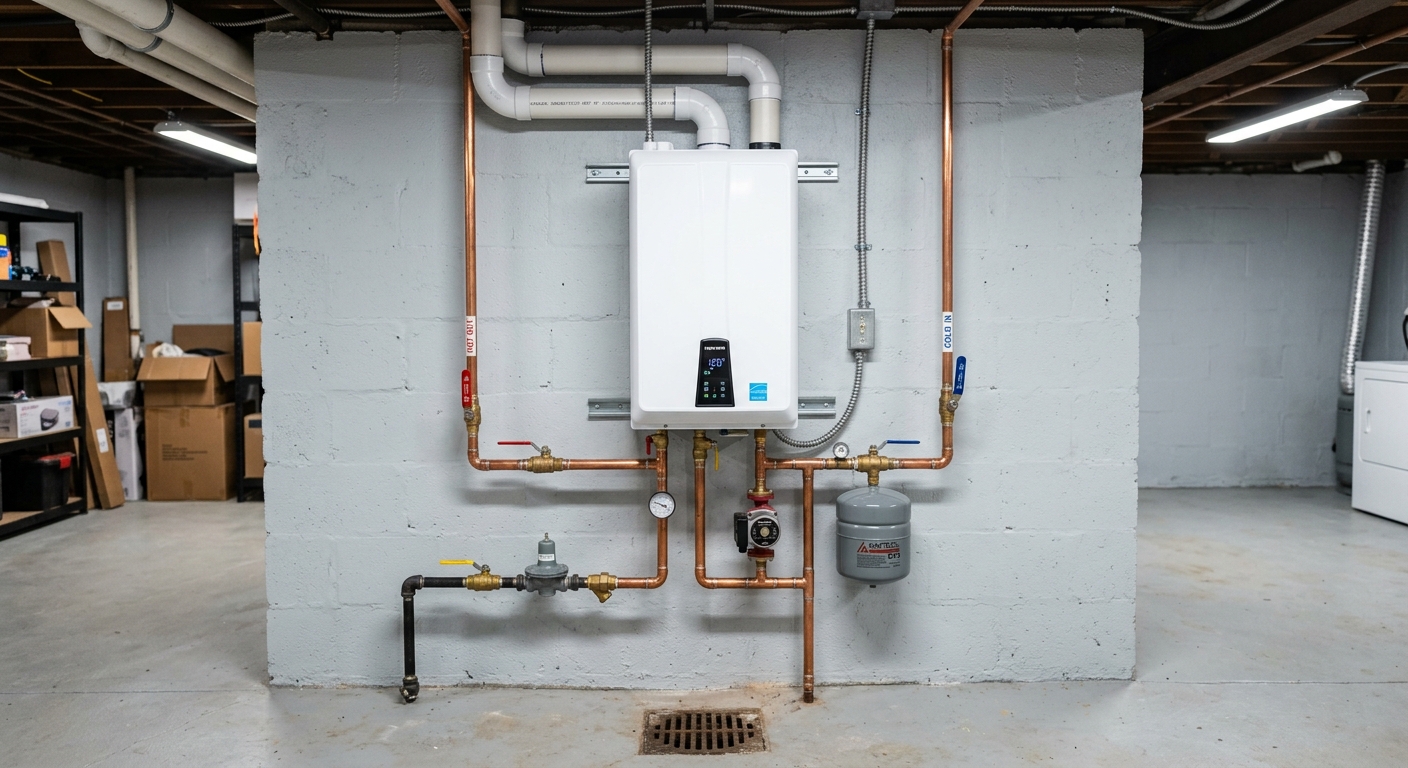
For Coatesville homes, if your gas water heater is leaking from the tank itself (not just a loose valve or fitting), it almost always means you need a replacement—the fix does not last. Expect replacement to cost $1,300–$3,100 for a standard 40–50 gallon unit. If the leak is from a pipe joint, valve, or fitting above the tank, a repair can be far less, sometimes under $375. Water heaters see hard service in Chester County due to both scale and aggressive water chemistry, especially in older homes. If it’s over 10 years old and leaking from the base, don’t spend on repairs—replace it, as continued leaks will cause water damage before long.
How much does a plumber cost in Coatesville?
Plumbers in Coatesville price jobs primarily by scope and urgency. Routine service during business hours (like clearing a main drain line) runs $200–$500. Bigger jobs like water heater replacements cost $1,300–$3,100. Emergency calls—especially after hours, on weekends, or for jobs that can’t wait—carry a significant premium, often landing between $650–$1,300 for a burst pipe repair. Coatesville’s dense suburban market offers competitive pricing, but always ask up front about the rate for your specific timing to avoid surprise costs.
How do I find a hidden water leak?
Hidden water leaks in Coatesville homes are usually found by a combination of meter checks and targeted inspections. First, check your water meter—turn off all taps and appliances, then see if the meter still moves. If so, a leak is likely. Listen for hissing behind walls or under floors, and check for unexplained water stains or mold. Plumbers in Coatesville often use thermal cameras, moisture meters, or acoustic sensors for pinpointing hidden leaks. Leak detection and repair commonly ranges from $375–$1,300, depending on complexity. Catching a leak early in older homes—which make up more than half in this area—can save thousands in repairs later on.
Do I need a permit for plumbing work in Coatesville?
Most new or replacement plumbing that connects to public water or sewer in Coatesville (and in West Goshen Township) requires a township plumbing permit. This includes water heater replacement, supply line changes, or large drain repairs. The local code office or, in some cases, the Pennsylvania Department of Labor & Industry if the township opted out, performs inspections. Unpermitted work can delay real estate sales and void insurance claims. For typical jobs like a whole-house repipe, permits are part of the process and factored into the price—usually in the $3,800–$9,300 range. Always confirm your plumber will handle permits and inspections.
Should I wait until business hours to call?
If you can safely stop the leak or isolate the problem (for example, with a working main shutoff valve or fixture shutoffs), waiting for business hours can save you hundreds. Emergency plumbing in Coatesville runs $650–$1,300, while the same repair during regular hours can cost as little as $375. If you’re facing active flooding, no water at all, sewage backing up, or a gas odor, treat it as an emergency. But a dripping faucet, a sluggish drain, or one non-working toilet can wait. Knowing how to shut off water at the main or fixture is the single best skill for turning many emergencies into standard work.
Who owns the sewer lateral, me or the city?
In Coatesville and Chester County townships, the sewer lateral that runs from your house to the street is typically your responsibility—the city or authority handles only the main in the street. If a clog or break occurs anywhere between your foundation and the tap-in point at the main, you’re on the hook for repairs. Spot repairs for sewer laterals often cost $2,200–$13,000 depending on location and depth. Always request a camera inspection before committing to major repairs, especially for older homes where aging clay or PVC pipes are prone to root intrusion or cracking.
Do older Coatesville homes have galvanized pipes?
Yes, many older Coatesville homes—especially those built before 1960—still have galvanized steel supply lines. These pipes are best identified by their metallic gray color, thick threaded fittings, and their attraction to a magnet. Over time, galvanized pipes corrode from within, cutting water pressure and eventually beginning to leak. Replacing these lines with PEX or copper can cost in the $3,800–$9,300 range for a whole-house repipe. If you notice persistently low pressure or rusty water, it’s time to check your visible pipe sections or call a plumber familiar with Chester County’s housing stock to confirm and plan your upgrade.