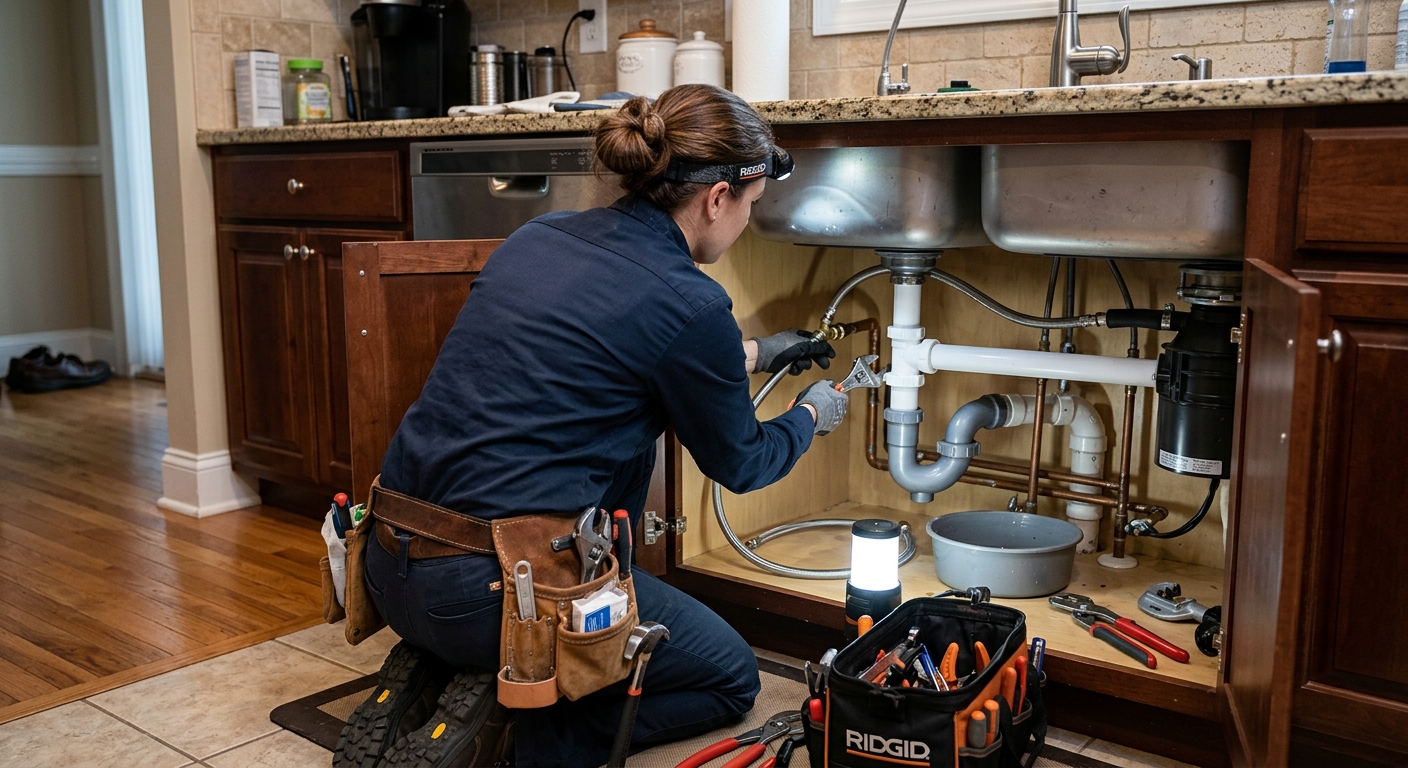
Tobyhanna plumbing prices by job type — 2026
In Tobyhanna, plumbing repair and installation costs depend heavily on the construction era of your home and whether you’re facing an emergency. With over 2,565 owner households in Tobyhanna and nearly half the housing stock built before 1980 (U.S. Census Bureau, ACS 2024), what you pay will hinge on both urgency and the plumbing materials present. Many homes from the 1970s to the 2000s were built as vacation or subdivision properties using a mix of copper, galvanized, and – in recent years – PEX piping, especially in homes that have had septic tie-ins or major retrofits. These choices affect both what fails and what a fix will cost.
Emergency calls—like an active leak or burst pipe—almost always cost more due to the need for immediate, sometimes after-hours work. For the same repair, emergency rates can be double what you’d pay for a scheduled job. For example, stopping an active leak in the middle of the night will almost never land on the low end of the range. Scheduled work like replacing an aging water heater or repiping with PEX, on the other hand, offers more predictable pricing and timeline.
| Service |
Scope |
Emergency rate |
Standard rate |
| Emergency repair — burst pipe |
locate, open, repair section, restore service |
$650–$1,250 |
$375–$1,250 |
| Water heater replacement (gas, 40–50 gal) |
remove old, install, test, haul away |
$2,000–$2,900 |
$1,250–$2,900 |
| Drain cleaning — main line |
augering or hydro-jet, camera if needed |
$350–$800 |
$200–$500 |
| Sewer line spot repair |
excavate or reline a failed section |
$2,100–$12,500 |
$2,100–$12,500 |
| Whole-house repipe |
replace supply lines throughout, patch and finish |
|
$3,700–$8,900 |
| Water service line replacement |
street to house, excavation and restoration |
|
$5,800–$12,500 |
Estimates for a typical Tobyhanna home. Access difficulty and pipe material move these figures more than anything else.
Detection methods and what they cost
Before calling a plumber, there’s one free leak test every Tobyhanna homeowner can try: turn off all taps and water-using appliances, then check the water meter. If the dial keeps turning, you’ve got a supply leak somewhere in the system. If not, you’re likely chasing condensation or a drain issue, not a supply leak.
For hidden leaks—especially in subdivision homes where much of the plumbing may be inside finished walls or below slab—professionals can use several methods. Acoustic listening devices pick up the sound of escaping water and typically run $150–$400 as part of troubleshooting (often credited to the repair if you move forward). Thermal imaging can highlight temperature drops from escaping water inside a wall, useful for pinpointing a concealed pipe break ($250–$600). For slab leaks under concrete, tracer gas is sometimes used—the plumber introduces a harmless gas and uses a detector to locate where it escapes, often finding what traditional methods can’t.
Most homes in Tobyhanna built since the 1970s are on slabs or have finished basements, so destructive searching is costly and should be the last resort. A proper plumber locates first and cuts second; any technician wanting to open walls or floors before running detection should be viewed with skepticism. In cases where leaks are suspected in irrigation lines, zone-by-zone pressure tests and meter isolation can narrow down the problem without guesswork, saving both money and repairs.
Tobyhanna's housing stock and its plumbing
If you own a home in Tobyhanna, odds are you’re in a 1970s–2000s build, characteristic of Monroe County’s suburban expansion. Nearly half (44.1%) of local homes were built before 1980 (U.S. Census Bureau, ACS 2024), so it’s common to find a mix of original copper or even galvanized supply pipes—often with PEX retrofits in visible areas, like under sinks or recent bathroom updates. Drains are usually cast iron or early plastic, but sewer laterals in older properties may still be clay tile, especially before municipal sewer reached these neighborhoods.
In homes built after the 1980s, expect PVC or ABS DWV (drain-waste-vent) lines, and PEX or late-model copper for supplies. Many water heaters in Tobyhanna have reached the end of their first or even second life; if you’re unsure whether replacement is due, anything older than 10–12 years is running on borrowed time, even more so if the system has no maintenance history.
If your home was a builder-grade vacation property, it may have had cheaper fixtures and lower-end materials, and corners cut in the original install can show up 20–30 years later. Polybutylene piping saw use in the late 1970s through mid-1990s; it’s prone to sudden failure and is a red flag for insurance. A newer home isn’t worry-free—it’s just got a different set of issues, often (but not always) easier and cheaper to deal with than what you’ll find in a 60-year-old property.
Licensing and permits for plumbing work in Tobyhanna
Pennsylvania does not have a statewide trade license for plumbing; it’s handled municipally, with each township or borough setting its own rules for licensing and permitting. This means a plumber legally registered in one locality may not hold any credential where your house is. In Tobyhanna and Monroe County, always ask if the contractor is approved to work in your specific municipality—not just “licensed in PA.”
If your job is above $500, state law requires a written contract under the Home Improvement Consumer Protection Act, and the contractor must be registered as a Home Improvement Contractor (HIC) by the Pennsylvania Office of Attorney General. You can verify this at hic.attorneygeneral.gov. For any work with employees (not solo owners), workers’ compensation is mandatory—verify coverage through the WCAIS system (wcais.pa.gov) before letting anyone start work on your property.
Permits for plumbing work—such as water heater replacement, repiping, or sewer line repair—are regulated and inspected under the Pennsylvania Uniform Construction Code (UCC), based on the International Residential Code. In Tobyhanna’s municipal townships, permit applications and inspections are typically handled by township code enforcement or the county authority. For those municipalities without local enforcement, the Pennsylvania Department of Labor & Industry steps in. For your protection, never pay in full or start a major job until you’ve seen an approved permit and verified both insurance and workers’ compensation.
Workers offering to waive your insurance deductible or complete large projects with no paperwork are not just breaking the law, they’re risking your coverage and safety.
Galvanized, copper, PEX, cast iron
Tobyhanna homes, built through the 1970s–2000s “vacation and subdivision” wave, show the full range of modern and vintage plumbing materials. Identifying what you have is step one in estimating failure risk and planning upgrades.
Galvanized steel, common before 1960, shows itself by being magnetic, a dull silver, and threaded at joints. It narrows with internal rust, dropping your water pressure before it springs a true leak. Copper lines—dull orange, soldered, nonmagnetic—were widely installed from the 1950s onward and can last 50–70 years, but are prone to pinhole leaks if your water chemistry is aggressive. Polybutylene, usually gray or blue flexible pipe (not to be confused with modern PEX), often hides in walls in late 1970s–mid-1990s homes; it’s unreliable and often triggers insurance problems. PEX is today’s standard, a flexible plastic often blue, red, or white, and usually joined with crimp rings or push-fit connectors.
Drains in pre-1980 homes may be cast iron—a heavy, magnetic black pipe joined by lead or rubber sleeves—or plastic PVC/ABS in newer homes. If you have a sewer backup, the line from your house to the main might be clay tile, which fails at the joints where roots break in.
Scratch your exposed pipe: a gray scratch says galvanized, a shiny stripe says copper, plastic is, well, plastic. Knowing your era—late 1970s retrofits point to PEX or Polybutylene, 1950s–1970s often means copper or galvanized—gives you a rough map of remaining life and leak risk.
| Material |
Typical era |
Failure mode |
Service life |
| Galvanized steel supply |
pre-1960 |
internal corrosion, pressure loss |
40–60 yrs |
| Copper supply |
1950s–present |
pinhole leaks, joint failure |
50–70 yrs |
| Polybutylene supply |
late 1970s–1995 |
fitting failure, sudden bursts |
unreliable |
| PEX supply |
2000s–present |
fitting or UV degradation |
40–50 yrs |
| Cast iron drain |
pre-1975 |
corrosion, cracking, scale |
50–75 yrs |
| Clay tile sewer lateral |
pre-1980 |
root intrusion at joints, offset |
50–60 yrs |
| PVC / ABS drain |
1970s–present |
joint separation, crushing |
50+ yrs |
Camera inspection, relining and replacement
In Tobyhanna and throughout Monroe County, the homeowner typically owns the sewer lateral from the house all the way to where it meets the main—sometimes even into the street. If you have a sewer problem, the repair is on you, not the county or township.
Early warning signs of trouble: a single slow drain often points to a localized clog, but multiple slow drains, gurgling, or a backup at the lowest fixture all mean your main sewer line is likely compromised. Especially for homes with pre-1980 clay tile laterals—still common in township areas—root intrusion at the joints and “bellies” (low spots) are the usual suspects.
Camera inspection is nonnegotiable. Before digging or lining a sewer, insist on a full camera run: you want to see the footage yourself, not just take a contractor’s word for it. Skipping this step before a $2,100–$12,500 repair is how people end up paying for unnecessary excavation or relining. Spot repairs can now be done with both open-cut or trenchless methods, but the right fix depends on what the camera shows—offset joints, roots, severe bellies, or a collapsed pipe all have their own best remedy.
Outside of East Stroudsburg, many Tobyhanna homes still use septic tanks. These need regular pumping (every 3–5 years is typical), and total failures (surfacing effluent or persistent backups) mean the drainfield is spent, not the pipe. Always treat drain problems in septic homes differently—fixing the line doesn’t help if the field itself is shot.
Hardness, treatment and fixture life in Tobyhanna
Most Tobyhanna homes draw from either public water or private wells, depending on neighborhood or township. Public water systems are required to provide annual water quality reports; you can and should request this if you’re curious about hardness, chlorine, or any regulated contaminants.
Hard water is typical in the Pocono Mountains and quickly shows its effects: mineral buildup on faucets, kettle elements, and inside your water heater. Scale cuts water heater efficiency and shortens appliance life, often leading to water heater replacements around the 10–12 year mark. Aggressive or acidic water, less common but possible with some wells, can make copper pipes pinhole sooner than their 50-year promise.
Water softeners can help if your fixtures are scaling up badly, but these systems cost real money in installation and ongoing salt. If your fixtures last 7–8 years before showing scale damage, a softener might pay back. Whole-house filters are more about taste and odor than health. For health concerns—lead, iron, or bacteria—point-of-use filters at the kitchen tap deliver better value and easier cartridge changes for most homes in this area. Private wells need annual testing; there’s no government report for your well, so you’re your own watchdog.
Beware the upsell: elaborate “treatment” packages or monthly service contracts rarely pay back their cost, unless you have a specific, tested contaminant. In most Tobyhanna homes, basic filtration and possibly a softener are as far as you need to go.
Frequently asked questions — plumbing in Tobyhanna
Why do plumbers charge a diagnostic fee?
A diagnostic fee covers the cost of a professional visit, tools, and time to properly assess your plumbing problem in Tobyhanna. For many homeowners, that means a technician traveling to a subdivision or rural address, running meter tests, opening access panels, and possibly using leak detection tools. Skilled troubleshooting isn’t just flipping a switch—it’s tracing symptoms to their source, which often takes over an hour. Some local plumbers will credit this fee toward the repair if you go ahead with their quote, but not all. The usual diagnostic charge is in the range of $150–$400, depending on the complexity. Paying for a true diagnosis up front avoids “parts changing” and guesswork, which costs even more in the long run. Transparent fees up front let you budget and make informed choices, especially in an area with a wide range of construction ages and plumbing types.
What does emergency plumbing cost in Tobyhanna?
Emergency plumbing rates reflect both urgency and the cost of sending technicians on short notice—sometimes at night, weekends, or during severe winter weather common in the Poconos. In Tobyhanna, stopping an active leak or burst pipe in a typical home runs from $650–$1,250 for emergency repair, with the average call landing near the middle. You’re paying for immediate service, on-the-spot troubleshooting, and the cost of bringing specialized equipment or parts after hours. For many homeowners, this is worth it to stop property damage from spreading, but if your leak can wait for standard hours, prices typically drop to $375–$1,250. Always weigh the urgency and risk of water damage before calling for emergency work.
Who pays to replace a lead service line in Tobyhanna?
In Tobyhanna, as in the rest of Monroe County, the homeowner is usually responsible for the water service line from the property to the main—sometimes even under the street. If your line is confirmed to be lead (uncommon, but possible in pre-1980 houses), the full cost of replacement falls on you. Expect to pay between $5,800–$12,500 depending on how far the line runs and obstacles like driveways or landscaping. Despite the health urgency, there are currently no state or county programs that will pay for total line replacement here. You can ask your water supplier if any lead-removal assistance is available, but most families need to fund this themselves. If you suspect your line is lead, have it professionally checked before making replacement plans.
Should I leave a faucet dripping in cold weather?
In Tobyhanna, where winter lows can hit 4 °F and frost depth is 36 inches, pipe freeze is a real concern—especially in homes with older uninsulated lines running through crawlspaces or exterior walls. Letting a cold-side faucet drip can keep water moving and reduce freezing risk, but it’s not a substitute for proper insulation or heat tracing. A small trickle overnight might add a couple of dollars to your water bill but can prevent a burst pipe event that could cost $650–$1,250 or more for an emergency repair. Focus especially on pipes running through unheated garages, under cabinets on exterior walls, or any plumbing lines exposed in unfinished basements.
Is Tobyhanna on combined sewers or septic?
Most homes in Tobyhanna’s townships—including Tobyhanna itself—are on individual septic systems, not municipal or combined sewers. Only East Stroudsburg within Monroe County has a municipal sewer system; everywhere else, expect a concrete or poly septic tank and a drainfield. Septic homes require regular pumping (every 3–5 years typical), and failure has nothing to do with a city “main” clog. If you’re having repeated backups and repairs approach $2,100–$12,500 for lateral work, make sure you’re not just chasing a spent drainfield or full tank. The plumbing approach is very different here compared to cities with combined sewers.
How long should a water heater last in Tobyhanna?
In Tobyhanna, water heaters often last 10–12 years, sometimes less if you have hard water, skipped maintenance, or the original unit was builder grade. Many of the 1970s–2000s homes in this area are on their second or third tank. If yours is approaching this age—and particularly if hot water isn’t lasting as long as it used to—it’s probably time to plan for replacement. Swapping out a standard 40–50 gallon gas unit typically costs $1,250–$2,900 depending on access and tank upgrades. Prolonged hot water recovery times, rust-colored water, or leaks at the base mean you may be at the end of the road. Funding a new unit before a complete failure is almost always cheaper than paying emergency rates after-hours.
Is trenchless sewer repair reliable?
Trenchless sewer repair—often called pipe relining or pipe bursting—is a proven option in Tobyhanna, especially where a lateral runs under a landscaped yard or driveway. Quality depends on the installer and the original pipe’s condition. Trenchless methods are best suited for clay tile or cast iron sewer laterals with sufficient structural integrity left; if the pipe is completely collapsed or has severe offset joints, digging may still be unavoidable. Costs for spot pipe repair (trenchless or otherwise) range from $2,100–$12,500 depending on scope. Insist on a camera inspection before any quote, then use that footage to get a second opinion if you’re unsure. When properly installed with good camera verification, trenchless repairs can last as long as a new pipe.
What counts as a plumbing emergency?
In Tobyhanna, a plumbing emergency is anything with active water damage or severe safety risk. That includes a burst pipe flooding an area, a main sewer backup putting sewage in your home, total loss of water supply, or a gas leak by your water heater. Emergencies usually demand after-hours or immediate dispatch, and will be billed accordingly. Emergency repairs such as stopping a burst pipe typically range from $650–$1,250. Slower leaks, drips you can collect in a bucket, or slow drains can often wait until business hours, saving you money. If the problem threatens health, safety, or major property damage, call now—otherwise, book a standard repair call and keep costs down.
Can I do my own plumbing work in Tobyhanna?
Pennsylvania allows homeowners to perform some plumbing work in their own properties, but you must meet municipal permit requirements for anything beyond basic fixture replacement. In Tobyhanna and the broader Monroe County area, any job involving supply or drain lines—water heater swaps, repiping, or sewer repairs—will likely require a permit and municipal inspection under the Pennsylvania Uniform Construction Code. Failing to pull the proper permit can jeopardize your insurance and the saleability of your home. DIY can save money in labor—professional water heater replacement runs $1,250–$2,900—but cut corners or missed code items can cost much more in the end. Always check with your township’s code office before starting any major plumbing project.