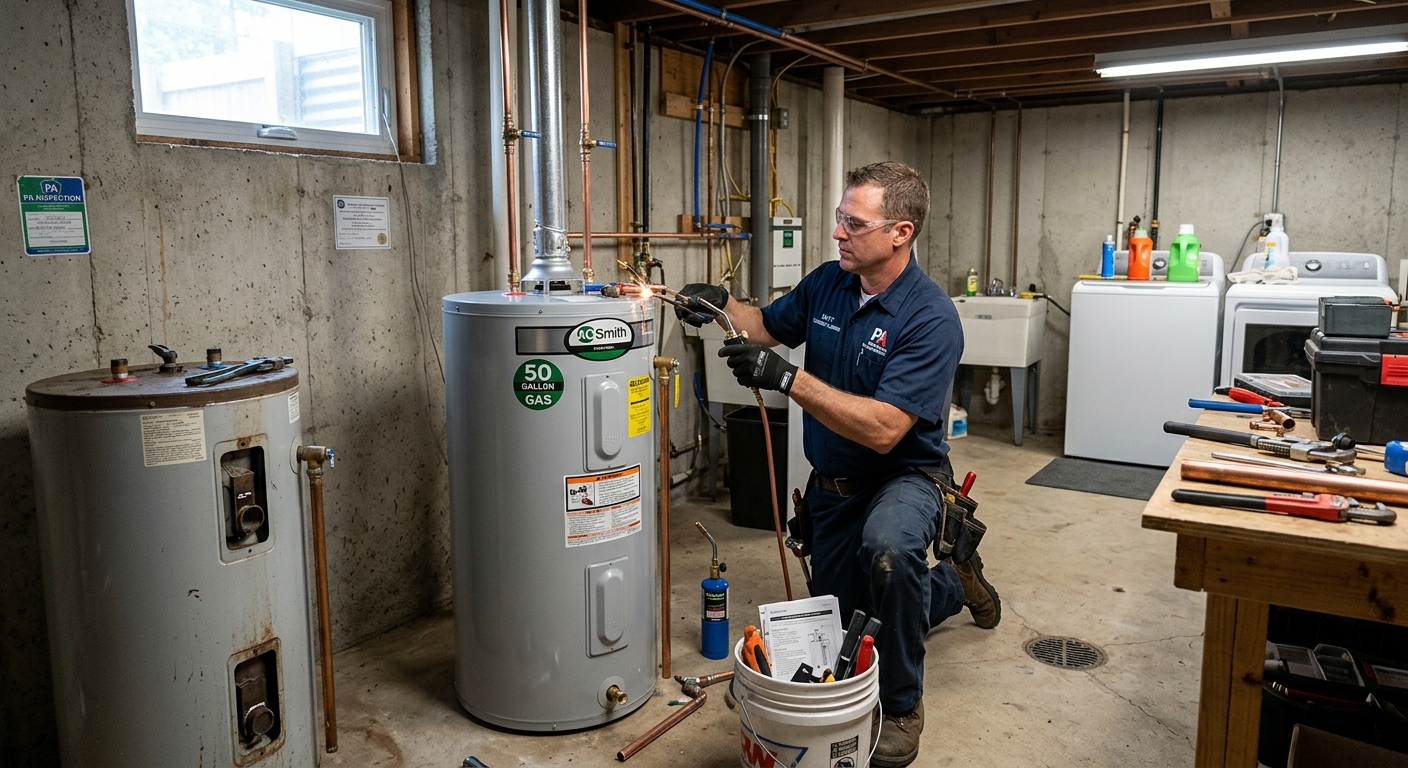
What plumbers charge in Swoyersville
Swoyersville, with over 80% of homes built before 1980 and a high homeownership rate of 81.1% (U.S. Census Bureau, ACS 2024), has plumbing costs tied closely to both house age and construction type. Early 20th-century homes, like much of what you see in Wilkes-Barre and Hazleton, often still have original galvanized or mixed piping tucked into dense framing, making access difficult and repairs more complex. Pipe material drives the work: galvanized steel restricts water flow and surprises you with leaks that seem to move, while copper or PEX updates cost less to fix but may require bigger replacements if the old lines are buried or inaccessible.
The biggest price swing comes from whether a job is an emergency, especially during off-hours or when water shutoff is urgent. Emergency calls—like a burst pipe in January, or a leaking water heater on Sunday—can cost twice what the same work runs during business hours. Some jobs, such as sewer lateral repair, cost the same whether you book ahead or respond to a backup, but most basic repairs and replacements come with premium pricing in an emergency. Below is a realistic range for typical Swoyersville homes:
| Service |
Scope |
Emergency rate |
Standard rate |
| Emergency repair — burst pipe |
locate, open, repair section, restore service |
$550–$1,150 |
$325–$1,150 |
| Water heater replacement (gas, 40–50 gal) |
remove old, install, test, haul away |
$1,800–$2,700 |
$1,150–$2,700 |
| Drain cleaning — main line |
augering or hydro-jet, camera if needed |
$350–$800 |
$200–$500 |
| Sewer line spot repair |
excavate or reline a failed section |
$1,900–$11,500 |
$1,900–$11,500 |
| Whole-house repipe |
replace supply lines throughout, patch and finish |
|
$3,300–$8,100 |
| Water service line replacement |
street to house, excavation and restoration |
|
$5,200–$11,500 |
Estimates for a typical Swoyersville home. Access difficulty and pipe material move these figures more than anything else.
Tank, tankless or heat pump water heater?
For Swoyersville homeowners choosing a water heater, cost, life expectancy, and daily convenience matter more than any marketing pitch. Traditional tanks (whether gas or electric) have the lowest installed cost, simple repairs, and work reliably. However, they lose heat constantly — “standby losses” hit your gas or electric bill even if you aren't running hot water that day. Electric tanks offer longer life than gas, but they cost more to run in most of Luzerne County due to electricity rates.
Tankless water heaters promise unlimited hot water, but the installed price is higher, especially for gas models. If you’re switching from a tank, you could need a heavier gas supply line and a larger vent, both of which drive up your project bill. Surprise add-ons happen all the time. Tankless works best for a smaller household with high hot water use at certain times, but payback is a long road in this climate.
Heat pump water heaters run the cheapest but need enough warm air to work efficiently. They take heat from the air, so put one in a small, cold basement and it will fight itself — plus, these units are louder than tanks. A finished basement with bedrooms or a home office nearby may not be the ideal spot. If natural gas isn’t run to the house or upgrading the gas service is cost-prohibitive, then a heat pump heater starts making more sense.
Proper sizing uses “first-hour rating” — the gallons of hot water supplied in the first hour of heavy use, not just tank size. With any replacement, figure on needing an expansion tank, a pan, and a working floor drain. When a heater fails, it’s almost always the tank itself, not the control board or thermostat.
| Type |
Installed cost |
Service life |
Operating cost |
Best when |
| Gas tank, 40–50 gal |
$1,150–$2,700 |
8–12 yrs |
moderate |
you have gas service and a utility area with a floor drain |
| Electric tank, 40–50 gal |
$1,150–$1,800 |
10–15 yrs |
high |
only electric available, infrequent hot water use |
| Gas tankless |
$1,800–$2,700 |
18–25 yrs |
low-moderate |
high simultaneous demand, limited space for a tank |
| Heat pump water heater |
$1,800–$2,700 |
13–15 yrs |
lowest |
warm basement, no gas available, looking for lowest bills |
Camera inspection, relining and replacement
In Luzerne County, the sewer lateral—your home’s main drain to the street—belongs to the homeowner all the way to the public main itself. Problems with the lateral are your repair and your bill, no matter where the break happens. Symptoms start with a slow drain, move to multiple fixtures gurgling or acting sluggish together, and end with sewage backup at the lowest point in the house, often the basement floor drain.
The diagnosis starts with a camera inspection. For any quote involving excavation or a big-dollar repair, demand to see the actual footage—with roots snaking through the pipe or an obvious offset between joints—because no responsible Swoyersville plumber will gamble with guesswork. In these older houses, lateral pipes are often clay tile, which are prone to root invasion at joints and shifting over time, and access can be a bear if everything is finished out or buried under concrete. A camera inspection also tells whether a spot repair or full replacement is even needed; sometimes a thorough drain cleaning or hydro-jetting is enough.
When a fix is required, open-trench replacement is the surest and most expensive. In some cases, trenchless relining works and avoids ripping through your landscaping or driveway. Choose your approach based on the inspection, not a flat quote. In outlying Luzerne County townships with septic systems, issues like tank pumping or a failing drainfield will show up as slow drains, but the fix is entirely different: regular septic tank pumping (every 3–5 years) or a full system replacement if the drainfield fails.
Do not accept any sewer repair or replacement bid without reviewing the camera footage together. It is the only way to be sure of what you’re paying for.
Licensing and permits for plumbing work in Swoyersville
Pennsylvania does not license plumbers at the state level. Licensing, when required, is handled by each municipality. In Luzerne County, Wilkes-Barre maintains its own contractor licensing through the Wilkes-Barre City Code Enforcement Office. This means a plumber who is perfectly legal in one city might not have any credential in your town—or even in the next block—unless they’ve specifically registered or licensed in that jurisdiction.
Homeowners in Swoyersville or surrounding areas should ask “Are you licensed to do plumbing work here?” rather than relying on a generic claim of state licensing. For anything beyond minor repairs—like adding or moving pipes, new supply or drain installations, or replacing a water service line—a permit is required within Wilkes-Barre. The inspection is performed by the city, or by the PA Department of Labor & Industry if a municipality opts out. Always get copies of insurance certificates and check workers' compensation status directly at WCAIS (wcais.pa.gov), which is Pennsylvania’s official system. For any job over $500, the contractor must carry a Home Improvement Contractor (HIC) registration, and you can verify that at hic.attorneygeneral.gov. Never waive your homeowner’s insurance deductible; it’s prohibited.
The practical upshot: check credentials locally, insist on a written contract, and ensure permit paperwork is in order before work begins.
Freeze risk and what to do about it
In Swoyersville, winter design temperatures drop as low as 4 °F, and the frost depth hits 36 inches. That means pipes in exterior walls, crawlspaces, and garages are at serious risk if they aren’t insulated. When northeast Pennsylvania gets a real cold snap, a pipe typically bursts not at the actual freeze point, but between the frozen section and the first closed fixture as pressure builds behind an ice plug.
The most vulnerable spots are pipes in unheated spaces: garages, unfinished basements, attics (when present in older homes), and especially those on north-facing exterior walls. Hose bibs burst every season if not shut off and drained before hard freezes, which usually hit in November. Prevention steps, ranked by cost and effort: insulating exposed pipes and sealing drafts, adding plug-in heat tape to pipes that can’t be re-routed, letting a faucet trickle during long cold spells (just enough for steady flow), and opening cabinet doors at the kitchen or bathroom sink so warm air circulates around pipes.
If a pipe does freeze, use a hair dryer or plug-in heat gun (no open flames or propane torches—too many fires start that way). Warm the pipe gradually, working towards the frozen section, and never leave electrical heaters unattended. If the pipe has already burst, shut off the main water supply before thawing so you don’t flood the house.
A burst pipe in Swoyersville runs anywhere from $550–$1,150 for emergency repair. Simple, cheap insulation is best done before winter and pays for itself the first time you dodge a break.
Pipe materials in Swoyersville homes and how they fail
In Swoyersville and most of Luzerne County, the plumbing in older homes is a patchwork reflecting the decades when it was installed or updated. Much of Wilkes-Barre and Hazleton’s housing is pre-1940 multifamily stock, so legacy galvanized steel pipes are everywhere behind the walls—these corrode from the inside, gradually narrowing flow and dropping pressure before you ever spot a leak. By the 1950s and on, copper began to replace steel, especially during partial remodels, but it comes with its own issues: high-acid water causes tiny pinholes over time, and poor solder joints can fail decades later.
Polybutylene popped up in the late 1970s to the mid-90s, but has an ugly reputation—fittings break without warning and many insurance policies won’t cover water damage from it. PEX is today’s standard, flexible to run and resistant to freezing, but it can be damaged by sunlight and needs care at fittings. For drains, cast iron sits under most homes built before the 1970s and eventually corrodes right through; scale inside cuts capacity long before leaks appear. Clay tile was the go-to for sewer laterals up till 1980, which means root problems at the joints for many Swoyersville houses. PVC and ABS are the plastics of choice since the 70s, reliable unless crushed or poorly glued.
You can check your own pipes: galvanized attracts a magnet and scratches gray, copper is reddish and won’t, while PEX is blue, red, or white plastic with crimped or push-fit joints. Copper and steel are usually threaded or soldered; polybutylene is gray-blue plastic with plastic or metal fittings. Pipe material and age point straight to remaining life and future headaches.
| Material |
Typical era |
Failure mode |
Service life |
| Galvanized steel supply |
pre-1960 |
internal corrosion, pressure loss |
40–60 yrs |
| Copper supply |
1950s–present |
pinhole leaks, joint failure |
50–70 yrs |
| Polybutylene supply |
late 1970s–1995 |
fitting failure, sudden bursts |
unreliable |
| PEX supply |
2000s–present |
fitting or UV degradation |
40–50 yrs |
| Cast iron drain |
pre-1975 |
corrosion, cracking, scale |
50–75 yrs |
| Clay tile sewer lateral |
pre-1980 |
root intrusion at joints, offset |
50–60 yrs |
| PVC / ABS drain |
1970s–present |
joint separation, crushing |
50+ yrs |
Vetting a plumber in Luzerne County
Licensing and insurance for plumbers in Luzerne County are handled locally. Swoyersville homeowners should ensure their contractor is licensed where the work will be done, not just anywhere in Pennsylvania. In Wilkes-Barre, verify the plumber is on file with the City Code Enforcement Office; for contracts over $500, the contractor must also be registered with the state’s Home Improvement Contractor system (check hic.attorneygeneral.gov). Always ask for a certificate of insurance naming your property, not just a general one. For workers’ compensation, Pennsylvania uses the WCAIS system (wcais.pa.gov) where the status can be checked directly. Ask whether the plumbing company uses its own crew or subs; direct accountability matters if there’s a problem. Finally, be clear on emergency pricing, which in this market is the source of most customer complaints about unexpected bills.
- Confirm local municipal licence—Swoyersville or Wilkes-Barre, as needed
- Verify Home Improvement Contractor (HIC) registration at hic.attorneygeneral.gov
- Request and review a certificate of insurance with your address listed
- Check workers' compensation at wcais.pa.gov
- Ask if all workers are employees or if subcontractors will be used
- Request and receive a clear written contract for jobs over $500
- Ask for references from recent local jobs (not just in the metro area)
- Clarify emergency rates and what triggers higher charges
- Insist on seeing camera footage before any sewer or big repipe quote
- For older homes, ask about experience with legacy galvanized and cast iron piping
- Understand warranty terms on both labor and parts
- Be sure you receive notice of your three-day right to cancel on major projects
If prices seem wildly different between contractors, remember this is a saturated market—too low is as worrisome as too high. Walk away from any contractor who pushes a whole-house repipe or sewer replacement without justification, like actual test results or camera evidence in hand.
Frequently asked questions — plumbing in Swoyersville
Should I repipe my Swoyersville home or keep repairing?
Underground water leaks and recurring pinhole leaks in Swoyersville’s older housing stock—much of which predates 1940—often indicate that repiping is more cost-effective in the long run. If you’re dealing with galvanized steel, pressure loss and hidden leaks get worse over time. Emergency spot repairs add up quickly, costing anywhere from $550–$1,150 per call. When repairs become an annual event or you’re planning a remodel, a whole-house repipe usually makes more sense—especially since the rough price for a complete job in this area runs $3,300–$8,100. For post-1950s copper or PEX, repairs might be all you need unless you see repeated failures. Consider the age, frequency of problems, and your budget; sometimes the peace of mind from a new system wins out.
Does Pennsylvania license plumbers at the state level?
No—Pennsylvania does not have a statewide plumbing license. All plumbing licensing is handled at the municipal level, so plumbers must be registered or licensed with the jurisdiction where the work takes place. For example, Wilkes-Barre requires contractors to be licensed through the city’s own code enforcement office; other Luzerne County townships may have different requirements. Home Improvement Contractor (HIC) registration is required for contracts over $500 anywhere in the state, which you can verify at hic.attorneygeneral.gov, but that alone is not a trade license. For Swoyersville homeowners, always ask if your chosen plumber is properly authorized for your town before starting jobs like a water heater replacement, which averages $1,150–$2,700.
What does drain cleaning cost in Swoyersville?
Drain cleaning in Swoyersville covers anything from clearing a bathroom clog to hydro-jetting a main sewer line. For a typical main line augering—removing tree roots or heavy buildup—you can expect to pay between $200–$500 for scheduled service, and $350–$800 if it’s an emergency (such as a backed-up basement). Many older homes still have cast iron or clay sewer lines, which clog more often and can be more time-consuming to clear. If the blockage recurs, ask for a camera inspection to pinpoint the cause before agreeing to bigger work. Transparent pricing and a clear scope are a good sign you’re dealing with a reputable Swoyersville plumber.
What does repiping a house cost in Swoyersville?
Repiping a standard single-family home in Swoyersville generally costs between $3,300–$8,100, with most jobs falling in the $5,400 range for typical layouts and access. If your home still has legacy galvanized or a mix of old and new pipes—common in Wilkes-Barre and Hazleton’s pre-1940 housing—the price goes up with access difficulty (finished basements, crawlspaces, and working around existing walls). Repipe jobs usually upgrade to PEX or copper, restoring full water pressure and removing the risk of hidden leaks. It’s not cheap, but it avoids the death-by-a-thousand-cuts that comes with repeated repairs. Always get a full written estimate and make sure it covers patching walls and restoring surfaces after the pipes go in.
What causes low water pressure in Swoyersville homes?
In Swoyersville, the most common culprit for persistent low water pressure is galvanized steel plumbing. Decades of internal corrosion narrow the pipes so much that only a trickle can get through. If you’re in a pre-1960 home, that’s almost certainly your starting point—especially since so much older housing remains in Luzerne County. Other causes are partially closed main shutoff valves (sometimes left that way after a service call), shared service lines with neighbors, and pressure regulators that are stuck or failing. If the problem is sudden and all over the house, it could also be a water main break or scheduled utility work. If you need a proper fix beyond a DIY adjustment, standard repair bills for pressure issues generally match minor leak work: $325–$1,150.
Does insurance cover a burst pipe in Swoyersville?
In most cases, homeowners insurance does cover sudden water damage from a burst pipe in Swoyersville, especially during extreme cold when frozen pipes are common. However, the carrier usually expects “reasonable care,” such as keeping the heat on and draining outdoor spigots before the freeze. Long-term neglected leaks, or a slow drip, typically aren’t covered. Direct costs to fix the pipe itself—anywhere from $550–$1,150 for emergency plumbing—are sometimes considered part of the homeowner’s responsibility, while damage to structure and finishes may be included in your policy. Never agree to any contractor waiving your insurance deductible; that’s not allowed under Pennsylvania’s Home Improvement Consumer Protection Act.
Should I leave a faucet dripping in cold weather?
Yes—during hard freezes in northeastern Pennsylvania, especially with Swoyersville’s winter lows of 4°F and a frost depth of 36 inches, allowing a slow drip from a faucet on an exterior wall can prevent pipes from freezing and bursting. The trickle keeps water moving so pressure doesn't build up between an ice plug and a closed fixture. The cost of the extra water (usually just a few cents overnight) is trivial compared to a burst, which can set you back $550–$1,150 for emergency repairs. Don’t forget to shut off and drain hose bibs before winter for extra protection. As always, insulate pipes in unheated spaces and open cabinet doors during cold snaps for extra peace of mind.
How hard is the water in Swoyersville?
Most Swoyersville homes are served by public water, which is moderately hard—enough to notice scaling on fixtures but not enough to require whole-house softening in every situation. Hardness varies slightly by neighborhood, since water supply sources differ between boroughs and townships. It’s worth checking if your tank-type water heater—common in this area—builds up scale quickly and runs less efficiently over time. Excessive hardness won’t usually damage pipes immediately, but it shortens the life of heaters and can clog showerheads or aerators. If you invest in a new water heater, factor in replacement costs ranging $1,150–$2,700 and consider periodic flushing to extend its service life.
How do I shut off the water to my house?
In most Swoyersville homes, especially those built before 1980, the main shutoff valve is found just after the water line enters the house—typically in the basement, close to an outside wall facing the street. For emergencies (like a burst pipe, which costs $550–$1,150 to repair), locate the wheel or lever valve and turn it fully clockwise (for wheels) or perpendicular to the pipe (for levers). If you have trouble moving the valve or aren’t sure it’s working, have a plumber check and replace it if needed. Some older homes still have original valves that seize up or leak at the stem, so it’s wise to test yours once a year—well before you ever need it in an emergency.