Plumbing costs in Moore — 2026
Moore homeowners are right to want straight answers on what plumbing work will actually cost. With a population just under 10,000 and a homeownership rate of 92.1% (U.S. Census Bureau, ACS 2024), most Moore residents will face a plumbing emergency at least once, and the timing matters as much as the work itself. The same job may cost more after-hours or on a weekend. Emergency calls carry a higher rate: you’re paying for immediate mobilization and the risk of parts or overtime. Standard rates apply if you can wait for a weekday appointment or schedule in advance. This pattern holds for everything from a burst pipe to a water heater swap.
Large post-1945 suburban tracts in Palmer and Forks Townships mean the area saw waves of copper installed in mid-century stock, and PEX in later upgrades. That era decides what pipes you have beneath your floors. Copper, once prized, can develop pinhole leaks after decades, while older galvanized and lead services are at the end of their lifespan. PEX, on the other hand, usually indicates a more recent rehab. If your house was built before 1980 — as 53.0% in Moore were — some pipes are past their design life and repairs can turn into replacements, driving up costs. Access — crawlspace, slab, finished basement — will move the needle more than any published price list.
| Service |
Scope |
Emergency rate |
Standard rate |
| Emergency repair — burst pipe |
locate, open, repair section, restore service |
$600–$1,250 |
$350–$1,250 |
| Water heater replacement (gas, 40–50 gal) |
remove old, install, test, haul away |
$1,950–$2,900 |
$1,250–$2,900 |
| Drain cleaning — main line |
augering or hydro-jet, camera if needed |
$350–$800 |
$200–$500 |
| Sewer line spot repair |
excavate or reline a failed section |
$2,100–$12,500 |
$2,100–$12,500 |
| Whole-house repipe |
replace supply lines throughout, patch and finish |
|
$3,600–$8,800 |
| Water service line replacement |
street to house, excavation and restoration |
|
$5,700–$12,500 |
Estimates for a typical Moore home. Access difficulty and pipe material move these figures more than anything else.
Water heater replacement decisions
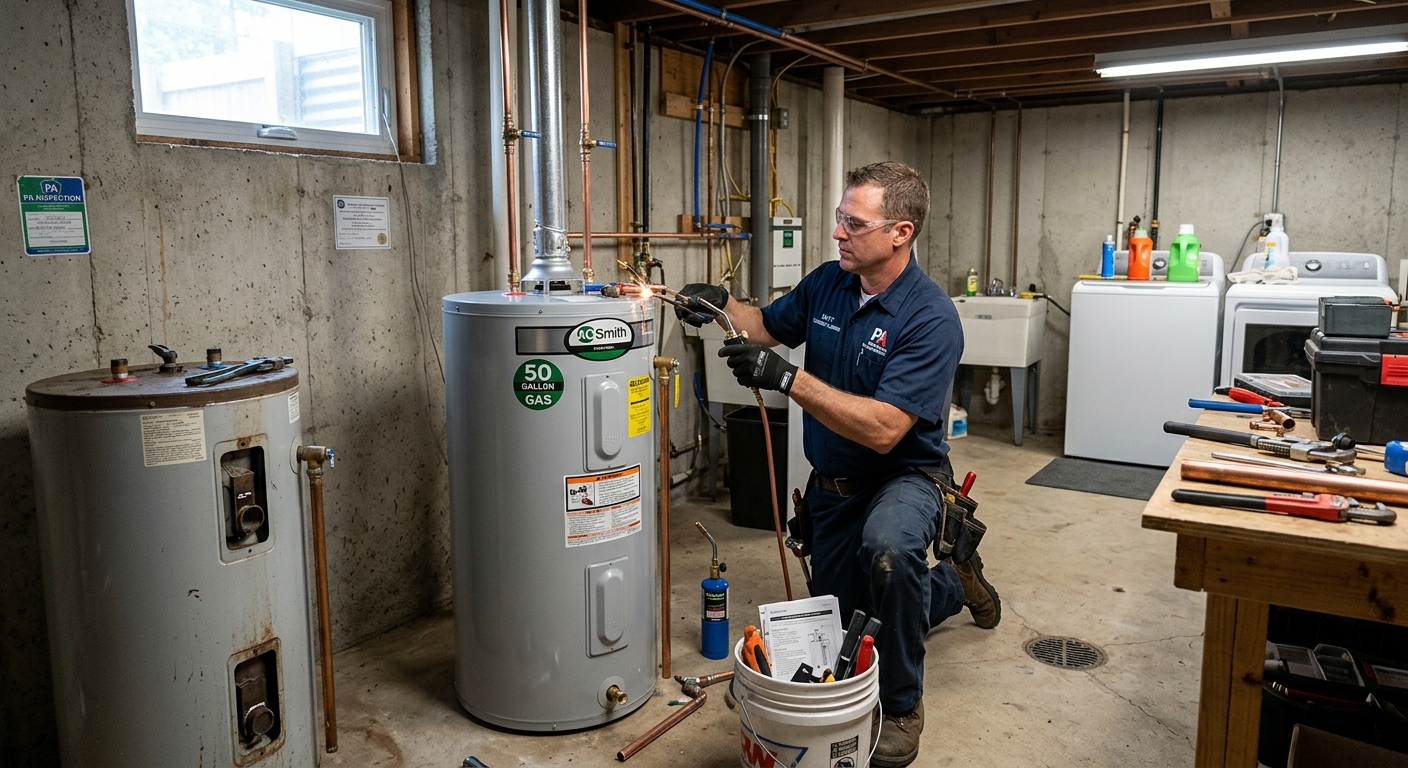
If your water heater is failing in Moore, you face three choices: gas or electric tank, tankless, or heat pump. Each has an upfront price tag and a long-term cost picture that isn’t always obvious. Most replacement calls land on tank models — they’re cheapest to install, are a drop-in fit for existing set-ups, and last 8–15 years depending on energy type. Downside: they waste energy keeping fifty gallons hot even when you’re not using water, and leaking is usually a tank failure, not the control electronics.
Tankless gas heaters are popular for "endless" hot water and lower running costs, but that comes with a catch in older Moore homes: gas tankless units almost always call for a new, larger gas line and upgraded venting, which can double the installed price on a retrofit. Don’t be surprised—always ask if your existing connections are suitable, especially in a home with original mid-century mechanicals.
Heat pump water heaters offer the lowest operating costs by a wide margin, especially where gas isn’t available. But they require a large, warm space with good airflow—putting one in a tight or finished basement isn’t ideal, as the unit both cools and dehumidifies the room. Noise is real, so if you use the basement for living space, consider the implications.
Regardless of fuel, match your heater to household peak usage using first-hour rating, not just gallon capacity. If you’re installing a new heater in a Moore home, expect to see the expansion tank, drain pan, and discharge line called out—Bethlehem permit inspectors want to see these for code.
| Type |
Installed cost |
Service life |
Operating cost |
Best when |
| Gas tank, 40–50 gal |
$1,250–$2,900 |
8–12 yrs |
moderate |
gas available, lower upfront cost matters |
| Electric tank, 40–50 gal |
$1,250–$1,950 |
10–15 yrs |
high |
no gas, replacement budget is tight |
| Gas tankless |
$1,950–$2,900 |
18–25 yrs |
low-moderate |
all-gas home, space is limited, family is large |
| Heat pump water heater |
$1,950–$2,900 |
13–15 yrs |
lowest |
ample space, low running cost is key, no gas |
The point where patching stops making sense
If you’ve had more than one pipe leak in the last three years in your Moore home — especially if the pipes are original copper from the postwar tract era — that’s not just bad luck, it’s a warning sign. Single leaks on modern pipe can often be repaired cost-effectively, but repeated issues mean a bigger problem: the pipe material itself is failing. Look out for low water pressure throughout the house, not just at one faucet; brown or rusty water the first time you turn on the tap each day; green or white corrosion at exposed copper joints; or clusters of pinhole leaks.
Homeowners in the Palmer and Forks tracts often face the copper-to-PEX decision as pipe failures mount. Full repipes cost more up front than spot repairs, but you stop chasing leaks and eventually save on both labor and water damage. If walls are plaster (common in pre-1980 stock), patching and painting can add thousands. Some try to fix just a failing branch, but if multiple areas are affected — especially with galvanized or polybutylene — replacement is the practical, not luxury, move.
| Situation |
Recommendation |
Cost |
Reasoning |
| One leak, accessible, modern pipe |
Spot repair |
$350–$1,250 |
Cheapest fix; no pattern of failure |
| Two or more leaks in 3 years |
Partial repipe |
$3,600–$5,900 |
Pattern means systemic issue |
| Galvanized supply, pressure loss |
Full repipe |
$3,600–$8,800 |
Pipes clog from inside out; repairs buy little time |
| Polybutylene anywhere in the house |
Full repipe |
$3,600–$8,800 |
Material known for sudden failure; insurance may refuse claims |
| Cast iron drain with root intrusion |
Camera, then reline or replace |
$2,100–$12,500 |
Roots signal main line is breached; relining may be less invasive |
| Suspected lead service line |
Test, then replace the lateral |
$5,700–$12,500 |
Ongoing local lead replacement program; safest not to gamble |
Flat rate versus time and materials
Most plumbing contractors in Moore offer both flat rate and time-and-materials billing. Flat rate means you get a price up front, typically for a defined scope of work, with the risk built into what you pay — you won’t pay more if the work takes longer, but you may pay more than the job’s minimum possible labor. Time-and-materials means you’re billed for the actual hours and costs as the job goes. This is rarely a scam, but it can become open-ended on a job with surprises behind walls or under floors.
On every quote, watch for a diagnostic fee and whether it’s credited towards repair, clear description of the scope, and whether wall or floor repair is included or excluded. In Bethlehem, permits are usually required for plumbing work other than fixture swap-outs, so the quote should say whether permit fees and inspection are covered. Look for separate warranty language on labor versus parts—those are not the same. Make sure after-hours rates and any fees are disclosed before you sign, not after.
| Line item |
What to look for |
Red flag if… |
| Billing model |
flat rate or hourly, stated up front |
unstated |
| Diagnostic fee |
amount, and whether it credits |
vague |
| Scope |
what is opened, repaired and restored |
price with no scope |
| Restoration |
drywall and finish explicitly in or out |
silent |
| Permit |
included and priced |
'not needed' |
| Parts |
brand and model for fixtures |
'standard fixture' |
| Warranty |
labour period stated separately |
parts only |
Water quality and what it does to your pipes
Moore’s primary water supplier is the City of Bethlehem Water and Sewer Resources, so most homes are on a public supply. You can request the annual water quality report from them, which spells out mineral content and any known issues. Hard water leads to scale, which cuts water heater and fixture life — if you hear rapid popping from your electric water heater, that’s scale building up. “Aggressive” water, while rarer here, can cause copper pinholes, explaining some of the leaks popping up in older Palmer and Forks homes.
Water softeners are a mixed bag. If you’re on public supply and not seeing scale crust inside appliances or on fixtures, they often don’t pay back in Moore. Where a softener does make sense is in part of the rural north served by smaller township authorities, or if you have a private well with measurable hardness. In that case, you’ll need to arrange your own testing — there is no published water report for a private well, and iron, bacteria, or other contaminants aren’t uncommon.
Whole-house filtration can make sense if your water tastes odd or you have specific contaminants, but point-of-use filters at the kitchen sink do as much for less money if taste or coffee residue is the only complaint. Be wary if you’re pitched complex, expensive treatment gear without clear evidence you need it.
Who is allowed to do plumbing work in Pennsylvania
Pennsylvania does not have a state-issued plumbing license. Instead, plumbing is licensed at the municipal level. This means a plumber licensed in Bethlehem may not be authorized to work legally in another area—Hanover Township, for example, issues its own Master Plumber License with requirements separate from neighboring towns (refer to the FACTS above). Always ask, “Are you licensed to work in this township?” rather than, “Are you licensed in Pennsylvania?”
The Pennsylvania Uniform Construction Code (UCC), based on the IRC, governs residential plumbing work. The PA Department of Labor & Industry oversees the code, but municipalities in Northampton County—Bethlehem, Palmer, Forks, and others—handle enforcement through their own code offices; if a municipality opts out, L&I steps in directly. In Bethlehem, any new or replacement interior plumbing piping or fixtures almost always requires a building/plumbing permit. Swap-outs of faucets or toilets may not, if you’re in a single-family home—always check local rules.
Contractors must hold Home Improvement Contractor (HIC) registration with the Pennsylvania Office of Attorney General for jobs over $500 (verify at hic.attorneygeneral.gov). Every employer providing plumbing services must carry workers' compensation insurance—look up their insurance at WCAIS (wcais.pa.gov). For work in pre-1978 homes, demand an EPA Lead RRP-certified company to avoid lead contamination risk (check at certifiedrenovatorsearch.epa.gov).
Sewer line problems in Moore
In Moore and throughout Northampton County, the responsibility for your sewer lateral — the pipe running from your house to the municipal main, often all the way to the middle of the street — falls on you, the homeowner. This is one of the biggest surprises for anyone with a collapse or blockage. The main line up to your foundation is not covered by the municipality.
Symptoms start small, but escalate: if one drain is slow, you likely have a branch clog. If multiple drains, especially the lowest one, gurgle or slow together, the issue is probably in the main. A full backup with sewage at the floor drain means the entire house is affected and should prompt an emergency call. Before accepting any quote for excavation or spot repair, always insist on a camera inspection — it tells you exactly where and what the problem is. In Bethlehem and Easton, separated sanitary and storm sewers mean combined line overflow is rare, but older clay or cast iron laterals are notorious for roots, bellies where the line sags, or joints offset by ground movement.
Older homes in the Moore area tend to see root intrusion and clay failure. Trenchless relining is increasingly practical — costs are comparable to open-cut if paving or landscaping would be destroyed, but not always the cheapest option. Never accept a sewer repair quote without seeing the camera footage for yourself. If you’re in a rural township with a septic system, different symptoms apply: slow drains could mean a full tank, poor leaching, or a failed drainfield. Regular septic pumping prevents most emergencies before they cost you dearly.
Frequently asked questions — plumbing in Moore
How much does sewer line repair cost in Moore?
Sewer line spot repair in Moore typically runs from $2,100–$12,500, with most jobs falling around the midpoint. Your cost will depend on the location of the problem, depth of the pipe (Moore's frost depth is 36 inches, so lines are often deep), and what sits above it. If your line runs under landscaping, driveways, or city sidewalks, restoration can quickly double the bill. Older homes in Palmer and Forks Townships may have clay or cast iron laterals, which are prone to root intrusion or offset joints—a camera inspection, typically included in the cost, is crucial. Always insist on viewing your own footage before approving work. Trenchless repairs can sometimes save money, but only if the layout allows. Remember, sewer laterals are your responsibility from the house all the way to the main, not just up to the curb.
Am I responsible for the water line under the street?
Yes, in Moore and throughout Northampton County, the homeowner usually owns and is responsible for the water service line from your house to the main in the street. This means if a leak develops beneath your yard, driveway, or even under the street itself, you—not the water utility—pay for the repair or replacement. Water service line replacement in Moore typically costs $5,700–$12,500 depending on the length, depth, and difficulty of excavation. This local rule catches many off guard, particularly in older tracts where service lines may still be lead or galvanized—materials that are both failing and subject to replacement programs. Before any work begins, always verify whether restoration of concrete or landscaping is part of the price.
Is a water softener worth it in Moore?
If you are on the City of Bethlehem public water supply—like most Moore residents—water is typically not so hard that a softener is an absolute need. The payback can be marginal: unless you see significant scale buildup on faucets or inside appliances, a softener might not noticeably extend your water heater's life or reduce soap use enough to justify cost. Installed properly, a softener runs in the $1,250–$2,900 range (comparable to tank water heater replacement). Rural homes with private wells or supplies from township authorities may see more benefit if their water tests "hard." Always get a water test before installing any equipment—a free "test" from someone selling you a softener is not good enough.
Is my water line lead?
Many Moore homes built before 1980, especially older stock in Palmer and Forks Townships, may have lead service lines or original galvanized lines. Bethlehem has an active lead service line replacement program, but no countywide completion. If you’re unsure, you can inspect your main water line where it enters the home—lead is dull gray, soft (can be scratched with a coin), and typically not magnetic. If you suspect lead, have it tested professionally; replacement cost starts at $5,700–$12,500. If in doubt, replacing a lead line is always safest, especially with children in the house.
Which utility supplies water to Moore?
Most of Moore is supplied by the City of Bethlehem Water and Sewer Resources, although some outlying zones may fall under smaller township-run authorities. Bethlehem's utility publishes an annual water quality report, available on request, that covers source, hardness, mineral content, and lead monitoring status. If you’re outside these utility boundaries—common in rural north Moore—you may be on a private well. For public water customers, regulatory reporting helps you know what you’re drinking; for private wells, only individual testing can answer those questions.
What do I do if a pipe is frozen but not burst?
If you suspect a frozen pipe in your Moore home (no water, but no leak), keep the faucet open, apply gentle heat near the pipe starting at the faucet end, and never use open flame. Hair dryers and portable space heaters are your friend here. If you can’t locate the frozen section, call a plumber before the pipe thaws and bursts—a proactive fix may only cost a service call ($350–$1,250 depending on emergency status), but a burst turns into a true emergency with far higher costs. Pipes most at risk are along exterior walls and in unheated basements, especially during our typical Lehigh Valley winters.
Should I wait until business hours to call?
If you have a true emergency—active leak, whole-house backup, water all over your finished basement—call right away, day or night. The emergency premium in Moore is real ($600–$1,250 for a burst pipe repair after hours), but waiting can lead to much more expensive water damage, especially with plaster or hardwoods in older homes. For a slow drip, fixture swap, or non-critical clog, scheduling during regular business hours saves money and gives the contractor a better chance at discounting the call if grouped with others in your area.
Does Pennsylvania license plumbers at the state level?
No, Pennsylvania does not license plumbers statewide. In Northampton County, every municipality sets its own requirements. Hanover Township has its own Master Plumber License, for example, completely separate from Bethlehem or Palmer Township. If someone claims to be "licensed in Pennsylvania" as a plumber, ask them to specify where. For jobs over $500 in Moore, contractors must have Home Improvement Contractor (HIC) registration with the Pennsylvania Office of Attorney General and workers’ compensation insurance. Always verify both.
How much does a water heater replacement cost in Moore?
Most water heater replacements in Moore run from $1,250–$2,900 installed, with a typical 40–50 gallon gas unit landing around $1,950. If you upgrade to tankless or heat pump models, expect to be at the upper end of the band, especially if electrical or gas system upgrades are involved — older tracts often require vent or line changes that bump up the total. Cost includes removal of the old unit, basic code-required upgrades like pans or expansion tanks, and haul-away. Always get a permit for water heater work in Bethlehem, as it’s required by local enforcement.