What plumbers charge in Jackson
In Jackson, what you'll pay for plumbing work depends first on whether it’s an emergency. Plumbing emergencies never respect business hours, and fast response always costs more—sometimes double. For typical homes in Jackson (with a high 84.1% homeownership rate and most houses built between the 1970s and 2000s), plumbing prices trace straight back to construction era and pipe material: for example, older iron or copper can be costlier to repair than PEX, and subdivisions with many water softeners may see more pressure-related failures. The common 1970s–2000s vacation and subdivision homes in the area are prone to particular issues—PEX may spring leaks at fittings, while septic tie-ins present different challenges than municipal sewers.
A burst pipe repair after midnight, for example, falls at the top end of the price band, while the same job during business hours may cut that bill by half. Even jobs like water heater replacement or whole-house repiping can play out differently depending on access and emergency timing. The table below gives a local sense for what you might pay in Jackson, with jobs running at different rates depending on urgency:
| Service |
Scope |
Emergency rate |
Standard rate |
| Emergency repair — burst pipe |
locate, open, repair section, restore service |
$650–$1,250 |
$375–$1,250 |
| Water heater replacement (gas, 40–50 gal) |
remove old, install, test, haul away |
$2,000–$2,900 |
$1,250–$2,900 |
| Drain cleaning — main line |
augering or hydro-jet, camera if needed |
$350–$800 |
$200–$500 |
| Sewer line spot repair |
excavate or reline a failed section |
$2,100–$12,500 |
$2,100–$12,500 |
| Whole-house repipe |
replace supply lines throughout, patch and finish |
|
$3,700–$8,900 |
| Water service line replacement |
street to house, excavation and restoration |
|
$5,800–$12,500 |
Estimates for a typical Jackson home. Access difficulty and pipe material move these figures more than anything else.
Who is allowed to do plumbing work in Pennsylvania
Pennsylvania doesn’t run a statewide plumbers’ license. Instead, licensing is municipal: a plumber approved in one town, like Philadelphia, does not automatically have the right to pull permits—or perform permitted work—in Jackson or anywhere else in Monroe County. That means the practical question for any homeowner in Jackson is: “Are you registered to do plumbing work here?” Never just “Are you licensed?” In this area, code enforcement is managed by each municipality or by the PA Department of Labor & Industry if the township has opted out, following the Pennsylvania Uniform Construction Code (UCC) based on the IRC.
For projects over $500, contractors must hold a Pennsylvania Home Improvement Contractor (HIC) registration, which is issued by the Office of Attorney General. You can verify this at hic.attorneygeneral.gov. On the insurance front, every employer is required to carry workers' compensation—check this at the state-run WCAIS system (wcais.pa.gov).
Most plumbing work—including water heater replacements, repipes, and new service line installations—requires a permit, with final inspection handled by the municipality’s code office or the state. Written contracts are required over $500, and you have a 3 business-day right of cancellation under the Home Improvement Consumer Protection Act. Federal EPA Lead RRP rules apply for homes built before 1978. Remember—ask for proof of registration and insurance every time.
Hardness, treatment and fixture life in Jackson
In Jackson, water quality issues tend to show up as scale on fixtures, mineral buildup in water heaters, and sometimes pinhole leaks in copper pipe. Public water systems are required to release an annual water quality report—if you’re on a municipal supply, ask your provider for it to see hardness levels and any specific contaminants tracked. In homes with 1970s–2000s plumbing, hard water shortens the life of water heaters and increases the maintenance needs on faucets and appliances. Typically, the harder the water, the more often you’ll hear about noisy water heaters or old fixtures losing finish.
If your Jackson home uses a private well or you’re on a septic system (quite common in the outlying township areas), you should have your well water tested yearly. Common issues in this region include iron staining, manganese, or bacteria—no water company tests these for you, and neglect adds real risk, especially for families with young children.
Whole-house water softeners can reduce mineral scale, but the payback often isn’t as clear-cut as sales folks claim, and on-demand softening units mostly make sense when replacing major fixtures. Point-of-use filtration is usually enough for drinking water if your annual test comes back clear. Expensive, overbuilt systems rarely pay you back—if in doubt, talk to a plumber who doesn’t also sell treatment gear.
Plumbing systems in Jackson homes
Most Jackson homes were built between the 1970s and 2000s, a period that saw builders transition from copper to PEX, with a window in the late ‘80s and early ‘90s where polybutylene showed up in a few installations. About 40% of homes predate 1980, so there’s a strong mix of supply piping—older homes may have original copper, possibly some galvanized steel, and the earliest subdivisions could have both cast iron and clay sewer laterals. Where large-scale PEX retrofits were done in the 2000s, expect push-fit or crimped connections, which can develop leaks at joints but generally avoid large-scale corrosion issues.
In terms of fixtures, builder-grade was the default, especially in vacation properties, and many water heaters in town are at their second or third replacement. In homes closer to the 1980 mark, sewer laterals are likely clay tile; for more recent builds, PVC becomes common, with far fewer tree root issues unless landscaping was added after construction.
If you’re seeing recurring pinhole leaks or rusty water, suspect older copper or galvanized, not newer PEX. Water heaters installed during original construction are often at the end of their expected life by now, and septic tie-ins mean you’re also managing restrictions on water usage and fixtures. Newer stock trades corrosion for potential fitting leaks and fixture wear, not immunity from failure.
Choosing a water heater in Jackson
When picking a new water heater in Jackson, you have three main types to weigh: tank (gas or electric), tankless, and heat pump. Your decision is only partly about fuel cost—it’s also about what fits in your home’s systems and usage pattern.
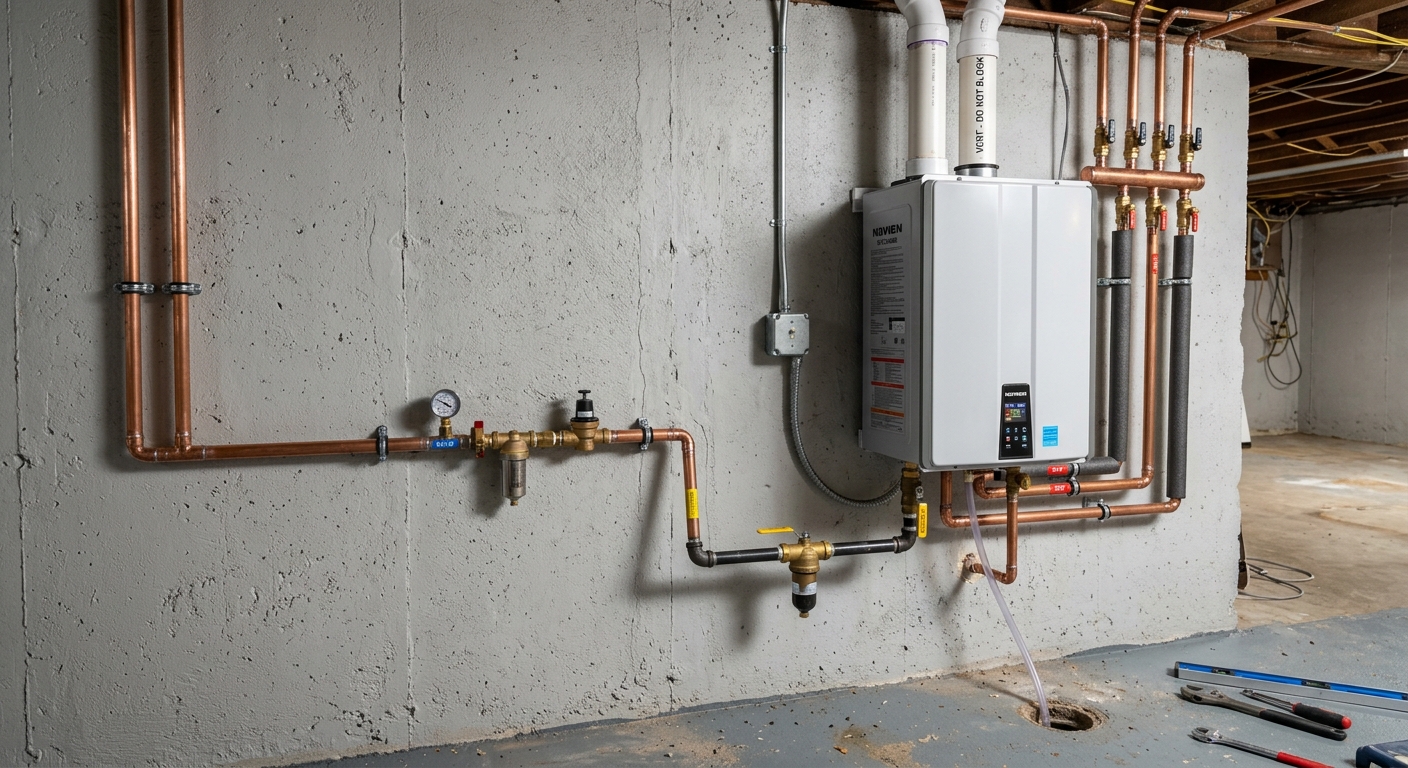
Conventional tank heaters are the lowest-cost to install ($1,250–$2,900), and in a typical Jackson home, they’ll last 8–15 years. Their main weakness is standby losses—the tank keeps water hot all day, whether you use it or not. Electric tanks are a bit cheaper ($1,250–$2,000) and can last a little longer, but with higher electric rates, their operating cost is the highest of the bunch. Gas tankless heaters run much longer (18–25 years) and provide endless hot water, but they require more labor to install ($2,000–$2,900), often with gas piping or venting upgrades that can drive up total cost.
Heat pump water heaters have the lowest operating cost and are ideal if you have space and the heater sits in a warm, unfinished basement where noise and heat loss don’t matter. They’re less well-suited to finished spaces; they are loud and actually cool their surroundings.
For sizing, use the first-hour rating based on your family’s peak demand, not just the tank size. Expansion tanks are code-required for most replacements. Drip pans and floor drains are critical in finished basements—most water heater failures involve a tank rupture, not just a faulty control.
| Type |
Installed cost |
Service life |
Operating cost |
Best when |
| Gas tank, 40–50 gal |
$1,250–$2,900 |
8–12 yrs |
moderate |
Easy access to gas; budget-sensitive; families with steady hot water use |
| Electric tank, 40–50 gal |
$1,250–$2,000 |
10–15 yrs |
high |
No gas available; infrequent hot water use; lower upfront cost needed |
| Gas tankless |
$2,000–$2,900 |
18–25 yrs |
low-moderate |
High-demand homes, long-term savings possible, venting and gas line upgrades allowed |
| Heat pump water heater |
$2,000–$2,900 |
13–15 yrs |
lowest |
Roomy, unfinished basements; higher up-front cost offset by low energy use |
Emergency rates versus scheduled work in Jackson
All plumbers in Jackson charge more for emergency work. The premium covers overnight dispatching, overtime labor, and the reality that diagnosis and repairs happen under pressure and sometimes in difficult conditions. For a repair like a leaking pipe, the difference can be significant: an emergency repair after hours may run $650–$1,250, while a scheduled job during business hours can be as low as $375–$1,250—often halving your bill if you can safely wait.
But not every plumbing problem is a true emergency. Here’s how to tell which is which in a Jackson home:
- True emergencies: active flooding (water pouring into a room), no water at all, sewage backing up into the house, a gas smell or visible gas leak in water heaters or boilers.
- Can often wait: a slow drip under a sink, a running toilet, a single slow drain (as long as you have others), or a leaking outdoor spigot with a shutoff.
If you catch an issue like a burst pipe, find the main shutoff valve—typically where water enters your basement, often near the front wall. Shut it off to stop the flow, then drain lines by opening the lowest faucet. Most fixture shutoffs are under sinks or behind toilets. Knowing how to do this can save you hundreds by turning an emergency into a regular scheduled appointment.
Camera inspection, relining and replacement
Most Jackson homeowners are surprised to learn they own the whole sewer lateral from their house—sometimes even to the main in the street. If a problem starts, you are responsible for repairs from your home all the way out. Common warning signs in Monroe County are: a single slow drain, multiple slow drains (especially at the lowest fixture), gurgling noises, and then sewage backups. When more than one drain is involved, the main line is likely the culprit.
The right way to diagnose is a camera inspection, always before excavation or lining quotes. Camera footage shows if you have a root intrusion, a section of clay pipe (common in homes built before 1980), a “belly” that collects waste, or an offset joint. Newer homes generally use PVC, which is less vulnerable to roots but can still fail at joints.
If the inspection finds a breach or collapse, you may end up choosing between open-cut replacement (dig up and replace the broken section) or trenchless relining (insert a new pipe inside the old). Both are permitted in the area and can cost from $2,100–$12,500 depending on depth and surface repair.
For township homes on septic, you need to focus on regular pumping (every 3–5 years is typical here) and watching for soggy ground over the drainfield—a failed field is a different problem, with its own set of headaches.
One hard rule: never accept a sewer repair quote without seeing the camera footage and getting a copy.
Frequently asked questions — plumbing in Jackson
How do I verify a plumber's licence and insurance?
In Pennsylvania, plumbing licenses are handled locally—there’s no statewide license program for plumbers. In Jackson or anywhere in Monroe County, you should ask your contractor if they are registered for plumbing work in your specific municipality. Then, check their Pennsylvania Home Improvement Contractor (HIC) registration at hic.attorneygeneral.gov, which is required for any contract over $500. For insurance, especially workers’ compensation, use the WCAIS system at wcais.pa.gov to verify active coverage. Make sure their insurance is current before you sign any contract exceeding $375–$1,250. If a plumber can’t show proof of both, find someone who can—it’s your protection against liability.
How much does a water heater replacement cost in Jackson?
For a standard 40–50 gallon gas water heater in Jackson, expect a replacement cost between $1,250–$2,900. The final price depends on access, any permits, and whether new venting or water line upgrades are needed, especially in a subdivision home built in the 1980s or 2000s. Emergency service can push the job to the top of the band. If you’re switching from tank to tankless, or considering a heat pump water heater, install costs rise slightly but you’ll save on operating expenses over the long run. Ask up front about required expansion tanks, pans, and drain lines—most homes here need those, and any reputable plumber will include it in their estimate.
Who owns the sewer lateral, me or the city?
In Jackson, and generally in the townships of Monroe County, you own the sewer lateral from your home all the way to the connection with the main, even if that’s under the street. That means any backups, root intrusions, or broken lines are your responsibility to diagnose and repair. Repairs can get expensive—spot repairs run from $2,100–$12,500 depending on depth, location, and surface restoration. Never agree to a repair without a camera inspection and a copy of the video for your records. If the property is on a septic system (quite common in township areas), you’re responsible for the entire drainfield and septic tank as well.
Do I need to drain outdoor spigots in Jackson?
With Jackson’s winter design temperature down to 4 °F and a frost depth of 36 inches, you absolutely need to winterize and drain outdoor spigots every fall. Failing to do so invites burst piping and water damage—emergency repairs for a burst line in winter run $650–$1,250. Shut off the interior valve serving the spigot (usually in the basement), open the spigot outside, and drain all trapped water. In newer subdivision homes, you might find freeze-proof sillcocks, but older stock often doesn’t have this feature—don’t skip the draining step. If in doubt, have a plumber show you the right valves to close.
How do I tell what my pipes are made of?
In Jackson’s housing stock, “what are my pipes?” is a common and smart question. If your home was built before 1980, your water supply lines are likely copper or even galvanized steel. Most 1980s–2000s subdivision homes use PEX or, in a brief window, polybutylene (usually gray or blue flexible tubing). Check for exposed pipe near your water heater or main shutoff—copper is rigid and reddish, PEX is flexible and often red, blue, or white. Not sure? A plumber can spot materials in minutes during a service call (which usually runs $375–$1,250) and advise what failure risks are typical for your setup.
Is Jackson on combined sewers or septic?
In this area, Jackson homes fall into two camps: East Stroudsburg uses municipal sewer, but outlying townships—including much of Jackson—rely on private septic systems. On septic, you are responsible for regular pumping and all repairs; expect to pay separately for that, rather than via property tax. If you need a sewer line repair or spot excavation, costs are in the $2,100–$12,500 range—septic repair costs depend on the specific failure. When buying or selling, always get a septic inspection as part of your transaction.
Should I repipe my Jackson home or keep repairing?
The decision comes down to frequency and cost of failure. If you’re getting pinhole leaks in copper or repeated leaks at PEX joints, and repairs are costing in the $375–$1,250 range each time, compare that to a whole-house repipe at $3,700–$8,900. For homes built before 1980, original copper or galvanized often reaches end of life by now. Repiping with PEX often pays for itself if you’re seeing problems more than once a year. If leaks are rare, you can probably keep repairing until evidence says otherwise. A reliable plumber will tell you when you’ve crossed that line.
Why do plumbers charge a diagnostic fee?
Diagnostic fees cover skilled labor, travel, and tool costs, especially in Jackson where access can mean snow, steep driveways, or tight basements. Insurance and registration overhead are built in, too. For jobs like leak tracing or camera inspections, expect to pay $375–$1,250. If you go forward with the repair, many plumbers will credit the diagnostic cost toward the job, but always ask. These fees aren’t padding—they reflect real time and professional troubleshooting, which is why you want an experienced local technician who knows the 1970s–2000s housing quirks in the area.
Should I wait until business hours to call?
If you’re facing a true emergency—active flooding, no water at all, sewage backing up, or a gas leak—don’t wait; call immediately, even if it’s after hours. Emergency repairs in Jackson typically cost between $650–$1,250. If it’s a small drip, a running toilet, or any issue that isn’t causing property damage or health risk, you can often safely shut off the water to the problem fixture or at the main and call first thing in the morning for a standard rate ($375–$1,250). Knowing how to use your shutoff valves converts many “emergencies” into standard service calls, so ask your plumber to show you during the next visit.