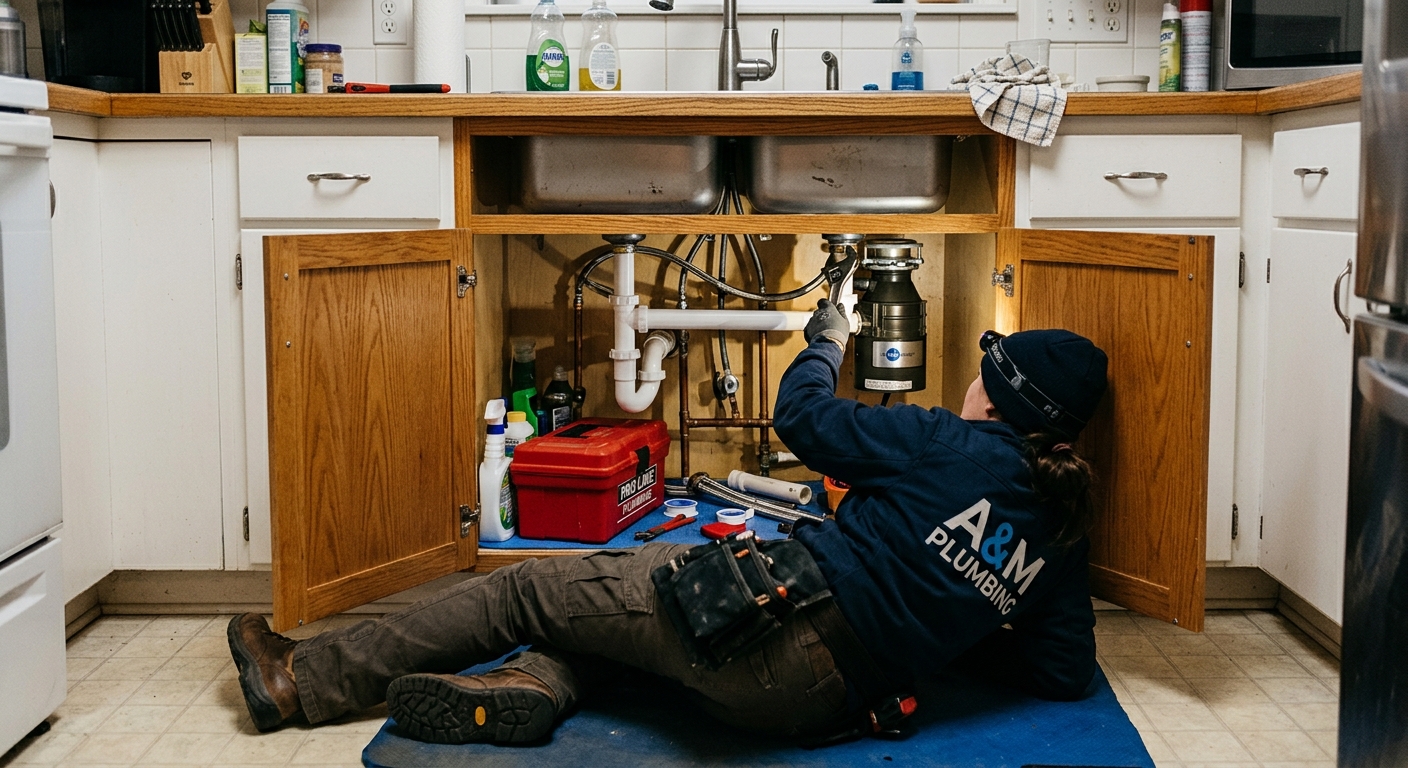
Logan plumbing prices by job type — 2026
If you live in Logan, plumbing repair costs depend on two factors above all: whether it’s an emergency, and what kind of house you own. With 78.6% of Logan residents owning their homes and almost 70% living in single-family houses (U.S. Census Bureau, ACS 2024), most jobs here mean working on individual service lines and aging plumbing. Blair County’s housing surge in 1900–1950 leaves many Altoona homes with galvanized piping—sometimes nearly as old as the houses themselves. These pipes are well past their prime and prone to both pressure loss and outright leaks, which means repair costs can spiral for the unlucky homeowner.
The same repair—for example, fixing a burst pipe—can carry a much higher price if it’s called in overnight or during a cold snap. Emergency dispatch and after-hours work can easily double the cost compared to work scheduled during business hours. That’s why every budget figure in Logan needs to be framed as both “emergency” and “standard” rate. Older homes here often add labor cost due to access: original plumbing is often hidden behind plaster or tough-to-remove finishes, driving up time and expense.
| Service |
Scope |
Emergency rate |
Standard rate |
| Emergency repair — burst pipe |
locate, open, repair section, restore service |
$600–$1,150 |
$325–$1,150 |
| Water heater replacement (gas, 40–50 gal) |
remove old, install, test, haul away |
$1,800–$2,700 |
$1,150–$2,700 |
| Drain cleaning — main line |
augering or hydro-jet, camera if needed |
$350–$800 |
$200–$500 |
| Sewer line spot repair |
excavate or reline a failed section |
$1,900–$11,500 |
$1,900–$11,500 |
| Whole-house repipe |
replace supply lines throughout, patch and finish |
$4,200–$8,100 |
$3,400–$8,100 |
| Water service line replacement |
street to house, excavation and restoration |
$6,500–$11,500 |
$5,300–$11,500 |
Estimates for a typical Logan home. Access difficulty and pipe material move these figures more than anything else.
Licensing and permits for plumbing work in Logan
In Pennsylvania, plumbing is not licensed at the state level—licensing is municipal. That means the real question is not “Are you a licensed plumber?” but “Are you licensed here in Logan?” In Blair County, the City of Altoona runs its own contractor license program for commercial plumbing work, which is separate from any credentials in other municipalities. For residential work in Logan Township and surrounding townships, municipal requirements may differ from Altoona. Always verify that your plumber is properly registered for your specific location.
Permits are required in Altoona for any commercial plumbing installation or alteration beyond basic fixture replacement, and the City of Altoona Codes & Inspections Office is the permitting and inspection authority in the urban core. For minor fixture swaps on existing pipe in a house, especially in areas outside Altoona, separate plumbing permits are not usually required, but contractor HIC registration (issued by the Pennsylvania Office of Attorney General) is mandatory for any job over $500. This registration can be verified through hic.attorneygeneral.gov.
Insurance is another key box to check. All contractors with employees need active workers’ compensation, which you can confirm in Pennsylvania through WCAIS (wcais.pa.gov). Consumer protection rules require a written contract over $500 and give you a three-day right to cancel under the Home Improvement Consumer Protection Act; a contractor waiving your insurance deductible is not allowed. Make sure you get certificates naming your property and double-check all documentation before work begins.
When to repipe a Logan home
In Logan, deciding when to repipe comes down to both what your house is made of and how often you’re fixing problems. Two or more leaks on the same material within three years is a clear sign: the system isn’t failing by accident—it’s at the end of its lifespan. With so many homes from Blair County’s 1900–1950 building boom, galvanized pipes are a common culprit. Signs it’s time to act include falling water pressure across the whole house (not just at one sink), rusty or discolored water on first draw, visible rust and corrosion at joints, or repeated pinhole leaks. If you spot these, piecemeal repairs usually just push off the inevitable.
Copper and PEX are standard for replacement. Copper is proven but costs more, especially now, while PEX is flexible and can be snaked through walls with less demolition. The real hidden cost many forget: in older homes, especially those with plaster walls, the patching and restoration after pipe work can add up to the plumbing bill itself.
A full repipe is almost always the answer for homes with galvanized supply or polybutylene anywhere in the system. For localized issues on newer piping, spot and partial repairs are still reasonable. Always factor in system age and the material’s track record—Altoona and Logan’s housing stock is full of clues.
| Situation |
Recommendation |
Cost |
Reasoning |
| One leak, accessible, modern pipe |
Spot repair |
$325–$1,150 |
Modern materials can be reliably patched without systemic failure. |
| Two or more leaks in 3 years |
Partial repipe |
$3,400–$5,500 |
Repeat failures signal the material is at end of life. |
| Galvanized supply, pressure loss |
Full repipe |
$3,400–$8,100 |
Internal corrosion narrows pipes and can’t be fixed by spot repair. |
| Polybutylene anywhere in the house |
Full repipe |
$3,400–$8,100 |
Material is unreliable and insurance issues are common. |
| Cast iron drain with root intrusion |
Camera, then reline or replace |
$1,900–$11,500 |
Roots and cracks often require section replacement or lining. |
| Suspected lead service line |
Test, then replace the lateral |
$5,300–$11,500 |
Lead lines are a health risk; replacement is the only safe option. |
Winter pipe failures in north-central Pennsylvania
North-central Pennsylvania winters are tough. Logan deals with a frost depth of 36 inches and a winter design temperature down to 2 °F, making our region one of the coldest—and snowiest—in the state. Pipes freeze not just by sitting in the cold, but as water expands to ice deep inside. The burst typically happens between the ice blockage and your first closed faucet; pressure builds up downstream of the frozen plug, not at the ice itself, and the pipe splits where it can’t relieve that pressure. You’ll see this most on supply lines in exterior walls, crawlspaces that aren’t heated, garages, outdoor spigots, and sometimes attic runs in older houses.
Prevention is cheaper than cleanup. Start with insulating pipes in vulnerable spots, add heat tape if they’re exposed, and on the coldest nights, allow a faucet to trickle—moving water doesn’t freeze as fast. Open cabinet doors under sinks against exterior walls, and always shut off and drain hose bibs before the first hard freeze. Never use an open flame to thaw a pipe; instead stick with a hairdryer, heat gun, or space heater at a safe distance.
When a pipe bursts, you’re looking at a real bill—emergency burst pipe repairs in Logan typically run $600–$1,150 on top of any water damage. Routine prevention costs far less in both hassle and money.
Vetting a plumber in Blair County
Hiring a plumber in Blair County means digging a little deeper than just checking a business card. Because there’s no statewide plumbing license, make sure any plumber you consider holds the right municipal license or registration for your specific part of the county. In Altoona, confirm the business is covered under the city’s own system for commercial jobs, but in Logan Township and rural townships, check what’s required locally. Home Improvement Contractor (HIC) registration from the Pennsylvania Office of Attorney General is required for any contract over $500—verify at hic.attorneygeneral.gov. Ask for a certificate of insurance naming your address and confirm active workers’ compensation through WCAIS (wcais.pa.gov) if the company has employees.
Ask if the company uses its own crews or subs, and make sure they’ll give you a written estimate that breaks out emergency rates. Blair County is a moderate secondary market; rural township jobs may see higher fees for travel, so beware lowball bids that "seem too good for Logan." Never accept a repipe or sewer job without camera footage of the problem or a pressure test—these are red flags for upselling.
- Verify HIC registration at hic.attorneygeneral.gov
- Check for municipal or city contractor license if applicable
- Get a certificate of insurance with your address listed
- Verify active workers’ compensation at wcais.pa.gov
- Confirm written contract with all pricing, emergency or otherwise
- Ask if crews are employees or subcontractors
- Request local references, not just internet reviews
- Demand before-and-after camera footage for sewer/drain work
- Never rely on a verbal bid for whole-house jobs
- Insist on a pressure test or proof of repeated leaks before agreeing to a repipe
- Don’t accept waiving an insurance deductible—this is prohibited
- Ask to see cancellation rights in your contract
Red flags here include any company pushing major replacements without documentation, or refusing to provide required verifications. In a smaller market, word travels; ask your neighbors who they would—and would not—call again.
Is your water line lead? How to find out
In Logan and much of Blair County, the history of your water service matters—a lot. Altoona Water Authority supplies public water for much of the area, and while they have been building a lead service line inventory, it’s still unknown how close they are to full replacement countywide. Your property’s water service line is split into two pieces: utility-owned (in the street) and homeowner-owned (from the curb to your house). Replacement programs don’t always handle both, so you may be on the hook for your section even if the street side is addressed.
To check your own line, locate where it enters through the basement wall. Try the scratch test: scrape the pipe gently with a key or coin. Lead is shiny, silver, and easily scratched, while copper is orange-brown. If a magnet sticks, it’s steel or iron—not lead. If the pipe is soft, bends easily, and there are bulbous joints, it’s likely lead. Even a partial replacement—where only one side is replaced—can temporarily worsen water quality because it disturbs protective scale inside older pipes.
Altoona Water Authority may publish their lead service inventory online, but because replacement status is not known, you should contact the utility directly (not assume you’re covered by a citywide program). Replacing a lead service line in Logan runs $5,300–$11,500, and that is a one-time health upgrade for your household. If you’re not sure, get your water tested, especially if your home falls into Blair County’s 66% pre-1980 era or if you see pipework that looks original to the house.
If you discover lead, act sooner rather than later. Don’t wait for a city notice—ownership and responsibility in Logan can be complex and costly if left unchecked.
Galvanized, copper, PEX, cast iron
Plumbing in Logan is an exercise in material archaeology: each era left its mark. Blair County’s housing surge in 1900–1950 leaves many Altoona homes with aging galvanized piping needing replacement—these are typically gray steel pipe with threaded joints, not soldered. Galvanized steel slowly corrodes from within, narrowing the bore and choking off water pressure long before actual leaks force your hand. You can identify it by its dull gray color and the fact that magnets stick to it (unlike copper or lead).
Copper took over in the postwar decades, recognized by its orange-brown color and smooth, soldered joints. Reliable, but aggressive water chemistry in wells or municipal supply can cause pinhole leaks—often at unexpected intervals. Polybutylene was scattered into some systems between the late 1970s and 1995. It can be flexible, gray or blue plastic, notorious for splitting at fittings. If you have it, most insurers won’t touch it for long.
PEX is today’s standard: a flexible, often blue or red plastic, with crimped ring fittings. It can snake through old framing without much demo, making it cost effective for retrofits. Cast iron drains, thick-walled and heavy, were standard until the mid-1970s—their failure isn’t far-off for most older houses. Root intrusion and corrosion are typical, and clay tile sewers laid before 1980 are especially root-prone at the joints. To check what you have, scratch the pipe or tap with a magnet, then consider your home’s construction date for a best-guess at remaining life.
| Material |
Typical era |
Failure mode |
Service life |
| Galvanized steel supply |
pre-1960 |
internal corrosion, pressure loss |
40–60 yrs |
| Copper supply |
1950s–present |
pinhole leaks, joint failure |
50–70 yrs |
| Polybutylene supply |
late 1970s–1995 |
fitting failure, sudden bursts |
unreliable |
| PEX supply |
2000s–present |
fitting or UV degradation |
40–50 yrs |
| Cast iron drain |
pre-1975 |
corrosion, cracking, scale |
50–75 yrs |
| Clay tile sewer lateral |
pre-1980 |
root intrusion at joints, offset |
50–60 yrs |
| PVC / ABS drain |
1970s–present |
joint separation, crushing |
50+ yrs |
Frequently asked questions — plumbing in Logan
Can I do my own plumbing work in Logan?
In Logan Township and most of Blair County, homeowners can sometimes do their own minor plumbing work—like changing a faucet or toilet—without a permit, especially if you’re only swapping fixtures and not changing the layout or cutting into new pipe. However, for any work over $500, a written contract is required, and the law still expects the project to comply with the Pennsylvania Uniform Construction Code. If you’re inside Altoona city limits, more jobs require city permits and inspections. Major projects like replacing a water heater, repiping, or altering drain layouts are usually best left to a registered contractor. If you get in over your head, calling a professional can avoid a bigger bill down the road—emergency pipe repair often lands between $325–$1,150. Always check municipal rules before starting, and if you’re unsure, make a quick call to codes or a local pro.
Does insurance cover a burst pipe in Logan?
In Logan and anywhere in Pennsylvania, homeowner’s insurance usually covers water damage from a sudden burst pipe—think freeze breaks or sudden splits—but won’t pay for the repair to the bad pipe itself, just the damage it did. If your home is vacant or you didn’t keep it heated as required, your claim might get denied. Also, insurance won't cover damage resulting from neglect or slow, hidden leaks. If water gets everywhere, you may be looking at restoration bills well beyond the emergency pipe repair itself (which often runs $600–$1,150). Always keep your heat on in the winter, shut off the main if you leave for long, and document everything if you do have damage—photos and immediate reporting are key. Don’t wait days to call; the faster you act, the more likely insurance will pay out what it should.
Is Logan on combined sewers or septic?
Logan and Altoona areas run on separated sanitary and storm sewers, according to the Blair County facts, while homes in many of the outer rural townships rely on private septic systems. That means most houses in Logan proper are hooked up to municipal sewer, but be sure to confirm for your address—some edge properties have their own septic tanks. If you’re in town and you see slow drains or backups, it’s a city sewer issue; if you’re in a rural part of the township, it could be septic. Either way, main line drain cleaning will typically set you back $200–$500 during business hours and more for an emergency. If you’re not sure which you have, look for a sewer bill or ask the Altoona Water Authority.
What does repiping a house cost in Logan?
A full repipe in Logan—replacing all supply lines, patching walls, and getting everything up to modern code—costs between $3,400–$8,100 in 2026 estimates. The wide range depends mostly on house size, access to pipes (old plaster walls cost more to fix than drywall), and which material you choose (copper is pricier than PEX). If you’re just patching sections, it may only cost a couple thousand, but piecemeal repairs add up fast, especially in Blair County homes with original galvanized steel pipe from the 1900–1950 era. Ask for a detailed bid and find out what wall restoration is included before you sign anything—this is where the “savings” in a cheap repipe quote usually disappear.
How much does sewer line repair cost in Logan?
Spot repair or relining for a main sewer line in Logan usually runs $1,900–$11,500, and that spread reflects everything from a shallow clay section in a small yard to complex, deep work under a driveway or street. Most Logan and Altoona homes are on the municipal sewer system, but some outlying properties are on septic. Tree roots, collapsed clay tile, and separated joints are common enemies in older houses—camera inspection is a must before you commit to any big dig. Always ask for video evidence and a written scope before agreeing to any major sewer work, and consider a second opinion if the full replacement is recommended without clear footage.
How long should a water heater last in Logan?
The average gas water heater in Logan will give you 8 to 12 years if properly installed and maintained. Public water from Altoona Water Authority is generally not especially hard, so tanks fare decently if you flush sediment once a year. If your home is older and the heater is fed by galvanized pipe, consider replacing both at the same time—bad supply lines shorten heater life due to rust and debris. A full replacement in Logan costs $1,150–$2,700 depending on size and venting. Watch for signs like rusty water, slow recovery, or a noisy tank. If your heater is approaching a decade old, start budgeting for a new one—waiting for it to fail on a Sunday will double the price and the stress.
What do I do if a pipe is frozen but not burst?
If a pipe in your Logan home is frozen but hasn’t burst, act quickly and safely. Turn on the nearest faucet to relieve pressure, and gently warm the exposed pipe using a hairdryer or space heater—never use an open flame, which is a major fire risk in old Blair County framing. Open any cabinets around the affected pipe and let warm air in. If the freeze is inside a wall, gentle heat to the surface may help. Monitor the pipe closely as it thaws; listen and feel for bulging or weeping that could mean a crack. If you regain flow and see leaks, call a plumber—emergency repair runs $325–$1,150. If you can’t thaw it or pipes are completely inaccessible, call for professional help before the pipe gives way and you’re stuck with not just plumbing but water damage repairs, too.
What do I do if sewage is backing up?
If you have sewage backing up in Logan, stop all water use immediately. Don’t flush, run sinks, or start laundry—any extra water will make it worse. If you’re in town with city sewer from Altoona Water Authority, call them as well as a local plumber, since clogs sometimes start at the main. For outer township homes on septic, check system alarms or lids—backup can mean a clog or a failing system. Professional main line drain cleaning is usually $200–$500 for a non-emergency or $350–$800 for after-hours response. Sewer camera inspection will reveal if the problem is a soft clog, tree roots, or a break needing excavation. Fixing the root cause quickly protects you from far bigger cleanup bills and health risks.
Is a tankless water heater worth it in Logan?
Tankless water heaters can be worth it in Logan if your hot water use is steady but not excessive, and you plan to stay in the house long enough to see savings pay off. They take up less space and can offer endless hot water, but up-front installation (and possibly upgrading gas or electrical service) is more expensive—figure on at least $2,500–$4,000 if you count all required system changes, above the standard tank replacement rate of $1,150–$2,700. In Blair County’s older homes, extra venting retrofits can add unexpected cost, especially with thick stone or brick walls. If you often have long gaps between hot water use, the energy savings make sense, but for most families with predictable demand, a standard tank remains the budget pick in Logan.