What plumbers charge in Penn
Penn homeowners considering plumbing work should know that costs here swing widely depending on urgency. In Penn’s neighborhoods, you’ll pay differently for an emergency call versus a standard scheduled job—even for the same fix. For example, a middle-of-the-night burst pipe will trigger both higher minimum charges and, often, faster restoration, so emergencies always cost more. That’s how the local market works. With roughly 77.6% owner-occupancy and nearly half the homes built before 1980 (U.S. Census Bureau, ACS 2024), Penn’s housing skews older, with heavy pre-1940 stock in row and twin homes. This correlates directly to more galvanized piping, which now reaches end-of-life and is often replaced with copper or PEX. The age and construction style of your house affect everything: access to pipes, degree of finish restoration, and whether legacy materials like lead or old steel are in the mix.
Take a look at the price bands below—not just as a menu, but as a guide to how job complexity moves the needle. With any plumbing job in Penn or Lancaster, access and material are the biggest variables. A concealed pipe run under a finished floor or tucked in a tight rowhome crawlspace costs more than a wide-open basement wall. There’s no meaningful “average” for this reason, but the ranges below are real.
| Service |
Scope |
Emergency rate |
Standard rate |
| Emergency repair — burst pipe |
locate, open, repair section, restore service |
$600–$1,200 |
$350–$1,200 |
| Water heater replacement (gas, 40–50 gal) |
remove old, install, test, haul away |
$1,900–$2,800 |
$1,200–$2,800 |
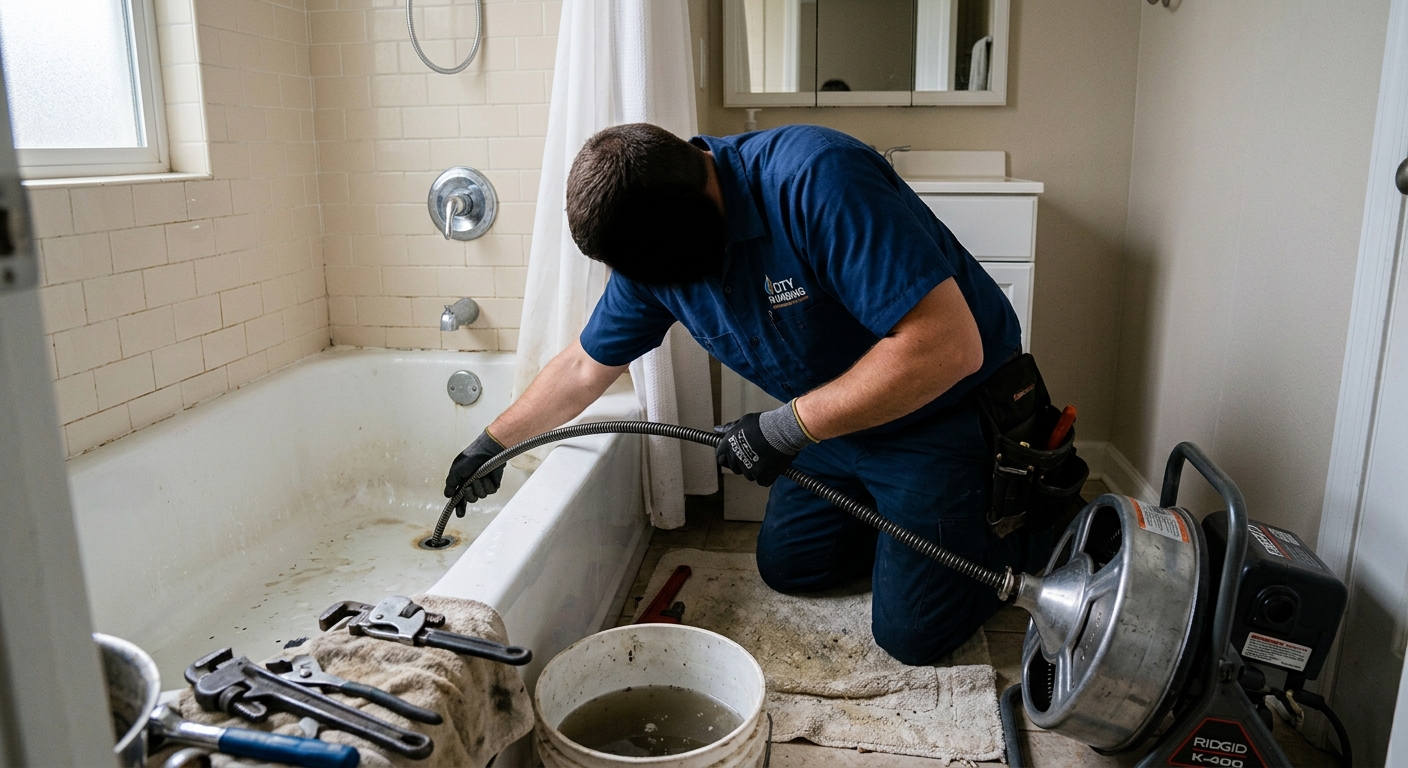
| Drain cleaning — main line |
augering or hydro-jet, camera if needed |
$350–$800 |
$200–$500 |
| Sewer line spot repair |
excavate or reline a failed section |
$2,000–$12,000 |
$2,000–$12,000 |
| Whole-house repipe |
replace supply lines throughout, patch and finish |
|
$3,500–$8,400 |
| Water service line replacement |
street to house, excavation and restoration |
|
$5,400–$12,000 |
Estimates for a typical Penn home. Access difficulty and pipe material move these figures more than anything else.
Verifying a Penn plumber's credentials
Plumbing work in Penn and Lancaster County is regulated at the municipal level, not the state. There is no statewide plumbing license for Pennsylvania. Each city or township sets its own credentialing process—so a plumber licensed in Lancaster may not qualify in nearby townships. Always ask if your plumber holds the right credential for your property’s municipality. In Lancaster city, for example, major plumbing work (anything that alters, expands, or improves the property) requires a plumbing permit, and the work is subject to inspection by the City of Lancaster Bureau of Building Code Administration. In surrounding townships, the code office for each jurisdiction fills this role.
If your job exceeds $500, Pennsylvania law requires your contractor to be registered as a Home Improvement Contractor (HIC) with the Office of Attorney General. Check this at hic.attorneygeneral.gov. For larger contractors with crews, workers' compensation insurance is mandatory and can be verified via WCAIS (wcais.pa.gov). While plumbers in Lancaster city work under the Pennsylvania Uniform Construction Code (UCC), rural and suburban areas may have slightly different permitting and inspection requirements. The practical upshot: Always verify municipal registration, HIC registration, and insurance before hiring. If your home is pre-1978, EPA Lead RRP certification should also be confirmed for any work that disturbs paint; use the EPA’s lookup to verify. Avoid anyone who is vague or refuses to provide proof—credentials matter on both the safety and legal compliance fronts.
Hardness, treatment and fixture life in Penn
The majority of Penn’s homes are served by the City of Lancaster Water Bureau or nearby municipal authorities, depending where you sit in the township. These public systems are required to provide an annual water quality report, which any homeowner can request for free—this is your primary source for hardness, chlorine content, and lead testing. Hard water is common in Lancaster County, and it shortens the life of water heaters and fixtures due to scale buildup. Water heaters often need more frequent flushing (which can stretch heater life) and can develop tank leaks as scale collects in the bottom. In some older copper plumbing, aggressive water chemistry can cause pinhole leaks, though this is less frequent than in some eastern counties.
If you are on a private well—typical for some northern or rural areas—the water isn’t tested by any authority, so annual or biannual homeowner-ordered testing for bacteria, nitrates, and hardness is essential. For most Penn city residents, a softener is optional but will reduce scale in appliances and plumbing. However, in this region, the cost of installing and maintaining a softener rarely pays for itself strictly on appliance replacement; it’s mainly about comfort and keeping fixtures looking clean. Whole-house filtration is only justified if you have consistent sediment or taste issues. Most homes are better served with a good point-of-use filter at the kitchen sink, unless your water report shows a broader problem. Skip high-pressure sales of water treatment gear—start with a lab report and work backward from actual data.
Choosing a water heater in Penn
Deciding on a new water heater in Penn should start with how you use hot water and where your heater will go. For most homes, a standard tank model is the cheapest to install and the most common choice. Gas tanks (40–50 gallons) handle large families and are less expensive up front, but they lose heat all day (“standby losses”). Electric tanks are typically less involved to install, but cost more to run. Tankless gas heaters promise endless hot water, but they require a new vent, often a gas line upgrade, and careful placement—surprise expenses that push total cost up. Many Penn row homes and older houses don’t have the right vent stack for tankless units without extra work. Heat pump water heaters cost the least to run, but they need plenty of air and a warm spot, and some Penn basements (especially finished ones) aren’t a match. They’re also loud and cool the space around them, which matters if the location is in your living or laundry area.
When sizing for any model, use the first-hour rating: how much hot water is delivered in the busiest hour of your day. Don’t just match the old tank’s size. Any heater should go in a pan with a drain if above a finished space, and an expansion tank may be required by code or best practice. Most failures are tank leaks—once it goes, replacement is unavoidable. Controls and thermostats rarely drive early replacement. If your gas service is uncertain, electric or heat pump usually wins out. For a typical Penn replacement, here’s how choices stack up:
| Type |
Installed cost |
Service life |
Operating cost |
Best when |
| Gas tank, 40–50 gal |
$1,200–$2,800 |
8–12 yrs |
moderate |
existing gas, vent OK, typical family |
| Electric tank, 40–50 gal |
$1,200–$1,900 |
10–15 yrs |
high |
no gas, easy install, small HH |
| Gas tankless |
$1,900–$2,800 |
18–25 yrs |
low-moderate |
large demand, space tight, willing to pay up |
| Heat pump water heater |
$1,900–$2,800 |
13–15 yrs |
lowest |
warm, unoccupied basement, long-term stay |
What a plumbing quote should contain
In Penn and across Lancaster County, plumbing estimates usually follow one of two models. Flat rate pricing gives you a firm price up front for a defined scope—the risk of surprises is built into the bid. Time-and-materials pricing can save you money on a simple or quick repair, but exposes you to added cost if it turns complicated. Neither approach is wrong, but you want to know which you’re signing up for. Ask if there is a diagnostic fee (often charged for a site visit and upfront diagnosis) and if it is credited toward the work if you proceed. Demand a clear scope: what parts of the wall or floor will be opened and restored, and what happens if the job expands beyond the seen problem. In city limits, permit costs should be shown, and after-hours or emergency rates called out if different from standard billing. Labor warranty stands apart from parts; read both. Any quote that lists “standard fixture” or skips specifics leaves you exposed.
| Line item |
What to look for |
Red flag if… |
| Billing model |
flat rate or hourly, stated up front |
unstated |
| Diagnostic fee |
amount, and whether it credits |
vague |
| Scope |
what is opened, repaired and restored |
price with no scope |
| Restoration |
drywall and finish explicitly in or out |
silent |
| Permit |
included and priced |
'not needed' |
| Parts |
brand and model for fixtures |
'standard fixture' |
| Warranty |
labour period stated separately |
parts only |
Frozen pipes in Penn: prevention and thaw
Winters in Penn bring repeated freeze-thaw cycles, with frost depth set at 30 inches and winter design lows down to 12 °F. This hits older, less-insulated housing stock the hardest. Frozen pipes are a real hazard in exterior walls, unheated crawlspaces, garages, under porches, and anywhere plumbing passes through an unconditioned attic. The burst doesn’t usually occur at the freeze point itself, but between the ice plug and a downstream fixture—the pressure of continuing flow against the plug forces a rupture in the pipe wall.
For prevention, insulate any exposed piping in vulnerable areas, especially in older rowhomes with pipes tucked into thin walls. Heat tape (UL rated) is a next step for crawlspaces or garages. In the coldest spells, let faucets trickle and open cabinet doors under sinks along exterior walls. Always shut off and drain outdoor spigots before the first hard freeze. If you find a frozen pipe, use a hair dryer, heat lamp or space heater—never an open flame. Move heat along the pipe toward the frozen area, leaving the faucet open to relieve pressure and allow melting ice to escape safely.
If prevention fails, emergency service to thaw and repair a burst pipe in Penn typically runs $600–$1,200. Spending $20–$100 on insulation and a few winter habits can save you much more than that every year.
Vetting a plumber in Lancaster County
To vet a plumber in Penn or anywhere in Lancaster County, begin by confirming whether the company or individual is registered for your municipality. Because plumbing licenses are issued municipally, a plumber qualified in Lancaster city may not be recognized in East Hempfield Township, for example. For any contract over $500, look up the company’s Home Improvement Contractor (HIC) registration at hic.attorneygeneral.gov. Request a certificate of insurance specifically naming your address, not just a generic proof. Check for workers’ compensation coverage on crews via the WCAIS system—this protects you if anyone is injured on your property. Ask whether the company uses its own crew or subs out work. Finally, clarify emergency and after-hours pricing so there are no overnight surprises. In a moderately dense market like Lancaster, most reputable firms expect you to ask for these. Beware the contractor who pushes a full repipe or sewer dig without offering camera footage or a pressure test as proof.
- Confirm plumber’s license/registration for your municipality
- Check HIC registration at the Attorney General’s site
- Request insurance certificate naming your address
- Verify workers’ compensation via WCAIS
- Ask about subcontractors vs. company crews
- Request after-hours/emergency pricing in writing
- Ask for a written scope of work, not just a price
- Clarify whether restoration is included or excluded
- Review permit costs and responsibility
- Get make/model for any major fixture to be installed
- Insist on warranty details for both labor and parts
- See proof (camera footage or pressure test) before approving major work
Red flags in the Lancaster County market: anyone who dodges documentation, can’t provide a license for your town, or skips diagnostic evidence before pitching expensive “whole house” repairs.
Frequently asked questions — plumbing in Penn
How deep do water lines need to be buried in Penn?
Water lines in Penn must be buried below the local frost depth, which is 30 inches in Lancaster County. This is required to prevent freezing during our pronounced winter freeze-thaw cycles. In practice, most service lines are installed closer to 36 inches to ensure protection even in harsher-than-average years. If a line is accidentally installed too shallow, you may have a recurring freeze risk that can cause expensive emergency repairs, sometimes ranging from $600–$1,200 for thawing and burst repairs. If you suspect your service line isn’t deep enough—common in pre-1940 homes that may not have originally been built to this standard—have it inspected before winter approaches, especially if you’ve had a freeze in the past.
Is a tankless water heater worth it in Penn?
In Penn, tankless water heaters offer endless hot water and energy savings compared to standard tanks. However, the installed price is higher—often $1,900–$2,800—and local gas and venting challenges can add surprise expenses in older housing. In many row and twin homes typical of Lancaster city, retrofitting the needed gas line or vent may push your install cost even higher. If your family uses hot water in short bursts throughout the day and you plan to stay in your home long-term, tankless may be worth it. For households with moderate use or without the existing infrastructure, standard tank heaters are simpler and more cost-effective. Always compare total install cost, not just the heater sticker price, before deciding.
Can I do my own plumbing work in Penn?
In Penn, minor repairs like faucet cartridge swaps or toilet flapper replacements typically don’t require a permit in Lancaster city. But for any significant job—anything that alters, expands, or adds plumbing fixtures—a permit is required, and code enforcement is managed by your municipality’s code office. Pennsylvania does not issue a statewide plumbing license, so if you’re a homeowner, you’re legally allowed to do your own work in many townships if you can meet code and inspection. However, older homes in Penn often hide surprises behind walls, and failed DIY work can quickly get more expensive than hiring a pro. If your job exceeds $500 in value, remember you must use a contractor with Home Improvement Contractor (HIC) registration if you hire out—no way around it. Emergency repairs can cost $600–$1,200 if a mistake causes a leak, so weigh risk carefully.
How much does a water heater replacement cost in Penn?
In Penn, a typical gas water heater replacement—removing the old unit, installing the new one, and hauling away the old tank—runs from $1,200–$2,800. Most homeowners pay around $1,900, but the range covers the tougher jobs, like narrow basement stairs or replacing venting and supply lines in older homes. Electric tanks are on the lower end, while tankless and heat pump models climb to the higher side. Remember that city homes built before 1980 may require vent or code upgrades to pass inspection, adding to your bottom line. Always get a quote that includes haul-away, permit, and new pan and expansion tank when needed—those details matter for both price and peace of mind in Penn.
Which utility supplies water to Penn?
Most Penn homes get their water from the City of Lancaster Water Bureau, especially if you’re in or around city limits. Outlying areas use local municipal authorities depending on your township—always check your bill or ask when buying a new home. These utilities provide an annual water quality report, which you should read for information on hardness, lead, and chlorine levels. If you’re on a private well, as is common in northern or agricultural outskirt parcels, you’ll need to test your water yourself since no utility is monitoring for contamination. If you need a new water service line (from the street to your Penn house), expect costs between $5,400–$12,000, especially in older neighborhoods with deeper mains and tougher access.
What does repiping a house cost in Penn?
Whole-house repipe jobs in Penn—common in pre-1940 houses that still have galvanized or aging copper—range from $3,500–$8,400. The price lands at the higher end in row or twin homes with limited access or lots of finishes to patch, while wide-open unfinished basements tend toward the low end. These jobs usually use PEX or copper today, with PEX shaving about 10–20% off material and labor costs. If you’re quoted a repipe in Penn, ask the contractor to show you camera footage or pressure tests that prove it’s required—don’t green-light a major expense on a hunch. Repipe work often triggers permits in Lancaster city, so factor that into your final number.
Should I wait until business hours to call?
If you have a sudden, active leak or flood in Penn, don’t wait—call immediately. Emergency plumbing rates do run higher here, from $600–$1,200 for a burst pipe, but the cost of waiting (damage to floors, insulation, or wiring and uncontrolled water loss) almost always exceeds the emergency premium. For less urgent issues, like a slow drain or pilot light out, waiting for normal business hours can save you $150–$400 in after-hours fees. Just be honest about risk—if a pipe is still leaking or you can’t safely turn off your water, the clock starts ticking on potential water and mold damage and the price tag climbs quickly.
Is my water line lead?
Many Penn and Lancaster city homes, especially those built before 1940, have water service lines that may be lead. The city has thousands of lead lines under active replacement. If your home fits the era and you’ve never had the line replaced (or don’t see a “copper” check on your city’s inventory), request a check from a qualified plumber or through the city’s lead inventory program. Replacing a lead service line here averages $5,400–$12,000. If you’re concerned, assume caution, use certified filters, and prioritize replacement—especially with small children or pregnant residents in the house. Your property’s status should be confirmed before any major plumbing work if original lines are still present.
Is a sewer line replacement covered by homeowner's insurance?
In Penn, most homeowner’s insurance policies do not cover the cost of repairing or replacing clogged or damaged sewer lines unless the damage is caused by a “covered peril” (like a sudden fire or vehicle impact). Regular wear, root intrusion, or age—the most likely causes in Penn’s older housing stock—are typically excluded. Sewer line spot repairs here can cost from $2,000–$12,000, so it’s worth calling your insurer to see if you have a “service line endorsement” or optional rider that covers these expenses. Some local carriers offer limited protection if you specifically add it, but it’s never automatic. Always check the policy fine print before assuming any coverage.