West Manheim plumbing prices by job type — 2026
Plumbing costs in West Manheim are shaped by when your house was built and what type of problem you’re facing. About 28.9% of local homes were built before 1980 and a large 77% are single-family, according to the U.S. Census Bureau (ACS 2024). These older or mid-aged homes often still have original galvanized or copper supply lines, which tend to need repair or replacement as they age out. In York City, where much of the stock dates 1900–1950, you see frequent galvanized-to-copper or PEX replacement projects—and West Manheim isn’t far behind given the local mix of houses. Your costs will depend heavily on the piping materials in your walls.
A second, equally important cost driver in West Manheim is the difference between emergency and planned jobs. A burst pipe at 2am nearly always costs more than a scheduled replacement, because of overtime labor, quick dispatch fees, and the need to fix things fast under pressure. The same scope of work can double in price strictly due to timing. If you’re looking for an honest estimate, start by deciding what’s truly urgent.
| Service |
Scope |
Emergency rate |
Standard rate |
| Emergency repair — burst pipe |
locate, open, repair section, restore service |
$600–$1,250 |
$375–$1,250 |
| Water heater replacement (gas, 40–50 gal) |
remove old, install, test, haul away |
$1,950–$2,900 |
$1,250–$2,900 |
| Drain cleaning — main line |
augering or hydro-jet, camera if needed |
$350–$800 |
$200–$500 |
| Sewer line spot repair |
excavate or reline a failed section |
$2,100–$12,500 |
$2,100–$12,500 |
| Whole-house repipe |
replace supply lines throughout, patch and finish |
|
$3,600–$8,800 |
| Water service line replacement |
street to house, excavation and restoration |
|
$5,700–$12,500 |
Estimates for a typical West Manheim home. Access difficulty and pipe material move these figures more than anything else.
What construction era means for your pipes
The age and style of your West Manheim home tells you a surprising amount about what’s in your walls and what to expect over the years. With 28.9% of homes built before 1980, there’s a split here between older inventory and more suburban, post-1980 builds. That matters for your plumbing. If your home is from the mid-20th century or earlier, you’re likely dealing with galvanized steel supply pipes (common before the 1960s), or early copper—sometimes mixed with short runs of cast iron waste lines and a clay tile sewer lateral if you’re tied into the public system. Homes from that era will have seen at least one water heater replacement already and may be on their third if the tank was undersized or under heavy use.
On the other hand, if your house went up post-1980, plumbing problems shift from old metal decay to newer materials wearing out. Polybutylene made its way into some builder-grade homes around the 80s and 90s; today, it’s a known weakness due to unreliable fittings. Many newer suburban homes still run their original water heaters—many are reaching end of life at 15–20 years, so no surprise if a leak appears now. Original builder-grade fixtures show up in many of these homes, and it’s not rare for plastic (PVC or ABS) to have replaced cast iron or clay for waste and sewer lines. Bottom line: “newer” homes don’t mean “problem-free,” just a different repair list—less about corrosion, more about brittle fittings and worn-out valves.
Sewer laterals: the pipe you own and can't see
Most West Manheim homeowners don’t realize that the sewer lateral—the pipe running from your house out to the sewer main—is your legal responsibility, even when it runs under the sidewalk or the street. This surprises people and is the source of most sewer-related headaches and disputes. If anything blocks, breaks, or backs up in that lateral, the bill usually lands in your lap, not the utility’s.
Knowing the warning signs matters. It starts small—a single slow drain. If you see multiple slow drains, gurgling in basement fixtures, or water backing up at the lowest drain in the house (often a floor drain or basement toilet), your issue is likely in the main line or the lateral itself. Before any honest plumber quotes excavation or major repairs, they’ll recommend a camera inspection. This is essential in West Manheim, especially where older clay tile lines are still in play (very likely in pre-1980 homes), because roots love to invade cracked joints and cause blockages or outright collapse. Camera footage shows you exactly where and what the problem is—don’t accept a dig quote without seeing it.
When a sewer lateral does fail, you may face a choice: open-cut trench and replace, or trenchless relining. Traditional excavation is more disruptive, but sometimes necessary if a line is collapsed. Trenchless options cost less in restoration but depend on the line being structurally sound enough to reline. For West Manheim homes with septic systems, the game changes—focus is on regular (every 3–5 year) tank pumping and watching for soggy, foul-smelling yard spots that mean the drainfield is failing. Both systems can fail underground where you can’t see—and both require proactive inspection to avoid the biggest bills.
Dating your plumbing by what it's made of
Homes built from 1900–1950 in the York area, and by extension many in West Manheim, are real time capsules of plumbing. Every pipe material has a “generation”: galvanized steel was king until the early 1960s, copper started to take over in the 1950s and still reigns, polybutylene crept in when suburban development boomed late 1970s to mid-1990s, and today’s new work is almost all PEX.
Each material has a story—and a failure mode. Galvanized steel grows crusty and narrow with internal corrosion, causing water pressure complaints before outright leaks. Copper lasts decades but can develop pinholes if the water chemistry is acidic or turbulent. Polybutylene is notorious for unreliable plastic fittings and catastrophic bursts, which is one reason insurers avoid it. PEX is flexible and fast to install, but UV light weakens it and some early fittings have had recall issues. Cast iron is usually under your floors for waste lines in early homes; it crumbles and splits around 50 to 75 years old. Clay sewer laterals, a given in older neighborhoods, crumble at the joints where tree roots squeeze in.
You can ID your own piping a few ways: scratch an exposed supply pipe with a screwdriver—if it’s grey and stays silvery, it’s steel (and a magnet will stick). Copper shines reddish and resists magnets; its joints are soldered, not threaded. PEX and polybutylene are plastic: PEX is usually red, blue, or white, handled by modern brass or plastic crimp fittings, while polybutylene comes in dull gray or blue and is joined by plastic or shiny metal bands. Cast iron drainpipe is thick, black, and clunky with bell-shaped hubs; PVC and ABS are white or black plastic with glued joints. Your era tells you your risk: galvanized steel and cast iron are usually living on borrowed time; copper and PEX, unless defeated by chemistry or poor installation, have a longer runway.
| Material |
Typical era |
Failure mode |
Service life |
| Galvanized steel supply |
pre-1960 |
internal corrosion, pressure loss |
40–60 yrs |
| Copper supply |
1950s–present |
pinhole leaks, joint failure |
50–70 yrs |
| Polybutylene supply |
late 1970s–1995 |
fitting failure, sudden bursts |
unreliable |
| PEX supply |
2000s–present |
fitting or UV degradation |
40–50 yrs |
| Cast iron drain |
pre-1975 |
corrosion, cracking, scale |
50–75 yrs |
| Clay tile sewer lateral |
pre-1980 |
root intrusion at joints, offset |
50–60 yrs |
| PVC / ABS drain |
1970s–present |
joint separation, crushing |
50+ yrs |
What urgency costs you
The cost difference between an emergency plumbing call and a planned fix in West Manheim isn’t subtle—it can easily mean several hundred dollars more for the same repair. The emergency premium covers more than just a plumber’s overtime: it pays for after-hours dispatch, travel, pulling a crew off another site, quick part sourcing, and, frankly, some guesswork when access is tight or old shutoffs won’t budge. In many cases, you’re paying not just for quick hands but for the chaos that a crisis brings to the schedule.
The honest path is to triage. You absolutely need an emergency plumber if there’s active flooding, water pouring through ceilings or walls, any sewage backing up into a tub or basement, or a strong gas smell. No water anywhere in the house (especially during cold snaps) is also urgent. On the other hand, you can safely hold off until normal hours for a slow drip, a single clogged drain, a malfunctioning faucet, or a running toilet. Doing so will save you at least $225 or more; for example, burst pipe repair averages $600–$1,250 after-hours, but scheduled work often runs $375–$1,250.
If you want to avoid paying emergency rates, the one tool every West Manheim homeowner should know: locate the main shutoff (usually in the basement, near where the water service enters) and turn it off clockwise. For fixture-specific leaks, each toilet and sink has a local valve. Shutting these off quickly converts most “disasters” into scheduled jobs—and keeps your bills in check.
Water heater replacement decisions
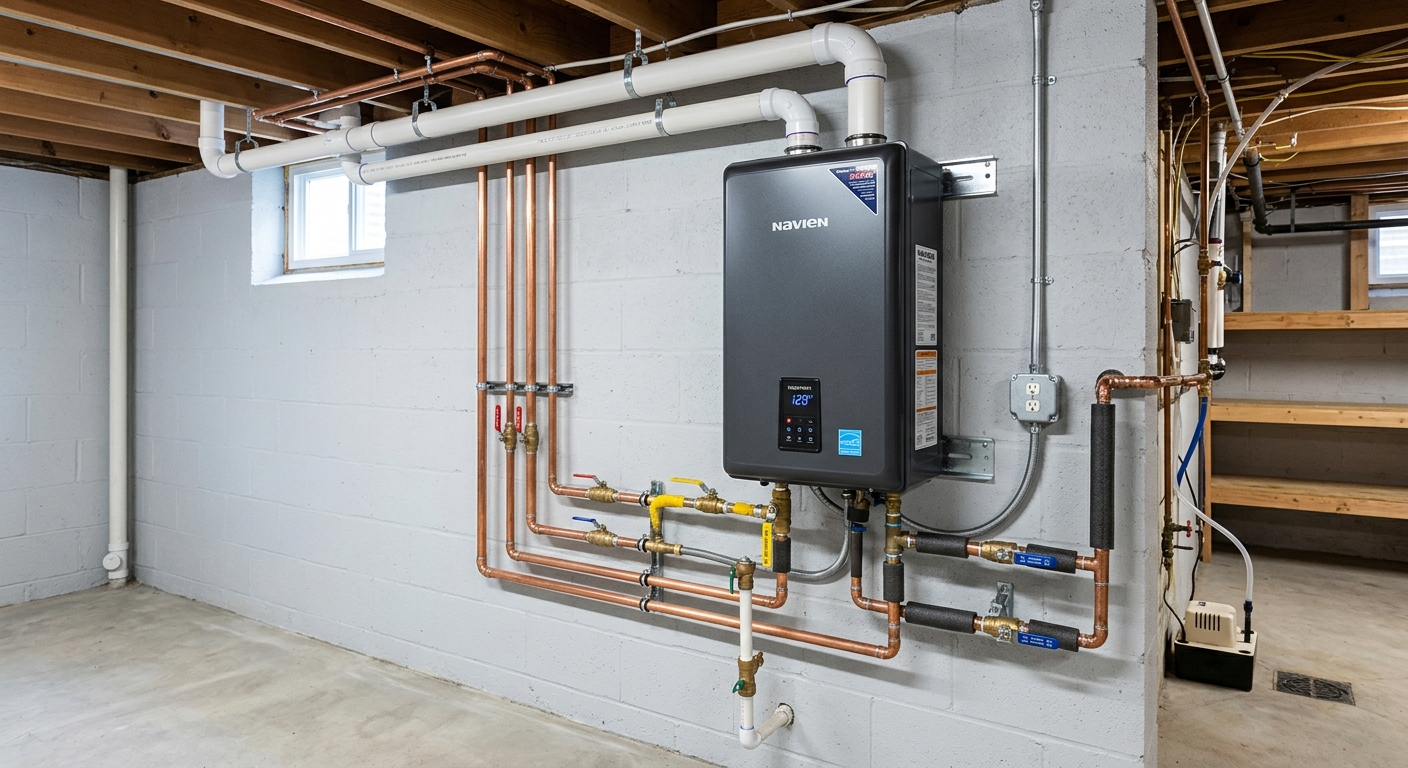
Replacing your water heater in West Manheim isn’t as simple as swapping a tank for what’s in stock—different types come with different costs and headaches. Most homes here still use gas or electric tank heaters because they’re cheapest to install upfront. These tanks lose a bit of heat around the clock (standby loss) and usually last 8–15 years before the bottom rusts out—a tank leak is nearly always non-repairable. Tankless gas heaters offer endless hot water and a smaller wall footprint, but in older homes may need a larger gas line or new venting, both hidden costs that drive up install prices. For homes without natural gas, or with finished basement space, heat pump water heaters are becoming more common. They use much less electricity but need a big volume of air (no small closets) and actually cool the room—a welcome feature in a hot garage, but a winter headache in a finished family room.
No matter which type you install in West Manheim, don’t just match gallons—check the “first-hour rating” to make sure the size fits your family’s actual patterns. Don’t skip the expansion tank and a good drain pan; local inspectors look for both on new installs. Most failures are tank related and come suddenly, not usually from a control board or anode rod failure that’s easy to catch beforehand.
| Type |
Installed cost |
Service life |
Operating cost |
Best when |
| Gas tank, 40–50 gal |
$1,250–$2,900 |
8–12 yrs |
moderate |
gas is available, lowest upfront need |
| Electric tank, 40–50 gal |
$1,250–$1,950 |
10–15 yrs |
high |
all-electric homes, simple swap |
| Gas tankless |
$1,950–$2,900 |
18–25 yrs |
low-moderate |
high hot water use, space and gas upgrades OK |
| Heat pump water heater |
$1,950–$2,900 |
13–15 yrs |
lowest |
ample space, no gas, want lowest bills |
Who is allowed to do plumbing work in Pennsylvania
Pennsylvania does not issue a statewide plumbing license. Instead, every municipality decides if and how it registers or licenses plumbers. In York County, for example, Spring Garden Township maintains its own plumbing license registry independent of neighboring towns. If you’re hiring for work in West Manheim or anywhere nearby, the right question is not “Are you licensed?” but “Are you licensed to work in this township?”—because a plumber licensed in York City may hold no local credential in your municipality at all.
For larger jobs—those over $500—you want to see a written contract, as required by the Home Improvement Consumer Protection Act. If the work is substantial, the PA Department of Labor & Industry oversees code enforcement under the Pennsylvania Uniform Construction Code, which is tied to the IRC. While the state registers home improvement contractors (HIC registration, which you can verify at hic.attorneygeneral.gov), they do not vet trade skills at the state level except in Philadelphia and Pittsburgh. Workers' compensation insurance is mandatory and can be checked through WCAIS (wcais.pa.gov).
Permit rules also differ by municipality. City of York, for instance, requires a permit for anything beyond a fixture swap, but most surrounding townships set their own rules. Always ask your plumber who inspects their work and which office issues local permits. This protects you when it’s time to sell or refi; unpermitted work is a headache you don’t want to inherit.
Frequently asked questions — plumbing in West Manheim
Do older West Manheim homes have galvanized pipes?
Homes in West Manheim built before the 1960s often used galvanized steel supply lines. About 28.9% of homes here were built prior to 1980, according to the U.S. Census Bureau (ACS 2024). If your house falls in that category, there’s a good chance some or all of the water plumbing is galvanized, especially if the system hasn’t been updated since construction. Galvanized pipes tend to corrode from the inside, causing water pressure drops and eventually leading to leaks. Replacing galvanized lines with copper or PEX is the standard fix. Whole-house repipe costs typically range from $3,600–$8,800, but sometimes a targeted replacement is enough if most of your system is holding up.
Who pays to replace a lead service line in West Manheim?
In West Manheim and across greater York County, lead service line replacement isn’t much of a concern today. According to the local facts, the York Water Company has already undertaken a full lead service line replacement for its York City system after a historical inventory. If your home is served by York Water and you haven’t received any notice, odds are high your service line is already copper or another safe material. If a lead line does turn up on your property, it is typically the homeowner’s responsibility from the curb to the home. Water service line replacement can cost $5,700–$12,500 depending on length and access. Always confirm with your water company before starting work.
What does repiping a house cost in West Manheim?
If you’re looking to replace all your supply lines in a West Manheim home (a “whole-house repipe”), you can expect to pay between $3,600–$8,800 as of 2026. The typical job falls around $5,900. Pricing depends heavily on access—finished basements and cramped crawlspaces push costs up, while open framing keeps it lower. The materials matter too: PEX is generally quieter to install and cuts down labor versus copper. Keep in mind that this estimate includes patching, but not major drywall restoration. West Manheim’s construction mix means you might see a bump if your home is pre-1980 and the plumber has to snake new pipe through thick plaster.
Does Pennsylvania license plumbers at the state level?
No—Pennsylvania does not license plumbers statewide. Each municipality is responsible for its own plumbing registration or licensing, except for Philadelphia and Pittsburgh, which run their own examination and registry. In York County, including West Manheim, you may find different credentialing rules in every township or borough. Always ask your plumber if they are licensed specifically where the work will happen. For home improvement jobs over $500, state law requires a contract and registration (HIC) with the Pennsylvania Office of Attorney General, which you can verify before hiring.
How do I shut off the water to my house?
Every West Manheim home has a main shutoff valve—usually located on the main water service pipe just inside where it enters your basement or utility area. Turn this valve clockwise (righty-tighty) to cut off water to your entire house in an emergency. Individual fixtures like sinks or toilets also have smaller local shutoffs on the supply lines. Learning this skill can mean the difference between a small repair billed at standard rates and a disastrous flood with emergency pricing ($600–$1,250 for a burst pipe). If your shutoff is stuck, have it serviced during regular hours.
How do I prevent frozen pipes in West Manheim?
With pronounced freeze-thaw cycles and winter lows dropping to 12°F, freezing pipes are a real risk in West Manheim. Protect pipes running along exterior walls, in crawlspaces, or in garages by insulating them and sealing any air leaks. When cold snaps hit, keep cabinet doors open on exterior sinks and let faucets trickle. If you travel or have a vacant property, always keep the thermostat at 55°F or above. A burst pipe during a deep freeze can lead to emergency repairs costing $600–$1,250, not counting any water damage repairs. Prevention with insulation (a DIY or inexpensive pro job) is almost always cheaper than even one freeze-related call.
What does emergency plumbing cost in West Manheim?
Emergency plumbing in West Manheim comes with a premium. Repairing a burst pipe or active leak after hours typically costs between $600–$1,250, compared to standard rates that can be as low as $375 if the job can wait for business hours. Emergency sewer line spot repairs or water heater swaps also climb higher due to overtime labor and quick part sourcing. To avoid paying a 30–50% premium, use shutoff valves to control the issue and schedule the job during normal business hours whenever safely possible.
Should I repipe my West Manheim home or keep repairing?
The answer depends on how much piping is original and how many symptoms you’re having. If you’re dealing with frequent leaks, low water pressure, or discolored water in a home with galvanized steel or polybutylene, a whole-house repipe—at $3,600–$8,800—usually makes more sense than paying for patchwork repairs. For minor isolated leaks in otherwise solid copper or PEX, targeted repairs are perfectly reasonable. In West Manheim’s older homes, repeated failures on aging pipe signal it’s better to replace than to keep paying emergency rates. Always ask for a full assessment before making the call.
What does discoloured water on first draw mean?
Discoloured or rusty water when you first turn on the faucet—especially after sitting overnight—is common in West Manheim homes with older galvanized steel pipes. The reddish or brownish tint is from internal corrosion, not usually harmful for cleaning but not ideal to drink. If it clears after running for a minute, it’s almost always caused by aging supply lines rather than a municipal water issue. Pipe replacement will solve it, but given costs between $3,600–$8,800 for a whole-house repipe, some homeowners live with it until other symptoms (like leaks or low pressure) appear. If the problem is persistent, a plumber can help pinpoint whether pipe replacement or a smaller repair is warranted.