Antrim plumbing prices by job type — 2026
Antrim, located in Franklin County, sits among some of Pennsylvania’s most homeowner-heavy, post-1970 housing stock, with 87.6% of all local households owner-occupied (U.S. Census Bureau, ACS 2024). This building era means most plumbing upgrades and repairs here target copper or PEX supply lines, while the oldest homes occasionally reveal galvanized steel or clay sewer laterals in need of attention. Your construction era predicts your pipe material, and that material sets your risk and repair costs. For example, aging septic systems and copper-to-PEX repiping are staples of this corridor along I-81, and a 52.1% share of homes built before 1980 means plenty of unexpected failures, pinhole leaks, or clogged drains arise as systems hit middle age.
Nearly every plumbing job in Antrim falls into one of two pricing buckets: a planned job at standard market rates, or an emergency call, which incurs higher charges for night, holiday, or immediate dispatch. A burst pipe, for example, can be far more expensive at midnight than at noon. Routine water heater replacement often has wiggle room to schedule around a lower standard rate, but sewer or main water service failures have no such luxury. Use this table not as a national average, but as a snapshot tailored by real Franklin County trends and construction types.
| Service |
Scope |
Emergency rate |
Standard rate |
| Emergency repair — burst pipe |
locate, open, repair section, restore service |
$600–$1,200 |
$350–$1,200 |
| Water heater replacement (gas, 40–50 gal) |
remove old, install, test, haul away |
$1,950–$2,800 |
$1,200–$2,800 |
| Drain cleaning — main line |
augering or hydro-jet, camera if needed |
$350–$800 |
$200–$500 |
| Sewer line spot repair |
excavate or reline a failed section |
$2,000–$12,000 |
$2,000–$12,000 |
| Whole-house repipe |
replace supply lines throughout, patch and finish |
|
$3,600–$8,600 |
| Water service line replacement |
street to house, excavation and restoration |
|
$5,600–$12,000 |
Estimates for a typical Antrim home. Access difficulty and pipe material move these figures more than anything else.
Who is allowed to do plumbing work in Pennsylvania
Plumbing work in Pennsylvania is licensed and regulated at the municipal level—there is no statewide plumbing license. In other words, a plumber working in Chambersburg may be fully qualified there but hold no credential for Antrim Township or neighboring townships. In practice, when you hire a plumber in Franklin County, ask directly if they are permitted or licensed in your specific municipality, not just “in Pennsylvania.” Chambersburg Borough, for example, has its own plumbing license and written exam requirements, enforced by the local codes department. Most rural Franklin County townships issue their own permits and do inspections through local code offices.
Permits are typically required for new or replacement water, sewer, or gas service piping within the Borough of Chambersburg. In the rural townships, minor fixture replacements like toilets or faucets are usually permit-free, but larger projects and anything involving service lines still require local approval. Work is inspected by the municipality’s own code office or the Pennsylvania Department of Labor & Industry if your township has opted out of code enforcement.
To confirm that your contractor is properly registered for contracts over $500, check their Home Improvement Contractor (HIC) registration with the Pennsylvania Office of Attorney General at hic.attorneygeneral.gov. Valid workers’ compensation coverage can be verified directly through the WCAIS system (wcais.pa.gov), which lists all known insured employers in the state. Only hire a tradesperson who can show proof of both before work starts on your property.
Freeze risk and what to do about it
Franklin County, including Antrim, sits in a region where the typical frost depth for foundations is 30 inches, and the winter design temperature drops as low as 12°F. With pronounced freeze-thaw cycles and moderate snowfall, freeze damage is a regular concern. Pipes freeze when sub-freezing air finds its way into unprotected areas, and the pipe bursts not where it freezes, but between the ice plug and a closed faucet, where rising pressure splits a joint or wall.
Vulnerable spots in Antrim homes include pipes in exterior walls, unheated crawlspaces and garages, those running through attic knee walls, and the all-too-common outdoor hose bibs left charged through winter. Prevention always beats the mess, disruption, and expense of a frozen line. Pipe insulation is the lowest-cost, most reliable fix for unconditioned spaces. Heat tape provides controlled warmth for especially tricky runs, but must be installed properly to avoid fire risk. When a deep snap is forecast, letting a faucet trickle keeps water moving, which is less likely to freeze. Opening cabinet doors under sinks on outside walls helps warmer air reach the pipes. Always shut off and drain hose bibs before the season’s first hard freeze hits.
If your pipes do freeze, use a hair dryer or gentle heat—not an open flame—to thaw the section. The cost of a winter pipe burst in Antrim is often $600–$1,200 if you need a plumber right away, so prevention pays for itself quickly.
Lead service lines in Antrim
While full countywide data on lead service lines in Franklin County is unknown, the Borough of Chambersburg Water Department—the main public water utility for central Franklin County—has confirmed a small, actively replaced inventory of known lead service lines. Water service lines are typically divided into two portions: the utility-owned segment (usually from the main to your curb or shutoff) and the homeowner-owned lateral (from the curb to your home’s point of entry). Replacement programs, if offered, often cover just the utility’s portion unless explicitly stated—so be sure to clarify coverage with the Borough of Chambersburg Water Department directly, as there is no published cost share or program named here.
You can check whether your service line is lead with a simple scratch and magnet test at the point where the line enters your basement or crawlspace. Lead is a dull grey, scratches easily to a shiny finish, and a magnet will not stick. If you find lead, understand that partial replacement (utility or homeowner’s side only) can actually raise your exposure, as disturbing old pipe scale releases particles into the water in the short term.
If full replacement is needed, the going rate for a spot repair is $2,000–$12,000 (for just part of the line if a single section is replaced) and a complete water service line replacement runs $5,600–$12,000 in this area. Never assume a replacement is included—always ask your water utility if you qualify for any programs. Proactive replacement, while costly, is often the only way to resolve the safety risk permanently.
Dating your plumbing by what it's made of
Franklin County’s housing profile, with a heavy post-1970s suburban tilt along I-81, means most Antrim homes will have copper or PEX water supply lines, while older properties may have galvanized steel or polybutylene—each with its quirks, clues, and risks. Galvanized steel (pre-1960) dulls and rusts, with threaded fittings and gray finish; over time, it corrodes from the inside, causing pressure loss long before leaks appear. Copper supply (1950s–present) is reddish and joined by solder; corrosion or pinhole leaks may develop, especially with aggressive well water. Polybutylene (late 1970s–1995) is bluish-gray or black plastic, usually with barbed fittings and crimp rings—this material has a history of sudden failures at joints and is considered uninsurable by many.
PEX, the current standard since the 2000s, is flexible plastic (often red, blue, or white) with crimp or push-fit connectors and is generally low-maintenance in Antrim homes. On the drain side, cast iron (pre-1975, black and heavy) and clay tile (pre-1980, orange-brown, bell-shaped joints) were common—both fail after 50 years from corrosion or root intrusion. PVC/ABS plastic (since the 1970s) is white or black, lightweight, and joined by glue at smooth fittings.
To check your pipes: try the scratch test (copper shines copper, galvanized is dull and the magnet test helps, lead is soft and dull), note pipe color, and look at how pipes are joined. The era your home was built usually signals what’s inside the walls—and most Franklin County houses from the 1970s through 2000s are already on their second generation of plumbing.
| Material |
Typical era |
Failure mode |
Service life |
| Galvanized steel supply |
pre-1960 |
internal corrosion, pressure loss |
40–60 yrs |
| Copper supply |
1950s–present |
pinhole leaks, joint failure |
50–70 yrs |
| Polybutylene supply |
late 1970s–1995 |
fitting failure, sudden bursts |
unreliable |
| PEX supply |
2000s–present |
fitting or UV degradation |
40–50 yrs |
| Cast iron drain |
pre-1975 |
corrosion, cracking, scale |
50–75 yrs |
| Clay tile sewer lateral |
pre-1980 |
root intrusion at joints, offset |
50–60 yrs |
| PVC / ABS drain |
1970s–present |
joint separation, crushing |
50+ yrs |
The leak you can hear but can't see
If you suspect a water leak in your Antrim home—a faint hissing behind a wall or an unexplained spike in your bill—the first step is free: shut off all fixtures, then check your water meter. If the dial moves, you’ve got a supply-side leak somewhere between the meter and your fixtures. From there, professionals rely on a progression of detection tools. Acoustic listening devices “hear” leaks inside walls and floors, costing as little as a quick service call. Thermal imaging cameras show temperature differences behind drywall from concealed leaks, especially when the ambient temperature is different from the pipe’s.
For leaks below slabs or in buried lines, tracer gas (safe, inert gas pressurized through the pipe, then sensors sniff out escaping gas) can pinpoint the failure. Slab leak location and high-tech line tracing methods tend to cost toward the upper end—figure some could approach $600–$1,200 if a significant amount of time is needed. In all cases, holes in drywall or digging should come last: Any plumber who wants to open up walls before verifying the leak’s location with non-invasive tools is doing it backwards. Demand a clear explanation of what’s needed and insist on proof of the problem before disruptive work begins.
Vetting a plumber in Franklin County
When hiring a plumber in Franklin County, the first priority is confirming that they are licensed (or otherwise permitted) in your specific municipality—licensing for plumbing is only at the local level here. In Chambersburg Borough, for example, a plumber must pass that borough’s licensing exam; in Antrim Township or neighboring districts, check with the local code office. Always confirm that your contractor holds active Home Improvement Contractor (HIC) registration for contracts over $500. Verify the HIC number with the Pennsylvania Office of Attorney General (hic.attorneygeneral.gov).
Insist on an insurance certificate that names your property, and independently verify workers' compensation coverage through the WCAIS database (wcais.pa.gov), especially if any non-owner employees will be on site. Ask if the company uses its own crews or subs out work—some rural outfits here in this thin market rely on third-party help. For emergencies, request full dispatch and after-hours pricing in writing before you agree to service.
- Confirm local (not just Pennsylvania) license or permit for the municipality.
- Check HIC registration with hic.attorneygeneral.gov.
- Verify workers' compensation on wcais.pa.gov.
- Request owner-occupier insurance certificate naming your address.
- Ask if any work is subcontracted or wholly done in-house.
- Demand a written contract for work over $500 (required by HICPA).
- Understand after-hours/emergency rate policy up front, not after the job.
- Get explicit permit details for sewer, water, and gas line replacements.
- Require camera footage or pressure test before any major proposed repipe.
- Check EPA Lead RRP certification (pre-1978 homes, certifiedrenovatorsearch.epa.gov).
- Ask neighbors who did their work—repeat appearances are a good sign in small markets.
- Search for official complaints or unresolved disputes via the Attorney General.
Red flags: In Franklin County’s rural contractor market, overbroad promises and pushy “full repipe” or “complete sewer replacement” quotes with no camera footage, pressure test, or clear documentation almost always point to padding or inexperience. Insist on real evidence before signing.
Frequently asked questions — plumbing in Antrim
What do I do about a burst pipe right now?
If you experience a burst pipe in Antrim, act quickly: shut off your main water supply immediately to prevent further flooding and water damage. Most main shutoff valves are found near where your water line enters the basement or crawlspace. After stopping the flow, open nearby faucets to relieve remaining pressure and begin draining the system. If water has come in contact with electrical outlets or equipment, do not approach—call a professional. Contact a plumber who serves your area and ask about emergency dispatch rates; expect to pay in the range of $600–$1,200 for after-hours service in Antrim. Avoid unnecessary demolition or moving soaked items until you have specific instructions from the plumber, as rushing can make repairs more complex or expensive. If you can’t locate the shutoff, ask your water utility (such as the Borough of Chambersburg Water Department) for guidance—sometimes, main shutoffs are outside in a meter pit.
Should I leave a faucet dripping in cold weather?
Yes, in Antrim’s climate it’s wise to leave a faucet dripping overnight during deep freezes (12°F or below). The moving water helps prevent ice plugs inside supply pipes routed through exterior walls, crawlspaces, or garages—common trouble spots. This minor increase in your water bill is insignificant compared to the cost of an emergency frozen pipe repair, which can hit $600–$1,200 if an active leak occurs. Choose the fixture farthest from your main shutoff so it keeps the most pipe length moving, and open cabinets under sinks if they’re on outside walls to let warm air circulate. Remember to disconnect hoses and shut outdoor spigots before winter; reattach only after freezing nights are over.
Does insurance cover a burst pipe in Antrim?
Homeowners policies in Pennsylvania, including Antrim, typically cover sudden, accidental water damage caused by a burst pipe—but not if damage results from neglect or poor maintenance (such as failing to heat your home). Be sure to document damage with photos and keep evidence of all repairs. Insurance may help with the cleanup and restoration, but you’ll still be responsible for the emergency plumbing bill, which in Antrim averages $600–$1,200 for a night or holiday response. Be aware: waiving your deductible is specifically prohibited by the Home Improvement Consumer Protection Act (HICPA). Always contact your insurance agent before repairs start to clarify your exact coverage, and save all receipts for claims.
How much does a water heater replacement cost in Antrim?
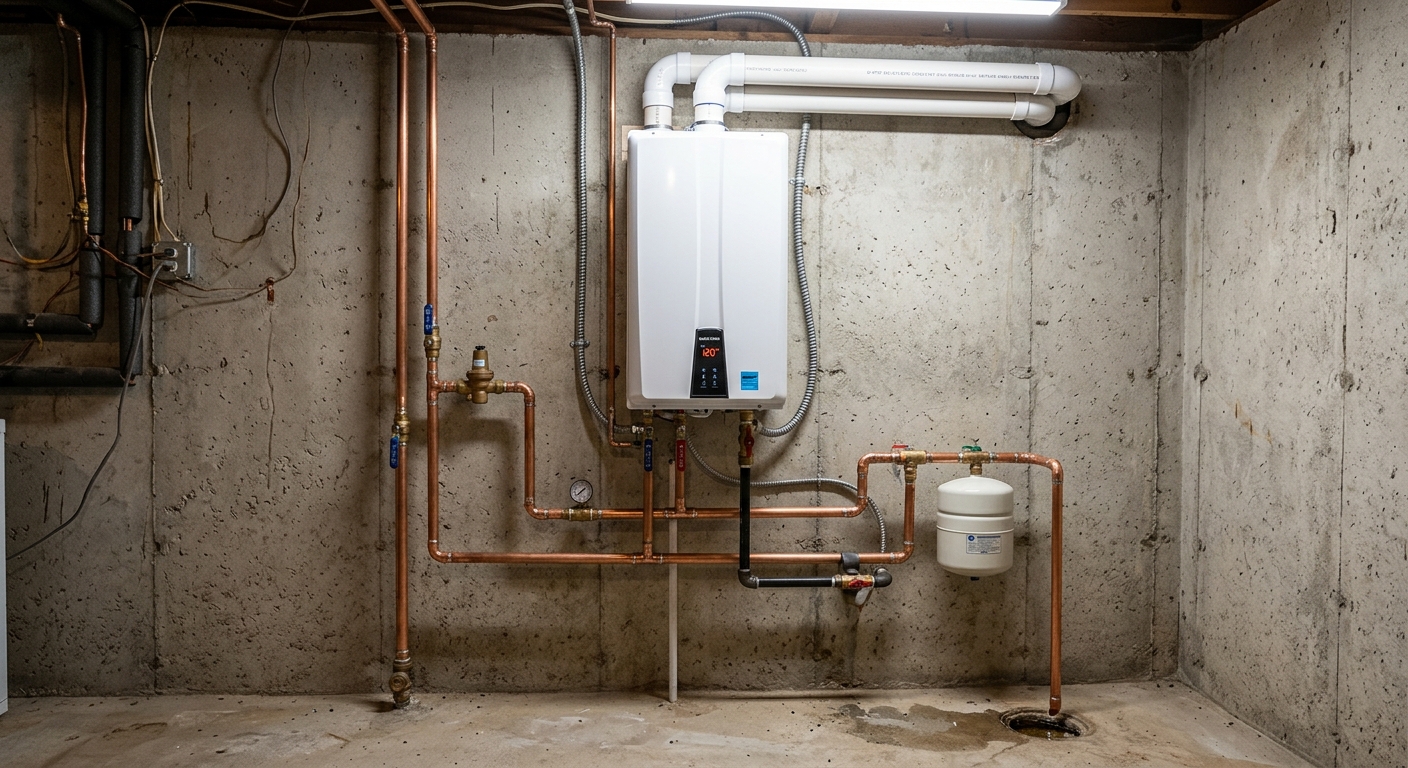
In Antrim, the total cost to replace a standard gas water heater (40–50 gallon, including removal, installation, and haul away) ranges between $1,200–$2,800. Most jobs fall closer to $1,950, but the price can swing higher for hard-to-access locations, code upgrades (earthquake straps, expansion pans), or if you need to upsize the tank. Emergency replacements—such as on the weekend or during a holiday—run higher, so if you have a little warning, schedule during normal business hours to save. Don’t settle for a generic quote—request one that fits your Antrim home’s setup, as county and township codes may dictate venting and location requirements. Haul-away and disposal fees should always be spelled out in writing.
Is Antrim on combined sewers or septic?
In Antrim Township and surrounding rural Franklin County, most homes rely on individual septic systems. Chambersburg itself operates separated sanitary and storm sewers—meaning sanitary waste and stormwater each have dedicated pipes, minimizing backup risks during heavy rain. If you’re buying or updating a home in Antrim, confirm your sewer connection type to avoid surprises with repairs or code compliance. Septic systems often need regular pumping and, as these systems in Franklin County age, repair costs can be significant. A spot sewer line repair in the area runs $2,000–$12,000, while septic systems can require similar or higher investments depending on access and failure type.
Should I reline or replace my sewer line?
In Antrim, choosing between trenchless relining and full replacement depends on both the sewer line’s condition and local code requirements. Relining can be a good option for stable pipe segments with isolated damage—especially for clay tile or cast iron, which fail most often at the joints. However, if your pipe has collapsed, has extensive offsets, or you’ve already had multiple spot repairs, replacement is usually more cost-effective in the long run. Costs for either option typically range $2,000–$12,000. Always insist on a camera inspection and a copy of the footage before accepting either option. Don’t sign a contract for major sewer work in Franklin County without this proof—too many homeowners have paid for unnecessary full replacements.
What causes low water pressure in Antrim homes?
In Antrim, chronic low water pressure can often be traced to aging pipe materials—galvanized steel pipes corrode and narrow after decades of service, and polybutylene piping (still found in some 1970s–90s homes) often fails at the fittings, creating restrictions. Sediment buildup in water heaters, partially closed shutoff valves, and failing pressure regulators are other common culprits. If your house was built before 1980—a real likelihood in Antrim, with 52.1% of homes in this age bracket—corroded steel water lines may be to blame. Replacing these with copper or PEX can restore flow but comes at a price: a whole-house repipe in this area ranges from $3,600–$8,600. Get a professional diagnosis before committing to major work.
Can I do my own plumbing work in Antrim?
In most rural Franklin County townships, including Antrim, minor fixture replacements (like changing a faucet or toilet) can often be done without a plumbing permit. However, new supply or drain lines, water heater replacements, and any work on the main service line typically require a permit and professional inspection. If you live in Chambersburg, stricter rules apply—many plumbing jobs require a borough-licensed plumber. Contractors must be HIC-registered and insured for work over $500. If you're tackling more than a quick swap, weigh the potential risks and fines—emergency repairs from mistakes can quickly cost you $600–$1,200. When in doubt, check with your township code office first.
What does emergency plumbing cost in Antrim?
Emergency plumbing service in Antrim is always more expensive than a scheduled job. If you have a burst pipe, flooding, or an active leak that needs same-day attention—nights, weekends, or holidays—the going rate typically falls in the $600–$1,200 range for a standard repair. This covers the callout, locating and fixing the leak, and restoring service, but not always the cost of cutting into walls or patching finishes afterward. For bigger emergencies like a major sewer backup or water service break, costs can climb substantially, especially if excavation is involved. Always ask for a clear emergency rate before dispatch, and never sign a blank work order—every Antrim homeowner has the right to a written contract and a three-business-day cancellation window for jobs over $500.