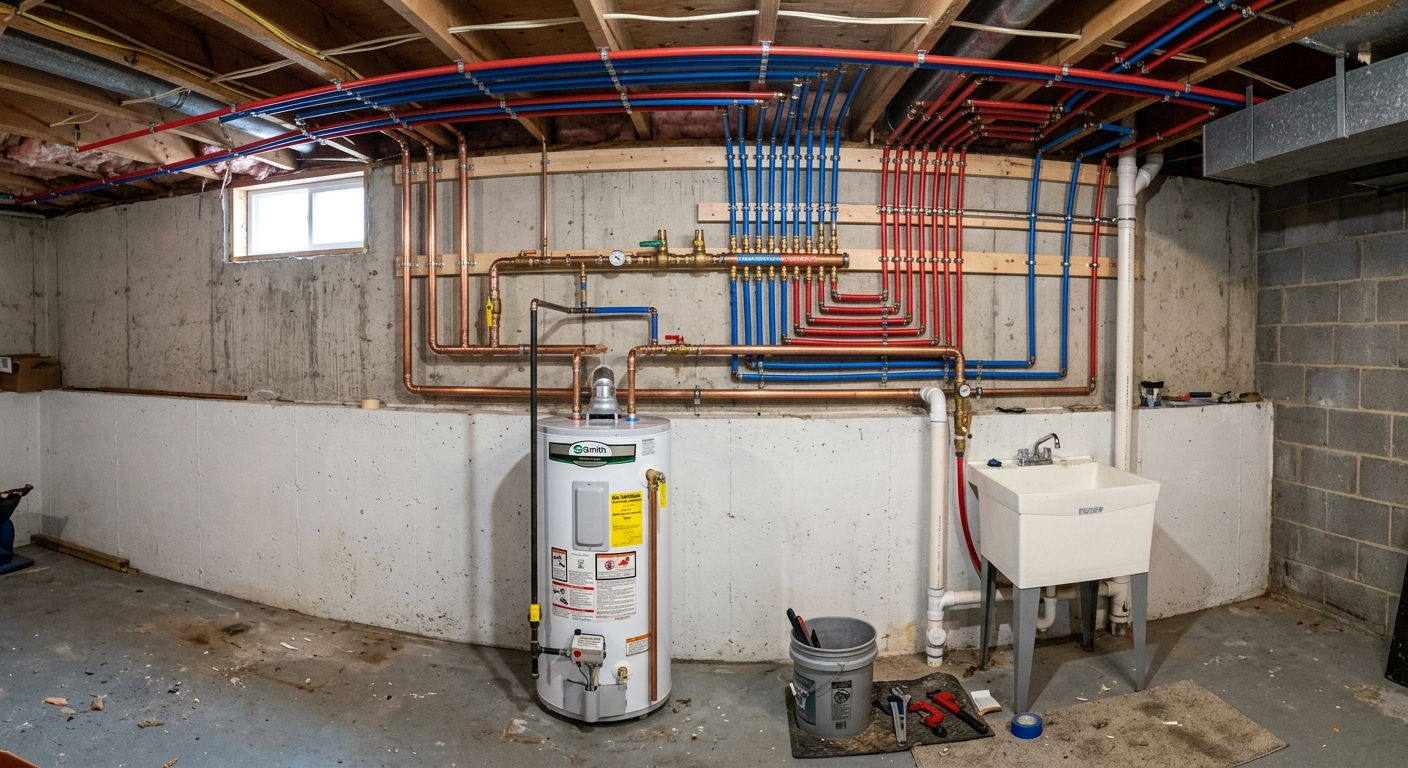
What plumbers charge in Conemaugh
Conemaugh, sitting between the Johnstown and Cumberland metro areas, is defined by older housing and a high homeownership rate of 91.5% (U.S. Census Bureau, ACS 2024). Many houses here date from 1900–1940, so plumbing jobs often mean dealing with original galvanized supply lines and cast iron or clay drains. That era tells you a lot — older pipes corrode, restrict flow, and can leak unexpectedly, pushing many residents to consider full repipes or major repairs. For these kinds of repair and replacement jobs, two price tiers dominate: emergency and scheduled work. The same job costs hundreds more when water is pouring through your ceiling after hours, and less if you can wait for a weekday call-out.
For true emergencies like a burst pipe or sewage backup, expect to pay emergency rates that reflect after-hours labor and rapid diagnosis. By contrast, planned work — such as a water heater swap or scheduled drain cleaning — comes in lower due to more predictable scheduling and less overtime. Given that nearly 79% of homes are pre-1980, and most supply lines have been patched or partially replaced by now, “typical” costs here skew toward partial updates and problem-solving, not untouched original systems.
| Service |
Scope |
Emergency rate |
Standard rate |
| Emergency repair — burst pipe |
locate, open, repair section, restore service |
$550–$1,150 |
$325–$1,150 |
| Water heater replacement (gas, 40–50 gal) |
remove old, install, test, haul away |
$1,800–$2,700 |
$1,150–$2,700 |
| Drain cleaning — main line |
augering or hydro-jet, camera if needed |
$350–$800 |
$200–$500 |
| Sewer line spot repair |
excavate or reline a failed section |
$1,900–$11,500 |
$1,900–$11,500 |
| Whole-house repipe |
replace supply lines throughout, patch and finish |
|
$3,300–$8,100 |
| Water service line replacement |
street to house, excavation and restoration |
|
$5,200–$11,500 |
Estimates for a typical Conemaugh home. Access difficulty and pipe material move these figures more than anything else.
What urgency costs you
In Conemaugh, like everywhere in Somerset County, urgency adds a real premium to plumbing costs. The “emergency” price means you’re paying not just for the repair, but for the circumstances: late-night dispatch, a trip charge, possibly overtime rates, plus the reality that repairs are done under pressure with little prep or diagnosis ahead of time. Plumbers often have to open up ceilings, walls, or floors without the chance to carefully plan, which runs the clock and sometimes means using higher-cost materials on hand to get your service restored.
For example, stopping an active flood from a burst pipe might run $550–$1,150 as an emergency, while the same repair scheduled for the next business day could be $325–$1,150. The difference may be just a few hours, but it can literally double your bill. And if you’re in an older house where main shutoffs are hard to reach or corroded, the risk is even higher.
What counts as a true emergency?
- Active flooding (burst pipe, water gushing through ceilings or walls)
- Sewage backing up into tubs, sinks, or toilets
- No water to the whole house (not just an isolated fixture)
- Gas odor (leave and call 911 or the gas company immediately)
What can usually wait for business hours?
- Slow leaks or drips (place a bucket and turn off the fixture valve)
- One clogged toilet or slow drain (if others are working)
- A running toilet
- Low but not no water pressure
If you know how to shut off water either at the main (usually a valve where the line enters the house, in the basement or crawlspace) or at an individual fixture, you can usually turn an emergency into a scheduled repair — saving yourself hundreds of dollars in premiums or trip fees. Practice finding and turning your shutoffs before you need them.
Comparing plumbing estimates in Conemaugh
When reviewing plumbing quotes in Conemaugh, you'll see two main billing styles: flat rate or time-and-materials. Flat rate gives you a full job price up front — a safer bet for larger or more complex jobs, as the contractor takes the risk of surprises. Time-and-materials means you pay for the hours actually worked plus parts — sometimes cheaper for quick fixes, but open-ended for jobs where hidden problems crop up. The key is knowing which you’ve agreed to before work starts; not knowing is how bills balloon with change orders.
Most reputable plumbers will start with a diagnostic fee — sometimes credited toward the repair if you proceed. Quotes should break out what exactly will be opened, fixed, and restored, including restoration of drywall or finishes. Permitting should be included where required, and the warranty should specify labor coverage as distinct from any manufacturer’s parts warranty. After-hours rates should always be stated before work begins, not left to surprise you on the invoice.
| Line item |
What to look for |
Red flag if… |
| Billing model |
flat rate or hourly, stated up front |
unstated |
| Diagnostic fee |
amount, and whether it credits |
vague |
| Scope |
what is opened, repaired and restored |
price with no scope |
| Restoration |
drywall and finish explicitly in or out |
silent |
| Permit |
included and priced |
'not needed' |
| Parts |
brand and model for fixtures |
'standard fixture' |
| Warranty |
labour period stated separately |
parts only |
Vetting a plumber in Somerset County
In Somerset County, there's no state-issued plumbing license, and municipalities set their own registration requirements—if any. Before hiring, verify the contractor's Home Improvement Contractor (HIC) registration with the Pennsylvania Office of Attorney General at hic.attorneygeneral.gov. For repairs over $500, this registration and a written contract are required by law. Since many surrounding townships enforce separate codes, always ask if the plumber is able to pull permits in your exact municipality. Insurance matters too: request a certificate naming your address, and check workers’ compensation status using WCAIS at wcais.pa.gov if the plumber employs a crew.
- Check HIC registration with the Attorney General’s online tool
- Ask if the plumber can pull permits specifically in your township or borough
- Request a written contract for any job over $500 (state law)
- Get a liability insurance certificate naming your property
- Confirm workers’ compensation coverage via WCAIS
- Ask if the crew are employees or subcontractors
- Request camera footage for any drain or sewer replacement quote
- Look for a clear emergency rate disclosure
- Demand a stated scope covering restoration of finishes
- Insist on labeled, branded fixtures in estimates
- See both labor and parts warranties in writing
- Ask about experience with homes built before 1940
In this rural market with thin contractor density, slow response isn’t shocking — but beware of any plumber quoting a whole-house repipe or sewer replacement without offering camera footage or a pressure test to justify the work. High-dollar jobs should be well documented, not based on a hunch.
Camera inspection, relining and replacement
As a homeowner in Conemaugh or the surrounding Somerset County area, you own the sewer lateral—the underground pipe—that runs from your house all the way to the public main. Disputes over who pays to dig up a failed line usually come down to this ownership line. When problems start, the early symptoms are subtle: one slow drain, then several backing up, then gurgling, then outright sewage coming up at your lowest fixture (often a basement tub or floor drain).
Before anyone quotes you on excavating or relining, you should see a video from a camera inspection. This is the primary diagnostic tool and will reveal if you have root intrusion in clay tile (common in pre-1980 housing here), offset joints, bellies where water pools, or cracks. No camera, no excavation quote — it’s that simple, especially when sewer line spot repair runs $1,900–$11,500 in this market. Trenchless relining can be an alternative to open-cut, but only if your line is a candidate (short, straight runs with moderate damage).
Keep in mind, not all of Somerset County is on public sewer. Conemaugh Township homes may rely on septic tanks; here, backups are rarely fixed by digging up a line and often relate to a full tank (pump every 3–5 years) or a saturated drainfield—a different and sometimes costlier issue.
For sewer repairs, never accept a quote for excavation or relining unless you are shown the camera footage that points to the problem’s exact location and type.
What construction era means for your pipes
Conemaugh’s housing stock is overwhelmingly pre-1980 (78.6%), with much of it dating from 1900–1940. That directly affects your plumbing. Supply lines may still include galvanized steel (prone to corrosion and flow restriction) unless already replaced with copper or PEX. Drains are usually cast iron or clay tile, both of which can fail after 60–100 years from roots, rust, or shifting soil in Somerset’s clay and shale subgrade. It’s also common to find lead solder joints in old copper lines, and service lines from the street may be original steel, iron, or copper, depending on when each stretch of main was upgraded.
Water heaters in these houses are almost never original — you could easily be on the third or fourth replacement. If a plumber sees newer PEX or copper, odds are the house had a full or partial repipe, but check basements and crawlspace joints for remaining galvanized.
Newer homes in outlying townships may have builder-grade plastic supply lines, but the norm for Conemaugh remains aging metal piping that increasingly justifies investing in a full repipe rather than chasing leaks room by room. Construction era almost always predicts where your next leak or blockage will crop up.
Who is allowed to do plumbing work in Pennsylvania
Pennsylvania does not issue a statewide plumbing license. Instead, licensing and registration for plumbing is set at the municipal level. In some places, like Philadelphia and Pittsburgh, plumbers must pass a local exam and register; in Somerset County municipalities, including Somerset Borough and Conemaugh Township, there is no separate published local plumbing license requirement beyond the state Home Improvement Contractor (HIC) registration. This means a plumber licensed in one city may not be approved to pull permits in another township, so always ask specifically if your contractor can perform work and obtain permits in your municipality.
The Pennsylvania Uniform Construction Code (UCC), based on the IRC, is administered by the PA Department of Labor & Industry and enforced locally — in Somerset Borough, the Borough of Somerset Building Inspections Department handles code and permitting, while surrounding townships manage their own offices. In Somerset Borough, permits are required for any new plumbing installations or alterations, but not for simply swapping in a new water heater of the same type. For any substantial job, your plumber should provide proof of insurance and workers’ compensation as required by Pennsylvania law — verify workers’ comp using WCAIS and insurance certificates naming your property as insured.
Frequently asked questions — plumbing in Conemaugh
How do I verify a plumber's licence and insurance?
In Conemaugh, you can verify a plumber’s Home Improvement Contractor (HIC) registration directly through the Pennsylvania Office of Attorney General at hic.attorneygeneral.gov. This registry tells you if they’re legally registered for jobs over $500 and if their insurance is current. Always ask for a copy of the plumber’s liability insurance certificate, ensuring your own property address is listed. For employers, workers’ compensation coverage is mandatory and can be confirmed at wcais.pa.gov. There’s no state-issued plumbing license, so if you need new plumbing permitted in Somerset Borough, confirm your plumber is allowed to pull the required permits locally. Taking these steps means you won’t be on the hook if something goes wrong — especially with higher-cost jobs like water heater replacement, which often runs $1,150–$2,700 here. If a plumber hesitates to provide proof, that’s your cue to keep looking.
Is a sewer line replacement covered by homeowner's insurance?
Homeowner’s insurance in Pennsylvania, including Conemaugh, rarely covers the cost of sewer line replacement from your house to the main unless the damage was caused by a covered “named peril” like a fallen tree or vehicle crash. Normal wear and tear, roots in clay tile, and ground movement—very common causes in Conemaugh’s older homes—are considered maintenance and are not covered. Sewer repairs can cost $1,900–$11,500 or more, so always read your policy’s “sewer and drain” sections, and ask about optional service line endorsements if your property qualifies. Even with extra coverage, you’ll need a clear camera inspection as proof, and in many cases, the policy will only pay after a backup or water damage event occurs—not for avoidance or proactive replacement.
Do I need to drain outdoor spigots in Conemaugh?
Yes, in Conemaugh you should always drain and shut off outdoor spigots before winter. Somerset County sees deep frost — design depth is 36 inches, and bursts happen quickly in unprotected lines when winter lows can hit 8 °F. Most older homes have hose bibs fed from interior pipes that sit above frosted ground, so even a small drip can split the pipe and require an emergency repair (which may run $550–$1,150 if caught late). Best practice is to shut off the interior valve for each outside faucet, then open the spigot to let any remaining water drain out. If your house is older and has no frost-free hydrants, consider upgrading; it costs less than blowing out drywall when spring comes.
Do older Conemaugh homes have galvanized pipes?
Many older homes in Conemaugh—especially built between 1900 and 1940—still have original galvanized steel supply lines, unless they’ve been updated over the years. Galvanized pipe rusts from the inside, eventually causing restricted flow or pinhole leaks. If your house matches the dominant stock (pre-1980, 78.6% of homes), it’s smart to check visible pipes in basements and areas above suspended ceilings for threaded, grayish steel lines. Slow water pressure, discolored water, or recurring leaks are signs it’s time to consider a full repipe, which typically costs $3,300–$8,100 in Conemaugh. If you only have partly updated supply lines, pay attention to mixing old and new materials—galvanic corrosion can eat through pipes faster at connection points.
How do I tell what my pipes are made of?
To check your pipe material in a Conemaugh home, start in the basement or at the water meter. Galvanized steel feels magnetic, is silvery-gray, and scratches to a bright finish but quickly rusts. Copper is orange-brown, non-magnetic, and often paired with greenish corrosion at joints. PEX is flexible plastic, usually colored blue or red. For drains, look for cast iron (thick, glossy black) or older clay tile — reddish and found where the line exits the foundation. If you’re uncertain, plumbers in Conemaugh routinely perform camera inspections and visual checks; this is often built into the diagnostic fee, sometimes credited toward repairs (for jobs like spot sewer repairs, often in the $1,900–$11,500 range). Knowing your material helps plan for future repairs or when to budget for a full repipe.
What does drain cleaning cost in Conemaugh?
Drain cleaning in Conemaugh depends on the severity and access. For a main line cleared with an auger or hydro-jet (and a camera inspection if needed), the cost is generally $200–$500 if scheduled as standard work. If you need an emergency same-night or weekend call, expect to pay $350–$800. These figures fit the local rural market, where travel surcharges for outlying areas are common. In homes built before 1980—the majority in Conemaugh—drains can clog with rust, scale, or roots. Consider a camera inspection if you get repeat blockages; this can prevent spending on repeated cleanings when you really need a repair or spot replacement instead.
Should I repipe my Conemaugh home or keep repairing?
If your Conemaugh home still relies on a mix of old galvanized, copper, and maybe even original steel service lines, repeated repairs can quickly outpace the cost of a whole-house repipe, especially with 78.6% of homes dating from before 1980. If you’re seeing leaks every year, reduced flow at fixtures, or rust-colored water, it’s worth getting a full estimate; in this market, repiping runs $3,300–$8,100. While a small repair may only be a few hundred dollars, patching again and again often means repeated service charges and drywall repair. If your water lines are patched together and look more like a quilt than a planned system, investing in a repipe can solve the problem for decades—especially as older pipes near the end of their typical lifespan.
Should I wait until business hours to call?
In Conemaugh, calling after hours always costs more—sometimes double or more the standard rate. If you have a drip, one slow drain, or a running toilet, you’ll save real money by waiting for a weekday appointment. Emergency repairs, such as stopping active flooding or sewage backing up, justify the emergency rate of $550–$1,150. For anything non-urgent, shut off water at the fixture or main, collect drips in a bucket, and breathe easy knowing the difference can be several hundred dollars. Plumbers in Somerset County are often covering wide rural areas, so even a minor emergency surcharge is significant. Only pay the premium for true, immediate risks to your home or health.
What does repiping a house cost in Conemaugh?
A whole-house repipe—in which all old supply lines are replaced, often with PEX or copper and all necessary wall/floor patching—is a common project in Conemaugh’s older homes. Typical cost ranges from $3,300–$8,100, depending on house size, access, and material choice. In homes built before 1980 (which covers nearly 4 out of 5 houses in Conemaugh), repiping is usually prompted by frequent leaks, rust or scale, and low flow at multiple fixtures. Pricing is in line with the rural Somerset County market, but if you have a larger or especially tricky home (lots of finished spaces, limited crawlspace, or multiple additions), expect to be at the higher end of the range. Always ask for a written estimate detailing restoration of walls and finishes before agreeing to the work.