Hazle plumbing prices by job type — 2026
Hazle homeowners, whether living in a tidy single-family on a quiet street or one of the many pre-1940 multifamily homes, face plumbing costs shaped by housing age and pipe material. With 65.7% of Hazle’s housing built before 1980 and most homes owner-occupied (77.1%), many still have legacy galvanized or cast iron piping, which narrows and leaks with age, or cramped access that drives up the time and risk for repairs. That’s why the same repair can run two very different prices: one for a regular appointment and another for an emergency call—when the problem can’t wait and deeper snow loads, travel, or immediate leaks mean overtime labor and after-hours rates. If you’re calling after coming home to water on the floor, expect the higher side of the range.
Older construction, especially in Wilkes-Barre and Hazleton, rarely leaves easy access, so even standard jobs like water heater replacement can end up costlier because of the need to bring lines up to code or manage surprise lead or galvanized. Every job in the table below—except full home repipes and service line replacements, which rarely qualify as emergencies—has two price bands depending on when and how urgently it’s done. More than in most towns, “how hard is it to reach the pipe?” is your price driver here.
| Service |
Scope |
Emergency rate |
Standard rate |
| Emergency repair — burst pipe |
locate, open, repair section, restore service |
$550–$1,100 |
$325–$1,100 |
| Water heater replacement (gas, 40–50 gal) |
remove old, install, test, haul away |
$1,700–$2,500 |
$1,100–$2,500 |
| Drain cleaning — main line |
augering or hydro-jet, camera if needed |
$350–$800 |
$200–$500 |
| Sewer line spot repair |
excavate or reline a failed section |
$1,800–$11,000 |
$1,800–$11,000 |
| Whole-house repipe |
replace supply lines throughout, patch and finish |
|
$3,200–$7,700 |
| Water service line replacement |
street to house, excavation and restoration |
|
$5,000–$11,000 |
Estimates for a typical Hazle home. Access difficulty and pipe material move these figures more than anything else.
The leak you can hear but can't see
If you suspect a leak but don’t see drips or water on the floor, do the meter test before calling anyone: shut off every faucet, appliance and toilet in the house, then check your water meter. If the dial still moves, you’ve got a leak on the supply side—often under a slab or inside a wall. This is 100% free and tells you whether to look further or leave the walls alone.
Professionally, plumbers use several tools to locate a hidden leak. Acoustic listening devices pick up the sound of water escaping under pressure, pinpointing leakage inside walls, below floors, or under slabs—these typically add $325–$1,100 for a detection visit. Infrared cameras check for cold water mixing with warm air or surfacing in odd spots, useful for slab leaks or wet insulation. Tracer gas is sometimes pumped into supply lines (after shutting the water), then detected as it escapes at the break.
Slab leaks—rare in Hazle’s older stock but possible—tend to show up as warm spots in the floor or unexplained water bills. Wall cavity leaks reveal themselves as stains or bubbling paint, but you should never start cutting before a definite location—opening walls blind is old-fashioned and unnecessary. Hidden irrigation line leaks, if you have them, are typically found by isolating the supply zone and checking for pressure loss on that side alone. A methodical plumber always locates first and opens last; be wary if someone is eager to tear in before finding where to look.
Hardness, treatment and fixture life in Hazle
If your Hazle home gets its water from Pennsylvania American Water or another area utility, you can always request a copy of their annual water quality report. Most of Luzerne County’s public water arrives moderately hard to hard, so scale deposits inside water heaters and on fixtures are an issue—especially for homes with older galvanized or copper lines, which accumulate scale more quickly and restrict flow over time.
Hard water will shorten the life of every water-using fixture and your water heater, and you may notice cloudy glassware or white residue on shower doors. Some Hazle customers also see pinholes in copper piping if the water is unusually aggressive, but that’s less common with public supply here. A softener can help, especially for households bothered by scale, but if you’re mainly worried about appliance longevity, weigh the initial cost and salt use against typical appliance lifespans. Most families won’t ever “make back” the cost of high-end treatment unless the hardness is extreme.
Whole-house filtration is helpful if you notice strong tastes, local chlorine odor, or visible sediment, but point-of-use filters under the sink can be more cost-effective for drinking water. For private well users in the outskirts of Luzerne County, you’re your own test authority—water isn’t monitored unless you have it checked. Don’t overspend: many “plumbing solutions” being pushed door-to-door cost more than they save, especially in Hazle where utility water quality is fairly well managed.
Licensing and permits for plumbing work in Hazle
Plumbing in Hazle and all of Luzerne County is licensed and regulated at the municipal level—not statewide. Pennsylvania does not issue a statewide plumbing license, and only certain cities (like Wilkes-Barre) maintain their own licensing systems. That means a plumber who is licensed in one town holds no authority in the next unless they’re licensed there too. For Hazle, always ask: “Are you licensed for this municipality?” If the company can’t show you proof for your specific area, keep looking.
For work in Wilkes-Barre, the Code Enforcement Office oversees both contractor licensing and building code administration. Plumbing work that involves new supply or drain lines, or any alteration, will require a permit—which brings inspections for code compliance based on the Pennsylvania Uniform Construction Code (UCC), itself based on the IRC. In other Luzerne County townships, check with the local code office; if your township opted out, the PA Department of Labor & Industry may inspect instead.
Every plumbing contract over $500 must be issued by a registered Home Improvement Contractor—verify this at hic.attorneygeneral.gov. Contractors must carry workers' compensation insurance for all employees and you can confirm this yourself through the WCAIS system at wcais.pa.gov. Any job involving pre-1978 housing may trigger federal EPA lead paint rules; make sure your contractor is properly certified, which you can verify at certifiedrenovatorsearch.epa.gov. Never accept a handshake agreement or a vague invoice: state law requires a written contract over $500, with a 3-day right to cancel.
Choosing a water heater in Hazle
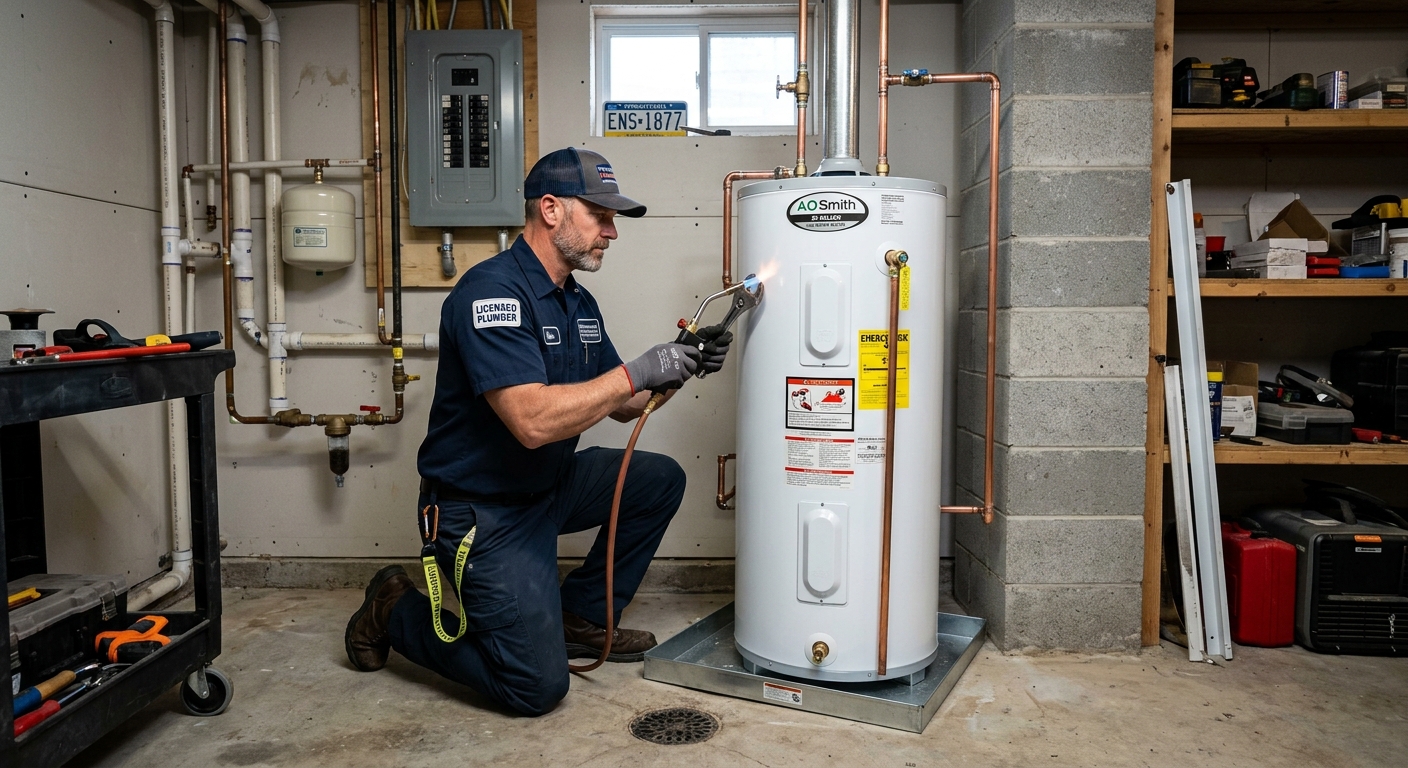
For Hazle homes, the main water heater choices are gas tank, electric tank, gas tankless, or heat pump water heater. Each option has strengths—and hidden costs to be aware of before you choose. Standard tanks (gas or electric) are the lowest up-front cost and fit older Hazleton and Wilkes-Barre basements with tight access, but they’re the shortest-lived and lose heat into the room while they sit. Gas tankless models mean endless hot water and lower bills over time, but usually need a larger gas line and a new vent—surprise costs in pre-1940 plumbing systems where nothing is sized for today’s codes. Don’t let anyone gloss over those upgrades.
Heat pump water heaters deliver the lowest operating cost, but need a big, warm room with lots of air to exchange. They cool the space they’re in, so if you have a finished basement or laundry room you actually use in winter, that’s a real tradeoff—and they can be loud. Sizing should always be by first-hour rating, not just tank gallons; older multifamily homes with more residents or one-bath setups can quickly exhaust a too-small heater. Expansion tanks are mandatory by code if you’re swapping a heater on a closed system, and it’s always wise to demand a pan and drain if your heater sits anywhere finished. Most replacements happen because the tank itself fails, not the controls, so when buying new, invest for longevity.
| Type |
Installed cost |
Service life |
Operating cost |
Best when |
| Gas tank, 40–50 gal |
$1,100–$2,500 |
8–12 yrs |
moderate |
existing gas line, need simple swap |
| Electric tank, 40–50 gal |
$1,100–$1,700 |
10–15 yrs |
high |
no gas available, low hot water demand |
| Gas tankless |
$1,700–$2,500 |
18–25 yrs |
low-moderate |
larger families, willing to upgrade vent/gas |
| Heat pump water heater |
$1,700–$2,500 |
13–15 yrs |
lowest |
warm, unfinished basement, high electric rates |
Pipe materials in Hazle homes and how they fail
If you live in Hazle or anywhere in Luzerne County’s older stock, you’re almost certain to find a mix of pipe types—each with its own aging issues. Much of Wilkes-Barre and Hazleton housing is pre-1940 multifamily stock with legacy galvanized piping and limited access for replacement. Galvanized steel supply lines, common pre-1960, corrode internally: you’ll see low pressure and brownish water before an actual leak. To check, scratch the outside—shiny silver and a magnet sticks means galvanized.
Copper, used from the 1950s onward, is more reliable but can develop pinhole leaks if the water is particularly "aggressive" (slightly acidic), though this is mostly an issue in isolated neighborhoods. Polybutylene, found in some homes from the late 1970s through the early 1990s, is almost always a replacement prospect due to frequent fitting failures. Modern PEX, used since the 2000s, is the best replacement unless you’re sticking to copper for resale. For drains, cast iron (pre-1975) will rust then crack—listen for gurgling, slow drainage, or thuds in the pipe. Clay tile sewer laterals are the root-inviting weak spot for many older lots, as the joints shift with freeze-thaw cycles.
To identify what you have: galvanized is silver and magnetic, copper is reddish and non-magnetic with soldered joints, PEX is plastic and colored red/blue, and PVC drains are white plastic with glued joints. If your house is pre-1960 and never repiped, your remaining life is often less than 20 years unless all visible branches have been swapped. Every era has its tell—ask your plumber to walk you through what’s visible before you sign for a big job.
| Material |
Typical era |
Failure mode |
Service life |
| Galvanized steel supply |
pre-1960 |
internal corrosion, pressure loss |
40–60 yrs |
| Copper supply |
1950s–present |
pinhole leaks, joint failure |
50–70 yrs |
| Polybutylene supply |
late 1970s–1995 |
fitting failure, sudden bursts |
unreliable |
| PEX supply |
2000s–present |
fitting or UV degradation |
40–50 yrs |
| Cast iron drain |
pre-1975 |
corrosion, cracking, scale |
50–75 yrs |
| Clay tile sewer lateral |
pre-1980 |
root intrusion at joints, offset |
50–60 yrs |
| PVC / ABS drain |
1970s–present |
joint separation, crushing |
50+ yrs |
Flat rate versus time and materials
In Hazle, plumbers use two main billing models. Flat rate means you get an upfront price for the job, no matter how long it takes; the plumber builds in some risk in case things get complicated. Time and materials means you’re charged for labor by the hour plus the parts used—this can be cheaper for something simple but open-ended if new problems crop up as they open pipes or walls. Both are legitimate, but not being clear about which one you’re agreeing to breeds the most disputes I see.
Always ask whether there’s a diagnostic fee and if it’s credited back if you hire them for repairs. Read the scope: does it list what will be opened and how restoration will be handled, or just show a lump sum? Make sure the quote mentions permitting (required for most supply or drain changes), brands and exact models for anything you’re buying, whether drywall and finish are included, and how long the labor warranty runs. After-hours rates should be spelled out up front. Any “quote” without this detail should be a red flag.
| Line item |
What to look for |
Red flag if… |
| Billing model |
flat rate or hourly, stated up front |
unstated |
| Diagnostic fee |
amount, and whether it credits |
vague |
| Scope |
what is opened, repaired and restored |
price with no scope |
| Restoration |
drywall and finish explicitly in or out |
silent |
| Permit |
included and priced |
'not needed' |
| Parts |
brand and model for fixtures |
'standard fixture' |
| Warranty |
labour period stated separately |
parts only |
Frequently asked questions — plumbing in Hazle
How much does sewer line repair cost in Hazle?
Sewer line spot repairs in Hazle run anywhere from $1,800–$11,000. Your price depends mostly on location and access. If the failure is directly under an old tree, a porch, or a concrete driveway, excavation adds cost quickly. With much of Hazle’s housing using outdated clay tile laterals (prone to root intrusion at joints), spot repairs are fairly common. A camera inspection—often done ahead of quoting—narrows the scope, and you want a quote that details how much pipe is being replaced or relined. If your home is outside Wilkes-Barre’s sanitary system on septic, line issues tend to be limited to the house-to-tank run and are usually cheaper unless major digging is required. Always verify restoration is included on the contract, especially if you need sidewalks or landscaping restored.
Is a water softener worth it in Hazle?
For most Hazle households with public water, a softener isn’t truly necessary unless you’re annoyed by scale or run lots of water-using appliances. Water here is generally moderately hard, so you’ll see some scale buildup inside water heaters and on fixtures—but not like the worst areas west of here. Add up your appliance repairs and cleaning costs before you invest: with softener systems often running $1,000 and up installed and regular salt costs, it’s rare to see a payback unless you’re running commercial laundry or care deeply about spotless glassware. A water heater replacement here is usually $1,100–$2,500, so that should also go into your calculus.
How hard is the water in Hazle?
Hazle’s public water is moderately hard, which is typical for Luzerne County and the Scranton–Wilkes-Barre area. If you’ve just moved in, expect to see the usual symptoms: cloudy glassware, scale on shower heads, and inside appliances. Public water providers including Pennsylvania American Water publish annual water quality reports, which will list the hardness in mg/L or grains per gallon. While this isn’t severe enough to destroy plumbing quickly, it’s enough that water heater life can be shortened by five years if you don’t flush it annually. A professional flush—priced as a regular service call, usually in the $200–$500 range—can keep things in top shape if you’re concerned.
Should I wait until business hours to call?
Unless water is actively running or you’re losing heat in a cold snap, you’ll save by waiting until the morning. After-hours emergency rates add up, with emergency repairs in Hazle typically costing $550–$1,100 compared to daytime rates. If you can shut off a leaking fixture or isolate a problem by using the home’s main shutoff, do that—and let things dry out while you arrange a next-day appointment. Call right away if the leak is threatening electricity, or you’re losing water pressure to the whole house. If you’re not sure how urgent it is, describe the symptoms to a plumber by phone; a straight-shooter will tell you honestly if it can wait.
What does repiping a house cost in Hazle?
Repiping a whole house in Hazle typically runs $3,200–$7,700, with most jobs centering around $5,100. The biggest factors are house size, how much access drywall you’re willing to have opened, and whether you’re upgrading from legacy galvanized—a common need in pre-1940 Hazle homes. PEX is easier and often cheaper than copper, especially in tight multifamily setups where access is limited. Restoration (patching and painting) adds cost, so clarify whether that’s included. Given the age of much of Hazle’s housing stock, repiping sooner rather than later can head off sudden leaks and water quality issues.
How deep do water lines need to be buried in Hazle?
In Hazle and throughout Luzerne County, code requires water lines to be buried below the local frost depth—here, that’s 36 inches. This is specifically tied to Pennsylvania’s winter climate, where deep freezes are common and service line freeze-ups can easily occur if you don’t meet depth requirements. If you’re replacing a water service line (typically $5,000–$11,000), always confirm that you’re meeting or exceeding the 36-inch minimum to avoid costly mid-winter failures. Keep in mind, some older properties may have shallow lines from when standards were different, so upgrades should always correct that.
What does discoloured water on first draw mean?
Discoloration of water on first draw, especially in Hazle’s older homes, usually traces to mineral deposits or rust dissolving from inside legacy galvanized or iron pipes. After sitting overnight, water takes on a metallic or yellowish tint, but should clear after a minute or two of running. This isn’t an urgent health concern on public water, but it does warn that your supply lines may be approaching end of life. If you’re seeing this and live in a pre-1940 or 1950s-era property, discuss repiping—costs are in the $3,200–$7,700 range, but it’s worth planning for before a leak turns up.
Does Pennsylvania license plumbers at the state level?
No, Pennsylvania does not issue a statewide plumbing license. All licensing is handled at the municipal level, so plumbers who work in Hazle or Wilkes-Barre must be locally licensed—being licensed in another township or city is not enough. Always ask “Are you licensed here?” and verify registration through your municipality’s code office. For any contract over $500, the plumber also needs to hold state Home Improvement Contractor registration, which you can check online. Permitting and code inspections (like those required for water heater replacement, $1,100–$2,500) are also handled locally.
Who owns the sewer lateral, me or the city?
In Hazle and most of Wilkes-Barre’s neighboring areas, you as the homeowner own the sewer lateral—the pipe running from your house to the main in the street. Anything from your foundation wall out to the connection point is your responsibility for repairs, maintenance, and replacement. This is why sewer spot repairs often run $1,800–$11,000, depending on distance and restoration. The city or public authority maintains only the main line; root damage, collapse, or joint offset in the lateral is 100% on you. Knowing this ahead of home purchase or before landscaping saves surprises.