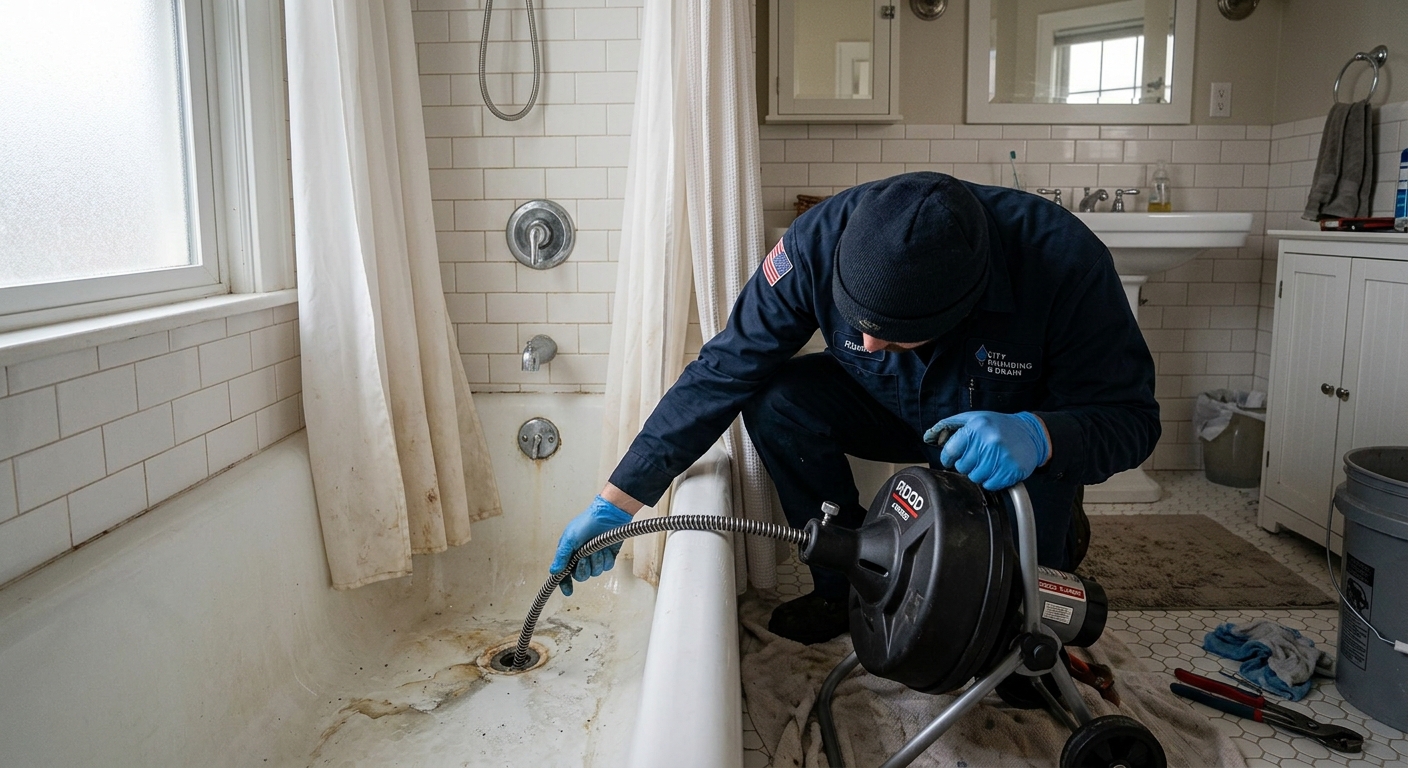
Plumbing costs in Tamaqua — 2026
Tamaqua’s plumbing costs reflect more than just labor and materials—they’re shaped by a housing stock where 91.7% of homes were built before 1980 and a regional trade market that often sees outside contractors charging for travel. The majority of homes here, as in Pottsville, date from the coal era (1900–1930), which means much of the original galvanized steel piping is being replaced with copper or PEX every year. That construction era heavily influences what goes wrong (galvanized lines closing up or leaking) and what it will cost you to fix it. In an older Tamaqua house, repair almost always means confronting access issues—there’s no “quick” hidden leak in a thick plaster wall.
For every job, you’ll see two price points: one for true emergencies (nights, weekends, or an active leak) and another for planned or scheduled work. Emergency calls carry a premium—often justified, since they mean the plumber is driving out on short notice, sometimes from as far as Reading or Allentown, and has to get you up and running no matter the time of day. For a typical burst pipe fix, that difference can be several hundred dollars. If you have the skills to safely shut off water and buy time until business hours, you’ll pay less every time.
| Service |
Scope |
Emergency rate |
Standard rate |
| Emergency repair — burst pipe |
locate, open, repair section, restore service |
$550–$1,050 |
$300–$1,050 |
| Water heater replacement (gas, 40–50 gal) |
remove old, install, test, haul away |
$1,700–$2,500 |
$1,050–$2,500 |
| Drain cleaning — main line |
augering or hydro-jet, camera if needed |
$350–$800 |
$200–$500 |
| Sewer line spot repair |
excavate or reline a failed section |
$1,800–$10,500 |
$1,800–$10,500 |
| Whole-house repipe |
replace supply lines throughout, patch and finish |
— |
$3,100–$7,500 |
| Water service line replacement |
street to house, excavation and restoration |
— |
$4,900–$10,500 |
Estimates for a typical Tamaqua home. Access difficulty and pipe material move these figures more than anything else.
Dating your plumbing by what it's made of
In Tamaqua and the rest of Schuylkill County, much of the plumbing you’ll find is tied directly to the era the house was built. The coal boom (1900–1930) left a patchwork of galvanized steel and cast iron in the walls and under the basement floor—materials that have specific lifespans and ways of showing their age.
Galvanized steel, a matte gray pipe that isn’t attracted to a magnet and is threaded at the joints, typically narrows before it leaks. You’ll notice a drop in water pressure and, sometimes, rusty or cloudy water. Copper, which is still common from the 1950s onward, is reddish-brown and soldered at the joints. It holds up well but can suddenly develop pinhole leaks if your water is aggressive (high in dissolved minerals or oxygen). Polybutylene, a blue-gray flexible plastic found in some late 1970s–mid 1990s homes, fails unpredictably at the fittings—insurance is sometimes an issue. PEX, used since the early 2000s, is flexible, comes in blue or red, and joints are crimped or expanded. It’s less likely to burst, but can degrade with UV or faulty fittings.
For drains, cast iron is heavy and magnetic, used up to the 1970s. These lines rot from within and can scale down until you get persistent clogs or cracks. Clay tile sewer laterals, also common pre-1980, are brittle and porous at the joints—the first place tree roots find their way in. If you have white or black plastic (PVC or ABS) drains, those likely date from more recent repairs or additions.
Your best clue is a scratch test—with a quarter or key, scratch an exposed pipe in the basement or near the water meter. Is it shiny silver (galvanized), coppery red, blue-gray, or white plastic? That answer plus your home’s construction date will tell you how much runway you have before you’re facing a major repair.
| Material |
Typical era |
Failure mode |
Service life |
| Galvanized steel supply |
pre-1960 |
internal corrosion, pressure loss |
40–60 yrs |
| Copper supply |
1950s–present |
pinhole leaks, joint failure |
50–70 yrs |
| Polybutylene supply |
late 1970s–1995 |
fitting failure, sudden bursts |
unreliable |
| PEX supply |
2000s–present |
fitting or UV degradation |
40–50 yrs |
| Cast iron drain |
pre-1975 |
corrosion, cracking, scale |
50–75 yrs |
| Clay tile sewer lateral |
pre-1980 |
root intrusion at joints, offset |
50–60 yrs |
| PVC / ABS drain |
1970s–present |
joint separation, crushing |
50+ yrs |
Emergency rates versus scheduled work in Tamaqua
In Tamaqua, the difference between emergency and scheduled plumbing work isn’t just the time on the clock—it’s a real split in cost. Emergency rates reflect more than a plumber’s hourly wage; you’re covering after-hours dispatch, travel time (often from Reading or Allentown when local crews are busy), overtime labor, and the fact that troubleshooting must happen on the fly, not after a methodical diagnosis.
When should you pay this premium? Emergencies are active floods, water pouring from ceilings or walls, a total loss of water, sewage backing up into tubs or floor drains, or any gas smell. These absolutely justify a call, even outside business hours. By contrast, a slow drip under the sink, a single slow drain, or even a toilet that runs intermittently can nearly always wait for regular rates—it’s the difference between $550–$1,050 for an emergency burst pipe repair and $300–$1,050 on a weekday appointment.
The single best skill for a Tamaqua homeowner: knowing how to shut off your water at the main. Find your main shutoff—usually near where the water line enters the basement. Ball valves turn one quarter; older gate valves require several turns. Always verify you can close it fully. For fixtures, under-sink and toilet supply valves can be shut to isolate a problem. If you master this, you have control, and can avoid paying emergency rates for what ultimately is a manageable leak until morning.
The point where patching stops making sense
It’s natural to hope that the next leak is the last, but with Tamaqua’s older homes, especially those with 1900–1930s piping, repairs cross a clear line from sensible to waste. That line is two or more leaks in three years on the same material, especially if it’s galvanized steel or polybutylene—if you’re seeing this pattern, the system itself is failing, not just a joint or one bad section.
Other signals to watch for include pressure dropping across the whole house (not just at one faucet), water that comes out rusty or brownish after sitting overnight, and visible roughness or flaking at pipe joints. Repeated pinholes in copper also point to the end of service life, especially with Tamaqua’s older supply lines.
The repair decision isn’t just pipe—it’s the finish work after, especially with lath-and-plaster walls common to the area. The cost to patch, paint, and repair can match or even exceed the pipe work itself in homes of this era. When a whole-house repipe is needed, PEX is usually faster to install and offers flexibility for difficult runs, but copper is still called for if code or insurance demands it.
| Situation |
Recommendation |
Cost |
Reasoning |
| One leak, accessible, modern pipe |
Spot repair |
$300–$1,050 |
Isolated issue, repair is cost-effective |
| Two or more leaks in 3 years |
Partial repipe |
$3,100–$5,100 |
Multiple failures signal system-age, fix root cause |
| Galvanized supply, pressure loss |
Full repipe |
$3,100–$7,500 |
Material at service life limit, patching is wasteful |
| Polybutylene anywhere in the house |
Full repipe |
$3,100–$7,500 |
Unreliable, risk of sudden major failure |
| Cast iron drain with root intrusion |
Camera, then reline or replace |
$1,800–$10,500 |
Root growth, corrosion require more than basic snaking |
| Suspected lead service line |
Test, then replace the lateral |
$4,900–$10,500 |
Possible health risk, full replacement solves source |
Sewer line problems in Tamaqua
In Tamaqua and throughout Schuylkill County, homeowners are responsible for the sewer lateral from their house to the main—and that often runs under sidewalks, lawns, or even streets. This ownership line is the source of most disputes; if there’s a clog, backup, or break between your house and the town’s main, it’s your responsibility to fix it, not the town’s.
Early signs include one slow drain, which might just be a local clog, but if multiple drains back up together or you hear gurgling in nearby fixtures when the toilet is flushed, you’re likely looking at a main line issue. Backup at the lowest fixture—typically a basement floor drain—is an urgent red flag. For permitted repairs, a camera inspection is critical before any excavation. Until you see the video, never approve a dig—tree roots, bellies, and offset joints will tell the story plainly.
In older Tamaqua and Pottsville homes, clay tile sewer laterals are routinely invaded by roots at the joints, and cast iron lines corrode internally until they scale shut or crack outright. Depending on what camera footage shows, repair options run from trenchless relining to open-cut replacement, with costs from $1,800–$10,500. Meanwhile, in rural Schuylkill township homes, most have individual on-lot septic systems. Here, “slow drains” may not be a pipe problem at all, but a full septic tank (typically pumped every three years) or a failed drain field—different causes, different fixes.
Bottom line: no reputable plumber in Tamaqua should quote a repair on the main drain line without showing you real-time video proof of the problem.
Service line material and drinking water in Tamaqua
In Tamaqua, public water is provided by the Schuylkill County Municipal Authority and the Pottsville Area Division of Pennsylvania American Water. The latter is actively inventorying its lead service lines, with partial replacements already recorded. Here’s what matters to you: the service line running from the street into your home is usually your responsibility, while the portion under the public right-of-way may belong to the utility.
Don’t assume both will be replaced in a utility upgrade. Often, only the public half is replaced unless you coordinate and pay for your portion. Identifying what you have isn’t hard: where the line enters your basement or crawlspace, try a scratch test (the pipe will be dull gray for lead, shiny copper for copper, or rusted steel for galvanized). A magnet won’t stick to lead or copper. If you find lead, know that partial replacement disturbs protective scale and can actually increase lead levels in your tap water for a while, as loose flakes work their way through the new/old joint.
Pennsylvania American Water publishes a map of their lead inventory. If you’re on their system, check online or call and ask how your address is listed. They may update their records or inform you of cost share or future planned replacements—but don’t assume full coverage unless they confirm it in writing. If you have to do it yourself, the cost for replacing a water service lateral runs from $4,900–$10,500 depending on length and surface restoration.
If you’re unsure what you have, ask the utility directly instead of assuming your line is safe—lead service lines are a documented issue here, and catching it early is the only way to protect your water.
Who is allowed to do plumbing work in Pennsylvania
Pennsylvania does not have statewide plumbing licensing. Instead, all plumbing licensing is handled at the municipal level. This means a plumber registered or licensed in one place may not be legal to work just a few miles over in a different borough or township. For Tamaqua, most area towns do not require a specific plumbing license—but Pottsville does require local plumbing contractor registration beyond the state’s Home Improvement Contractor (HIC) rules. In Schuylkill Haven and similar boroughs, like-for-like faucet replacements often don’t even require a permit, but any new fixture or relocation in Pottsville likely triggers a building and plumbing permit, enforced by its Codes and Zoning Office.
For contracts over $500, Pennsylvania requires the plumber to have HIC registration, administered by the Attorney General’s office. This is your baseline protection, and you can check a contractor’s status at hic.attorneygeneral.gov. Insurance and workers’ compensation are mandatory for any employer, verified via the state’s WCAIS system. As a homeowner, never accept “I’m licensed” at face value: always ask, “Are you licensed to do this work here in Tamaqua?” and ask for proof of insurance and workers’ compensation documentation.
Finally, if your home was built before 1978, any disturbance of lead paint triggers the EPA’s Lead RRP Rule, so the contractor should be certified for that as well.
Frequently asked questions — plumbing in Tamaqua
Why do all my drains drain slowly at once?
If every drain in your Tamaqua home is sluggish (tubs, sinks, shower, even the washer standpipe), it’s almost never a fixture issue—it’s a main drain issue or a larger pipe partially blocked. In this part of Pennsylvania, older homes frequently have cast iron or even clay main stacks, which corrode or develop thick internal scale over decades. In rural Schuylkill, if you’re on septic, a full tank or failed drainfield can act just like a clogged sewer. You may need a camera inspection and a full main drain cleaning, which runs $200–$500 on a scheduled basis. Don’t ignore this—if left, it often leads to a total backup at the lowest drain.
Are tree roots a common sewer problem in Tamaqua?
Yes—especially if your home’s sewer lateral is original clay tile or cast iron, which is very common in Tamaqua and Pottsville’s older housing. Roots enter through clay tile joints or cast iron cracks. They grow slowly, then suddenly cause wipes or heavy toilet paper to snag, leading to major backups. Main line augering with a camera follow-up typically runs $350–$800 if the roots are accessible. Long-term, the fix might be trenchless relining or a full replacement, which is more expensive, but repeated snaking more than once a year is a sign the line itself is failing.
Repair or replace a leaking water heater?
In Tamaqua, typical water heater leaks at valves or connections can often be fixed (a few hundred dollars), but if water is leaking from the tank itself, replacement is the only option. Most tanks in this area are well beyond their service life by 10–12 years, especially with hard water. For a gas unit, a new 40–50 gallon replacement will cost $1,050–$2,500. Compare this to the risk and future damage from ignoring a failed tank—when it bursts, it’s considered an emergency.
What do I do if a pipe is frozen but not burst?
In Tamaqua’s winter climate, frozen pipes are a reality. If you catch one before it bursts (you have no flow at a faucet, or hear ice cracking), shut off the main water valve to be safe, open the nearest faucets, and use a hair dryer or gentle heat (never an open flame) on the frozen section. Call a plumber if you can’t locate it easily. If you do have a split pipe, an emergency repair is $550–$1,050; avoid that by taking action early, especially in older uninsulated homes.
Can I do my own plumbing work in Tamaqua?
In most of Tamaqua and Schuylkill County, you can legally do your own plumbing work on a detached single-family home you own. However, if you require a permit—like for new fixture locations—or if you’re in Pottsville (which requires licensed plumbing contractors for some work), you may be limited. All contracts for work over $500 by any contractor must follow state HIC rules. Don’t forget: any disturbance of lead paint (in homes built pre-1978) requires an EPA-certified contractor, so for those jobs, it’s best to bring in a pro.
Is a sewer line replacement covered by homeowner's insurance?
Standard homeowner’s insurance in Pennsylvania, including Tamaqua, rarely covers the cost of routine sewer line replacement due to age or root damage. It’s considered a maintenance issue rather than an accident. Sudden, clearly accidental damage (like from excavation) may be covered, but almost always with restrictions. Full replacement between the house and the main typically ranges from $4,900–$10,500. Some insurers offer supplemental “service line” coverage for a small annual fee—worth asking your agent about before there’s a problem.
What does repiping a house cost in Tamaqua?
Almost every full repipe in Tamaqua is driven by failing galvanized steel or dangerous polybutylene piping, especially with most housing stock built before 1980. Expect to pay $3,100–$7,500 for a whole-house repipe, including labor and patching. The lower end covers a simple one-story home with easy access; large, multi-story or tightly finished basements push toward the top. Don’t forget finish costs—older homes with plaster walls mean repair costs can run high.
What do I do about a burst pipe right now?
First, immediately shut off your home’s main water supply (usually at the pipe entering the basement). This stops the flood and limits damage. Then, open a faucet at the lowest level to relieve pressure and drain down remaining water. Call a local plumber for an emergency repair, which typically costs $550–$1,050 in Tamaqua. While you wait, start mopping up and move valuables out of harm’s way; if you can avoid active electrical hazards and damage, you’ll keep your claim and costs down.
How much does a water heater replacement cost in Tamaqua?
For a standard 40–50 gallon gas water heater replacement in Tamaqua, including removal of the old unit and haul-away, expect to pay $1,050–$2,500. Access and venting issues may push it toward the higher end. If your unit is leaking from the tank body, replacement is the only smart choice—holding out for another year to save a couple hundred dollars almost always ends up costing more in property damage when it fails.