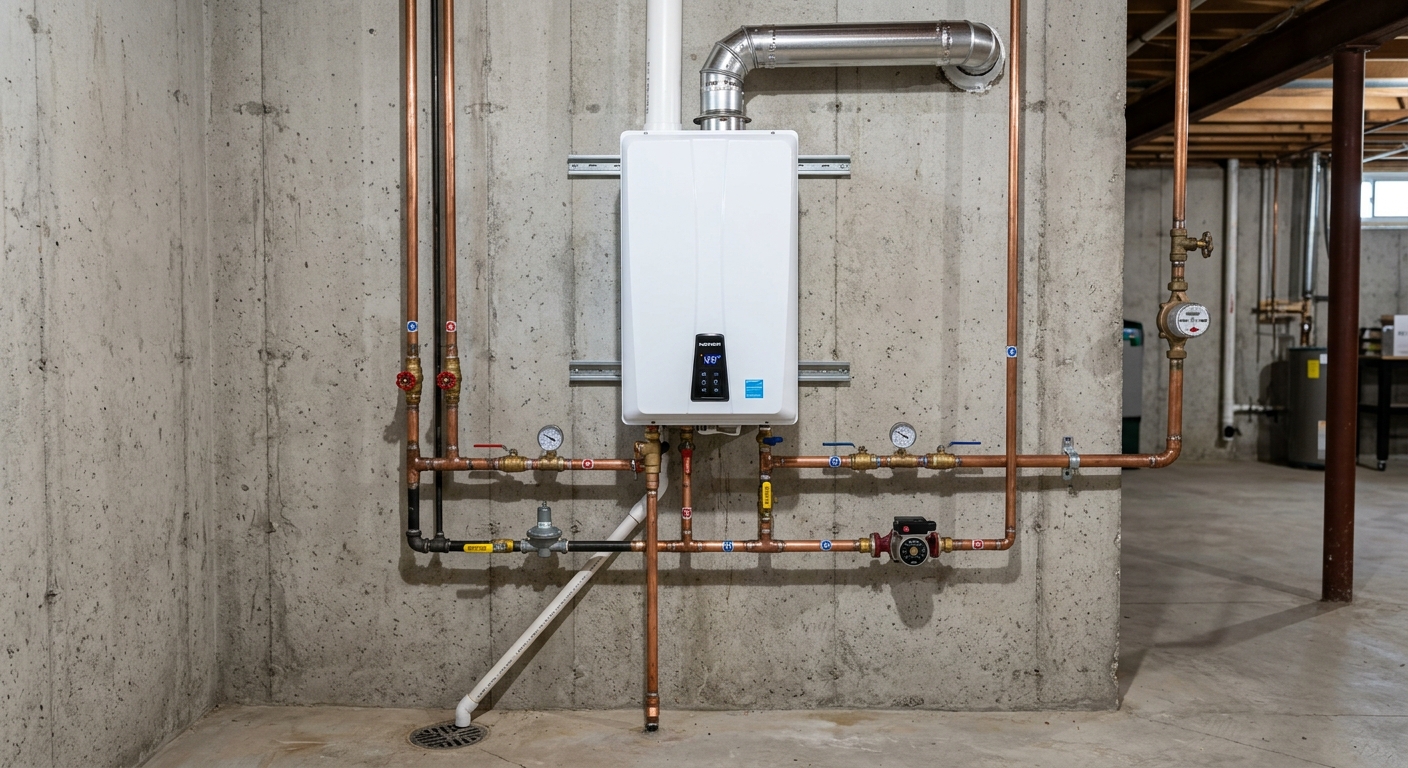
Cumberland plumbing prices by job type — 2026
Cumberland Township sits just west of Gettysburg in Adams County, where nearly half the homes were built before 1980 and the homeownership rate is a solid 83.1% (U.S. Census Bureau, ACS 2024). Plumbing costs here reflect both the age of the stock and the freeze-thaw cycles our winters bring. One key factor shaping cost in Cumberland is whether you call for service in an emergency — a burst pipe on a cold night with water pouring in gets priced differently than a scheduled water heater swap next week.
Many Battlefield-adjacent Gettysburg homes predate modern plumbing, so era-specific issues — like galvanized or even lead service lines — drive both the type of repair and what it costs. Emergency plumbing calls in this area typically carry a premium not just for after-hours, but for the travel surcharges that come from working in a rural market tucked between metro Harrisburg–Carlisle and Frederick, MD.
If you’re budgeting, remember: the material and condition of your pipes — usually linked to when your home was built — matter as much as square footage. Limited crawlspace access or thicker stone walls in older homes mean even basic work can require more time and disruption. Here’s what you can expect to pay in 2026 for the most common jobs in Cumberland:
| Service |
Scope |
Emergency rate |
Standard rate |
| Emergency repair — burst pipe |
locate, open, repair section, restore service |
$650–$1,250 |
$375–$1,250 |
| Water heater replacement (gas, 40–50 gal) |
remove old, install, test, haul away |
$2,000–$3,000 |
$1,250–$3,000 |
| Drain cleaning — main line |
augering or hydro-jet, camera if needed |
$350–$800 |
$200–$500 |
| Sewer line spot repair |
excavate or reline a failed section |
$2,100–$12,500 |
$2,100–$12,500 |
| Whole-house repipe |
replace supply lines throughout, patch and finish |
— |
$3,700–$9,000 |
| Water service line replacement |
street to house, excavation and restoration |
— |
$5,800–$12,500 |
Estimates for a typical Cumberland home. Access difficulty and pipe material move these figures more than anything else.
Service line material and drinking water in Cumberland
If you live in Cumberland Township or nearby Gettysburg, your water most likely comes from the Gettysburg Municipal Authority, though some outlying areas use different authorities or private wells. Service lines — the pipe running from the water main to your home — have two owners: the utility owns up to the curb or property line, and homeowners are responsible for the lateral from there into the foundation. Replacement programs, when available, often cover only the utility side, leaving you to handle your part.
No county-wide lead service line count exists in Adams County, but the Gettysburg Municipal Authority has an active inventory program. Check their published records or contact them directly to find out if your address appears on their list. Never assume you’re covered by a cost share; always confirm with the utility if there’s any program or reimbursement available locally.
To identify your service line’s material, locate where the line enters your basement or crawlspace. A simple scratch test: scrape with a coin and observe the color — shiny, silver-gray is likely lead, while copper is reddish. A magnet will not stick to lead or copper but will to steel. If you find lead, replacing just your half can make things worse in the short term by disturbing protective internal scale, so plan for full replacement whenever possible.
Homeowners in this area should budget $5,800–$12,500 for a full water service line replacement (street to house), not including any public side work the utility might cover. Spot repairs — sometimes an option if only part of the line is failing — fall in the $2,100–$12,500 range but are rarely recommended for lead.
Water quality and what it does to your pipes
If you’re on Gettysburg Municipal Authority water, you can request their annual water quality report, which lists everything from hardness to chlorine residuals. Many homes here contend with scale from mineral-rich water; that buildup shortens water heater and fixture life. In older supply lines, aggressive water (low pH or high chlorides) can eat pinholes in copper, especially in the pre-1980 homes common in Cumberland.
A softener can reduce scale and extend appliance life, but the economics don’t always pay out — salt, maintenance, and the upfront cost can outweigh any savings if your fixtures are newer. Whole-house filters target sediment or chlorine but are typically overkill unless your water comes from a private source with known issues. For most homes, a good drinking water filter under the sink is plenty.
If you’re on a well, remember: nobody else tests your water. Plan an annual test for bacteria, and check iron and pH every few years. Filtration or softening on a well is best decided after that lab result, not before. In this area, resist high-pressure pitches for treatment equipment; most quality and scale concerns show up as common, visible problems — not invisible threats.
Sewer line problems in Cumberland
In Cumberland as throughout Adams County, the homeowner owns the sewer lateral from the home all the way to the main — even if that main is under the street. Most disputes start there, especially after backups or slow drains. In Gettysburg Borough, separated sanitary and storm sewers mean backups usually trace to the homeowner’s line rather than the public main. In outlying townships, on-lot septic is common, so the whole waste line is the homeowner’s responsibility.
Watch for warning signs: if just one drain is slow, it’s usually a local clog; several slow drains, gurgling after flushing, or water backing up at the lowest fixture signal a problem deeper in the sewer lateral. Before accepting any quote for excavation or major repair, insist on seeing camera inspection footage — it’s the only honest way to know if you’re facing roots, a collapsed pipe, or just a clog.
Battlefield-era clay tiles experience root intrusion and “bellies,” where the pipe sags and holds water. Modern homes are less likely to see these, but nothing’s immune to an offset joint or frost heave. Depending on what the camera shows, repairs are either open-cut (dig-and-replace — disruptive but sometimes necessary) or trenchless (lining the pipe from the inside). In townships with septic, don’t confuse field failure or tank overload with a sewer problem; regular septic pumping and simple filter maintenance often solve those issues.
Don’t ever sign for sewer excavation without seeing the footage. Digging is disruptive and costly — $2,100–$12,500 is not unusual — so be sure before you break ground.
Cumberland's housing stock and its plumbing
Cumberland Township and the Gettysburg area reflect an older south-central Pennsylvania profile, with nearly half the homes built before 1980. Battlefield-adjacent housing means frequent encounters with original galvanized supply lines and cast iron drains — materials prone to scale, internal rust, and the kinds of leaks or backups only age can bring. If your house was built before 1920, upgrades have likely happened, but you may still find remnants of the original system, including the possibility of lead service lines or clay sewer laterals.
In these older homes, the water heater has often been swapped at least once, sometimes twice, so don’t expect a “lifetime” unit. The same goes for fixtures and valves: replaced as needed, not all at once. By contrast, newer suburban infill from the 1980s or 1990s may have polybutylene or CPVC in supply lines — not hazardous, but less durable than copper or PEX. Many of these newer homes are just hitting their first round of plumbing updates, especially water heater and fixture replacements.
No matter the age, every era brings its own headaches: early houses need full modernizations, mid-century homes are plumbing patchworks, and even newer ones aren’t trouble-free. Knowing what’s in your walls is worth an inspection — it predicts what will go wrong, and what repairs might cost.
Verifying a Cumberland plumber's credentials
In Pennsylvania, there is no statewide plumbing license. Rather, plumbing is licensed (or not) at the municipal level. In Adams County, you’ll find that Gettysburg Borough issues permits and inspects work through the Gettysburg Permits and Licenses Office, while the rest of the county relies on the Adams County E-Permit Center. This means a plumber who is qualified and legal to work in Gettysburg may not hold any credential in the next township, and vice versa. When you hire, don’t just ask if they’re “licensed” — ask if they’re licensed to work specifically where your house is located.
In Gettysburg Borough, any plumbing work that adds to or modifies a UCC-permitted system requires a plumbing permit, which also triggers an inspection. In most surrounding townships, minor fixture replacements are often done with no permit if no piping changes are made, but if in doubt, contact the Adams County E-Permit Center to confirm.
For any job over $500, Pennsylvania law requires the contractor to be registered with the state as a Home Improvement Contractor (HIC). You can verify a plumber’s registration any time at hic.attorneygeneral.gov. Workers’ compensation insurance is mandatory for any employer and can be checked at WCAIS (wcais.pa.gov). For pre-1978 homes, verify the plumber or renovator’s EPA lead RRP certification if they’re disturbing paint or original plumbing. Always demand a written contract for any project over $500. These are the rules that protect you — obeyed by professionals, evaded by handymen who cut corners.
When to repipe a Cumberland home
If you’re in a Cumberland or Gettysburg house and have two leaks from the same type of pipe in three years, that’s a sign to stop patching and start planning a repipe. Falling water pressure through the whole house, brown or discoloured water when you first run the tap, visible corrosion at exposed joints, and persistent pinhole leaks are classic signals. In pre-1920 housing, these patterns point to original galvanized or even lead pipes reaching the end.
Copper remains the benchmark for durability, but modern PEX delivers similar service life at lower cost and with easier installation (especially in crawlspaces or retrofits). Plumbing cost isn’t the whole story: after the pipes, you’re left with drywall or—worse in older homes—plaster repairs. In Gettysburg’s older stone or lath-and-plaster houses, these restoration costs sometimes approach what you’ve paid the plumber, so budget for that work too.
Here’s how typical situations map to practical recommendations and their rough cost in Cumberland:
| Situation |
Recommendation |
Cost |
Reasoning |
| One leak, accessible, modern pipe |
Spot repair |
$375–$1,250 |
Cheapest solution if the rest of the system is sound |
| Two or more leaks in 3 years |
Partial repipe |
$3,700–$6,000 |
Emerging pattern — patching is no longer cost-effective |
| Galvanized supply, pressure loss |
Full repipe |
$3,700–$9,000 |
Lifetime reached — full replacement stops future failures |
| Polybutylene anywhere in the house |
Full repipe |
$3,700–$9,000 |
Material defect — known for failure, best to replace all |
| Cast iron drain with root intrusion |
Camera, then reline or replace |
$2,100–$12,500 |
Hidden issues need proper diagnosis first |
| Suspected lead service line |
Test, then replace the lateral |
$5,800–$12,500 |
Lead is a health hazard and must be fully replaced |
Frequently asked questions — plumbing in Cumberland
Which utility supplies water to Cumberland?
Gettysburg Municipal Authority supplies the public water system for most of Gettysburg Borough and parts of Cumberland Township. However, several outlying Adams County townships and some rural properties use separate local authorities or private wells. If you’re unsure about your own supply, call the Authority directly or check your property’s recent water bill. Most professionals in Cumberland are familiar with the Gettysburg system but always confirm before planning major plumbing work, especially if you’re scheduling a job like a service line replacement at $5,800–$12,500.
Do I need to drain outdoor spigots in Cumberland?
Yes, you do. In Cumberland and all of Adams County, pronounced freeze-thaw cycles and a winter design temperature near 12 °F make frozen pipe bursts a recurrent problem. If you have a freeze-proof sillcock that’s properly installed, you can just shut off and disconnect hoses. For older homes with traditional spigots — common in Gettysburg’s historic housing — you’ll want to turn off the interior shutoff, drain the line, and leave the outside valve open. A burst outdoor line can bring a repair bill of $375–$1,250 if you catch it early, more if water runs unnoticed. Cheap prevention beats an emergency call every time.
How much does a plumber cost in Cumberland?
Plumbing costs in Cumberland are most shaped by the type of job and whether it’s an emergency. A standard, non-emergency call to swap a water heater runs $1,250–$3,000 (typical $2,000), while an emergency leak repair after hours can be double — $650–$1,250 is routine when water is flowing onto the floor. Geographic factors matter too; in our mostly rural market, travel surcharges creep in for providers based outside Adams County. When calling, always ask for a specific window and whether the rate quoted includes diagnostics, parts, or just travel and labor.
Who pays to replace a lead service line in Cumberland?
In Adams County, including Cumberland and Gettysburg, the portion of a water service line crossing your private property — from curb to basement wall — is your responsibility, including all costs. The Gettysburg Municipal Authority runs a lead service line inventory but does not guarantee a replacement cost-share, so always ask directly; don’t assume there’s funding in place. Homeowners usually pay $5,800–$12,500 for this job, not including any work the utility may cover on their half. If both sides are being replaced, coordinate work dates to avoid added excavation or restoration charges.
How do I find a hidden water leak?
In Cumberland’s housing stock — especially pre-1980 builds — hidden leaks often show up as falling pressure, discolored water, or fresh stains at the base of a wall or ceiling. If you suspect a leak but see nothing wet, shut off every faucet and look at your water meter. If the dial spins, you have a supply leak. Plumbers in this area use acoustic devices or thermal cameras to trace leaks in walls, with diagnostic visits running from $375–$1,250 if a repair is needed. Don’t delay: with stone foundations and plaster walls, minor leaks can create major repair bills if ignored.
What counts as a plumbing emergency?
In Cumberland, emergency calls mean uncontrolled water: a burst pipe, sewage backing up into living space, or a failed water heater flooding a room. In cold weather, no-heat situations with boiler leaks also qualify. You might be tempted to wait, but these problems worsen quickly — a burst pipe can dump hundreds of gallons per hour, leading to both big water bills and structural damage. Emergency rates here usually start at $650–$1,250, so if you can safely shut off the supply and wait for regular hours, consider it. If water can’t be stopped at the main valve, that’s a true emergency.
What does emergency plumbing cost in Cumberland?
Emergency plumbing in Cumberland runs higher than scheduled work, mostly due to travel and after-hours premiums. A typical burst pipe repair lands between $650–$1,250, depending on the pipe location and how quickly you caught it. Night, weekend, or holiday calls are at the high end of that range. If you’re able, shut off the supply and contain any leak to minimize damage. For less urgent fixes — like a leaking valve you can isolate, or low water pressure affecting just one fixture — waiting for a regular appointment ($375–$1,250) pays off.
Is trenchless sewer repair reliable?
For many Cumberland homeowners, especially those with older houses along the Gettysburg battlefield or clay tile laterals, trenchless (“no-dig”) sewer repair offers a real alternative to disruptive excavation. When used correctly — pipe lining or pipe bursting, chosen after a camera inspection — these methods yield repairs lasting decades. Costs typically start at $2,100–$12,500, similar to open-cut but with far less disturbance to lawns, landscaping, and driveways. Reliability depends most on the initial camera diagnosis and soil stability; demand a video showing your actual pipe, not just a written description, before greenlighting the repair.
Does Pennsylvania license plumbers at the state level?
No, Pennsylvania does not license plumbers statewide. Plumbing work is licensed at the municipal level — what’s legal in Gettysburg Borough may not be in the next township. Always ask your contractor whether they are qualified to work in Cumberland or your specific municipality. For any job over $500, Pennsylvania requires Home Improvement Contractor (HIC) registration, which can be verified statewide at hic.attorneygeneral.gov. When you hire, insist on proper insurance and workers’ comp verification; in Adams County, this comes via WCAIS. A legitimate plumber will gladly show proof and explain code compliance for any job priced at $375–$1,250 or more.