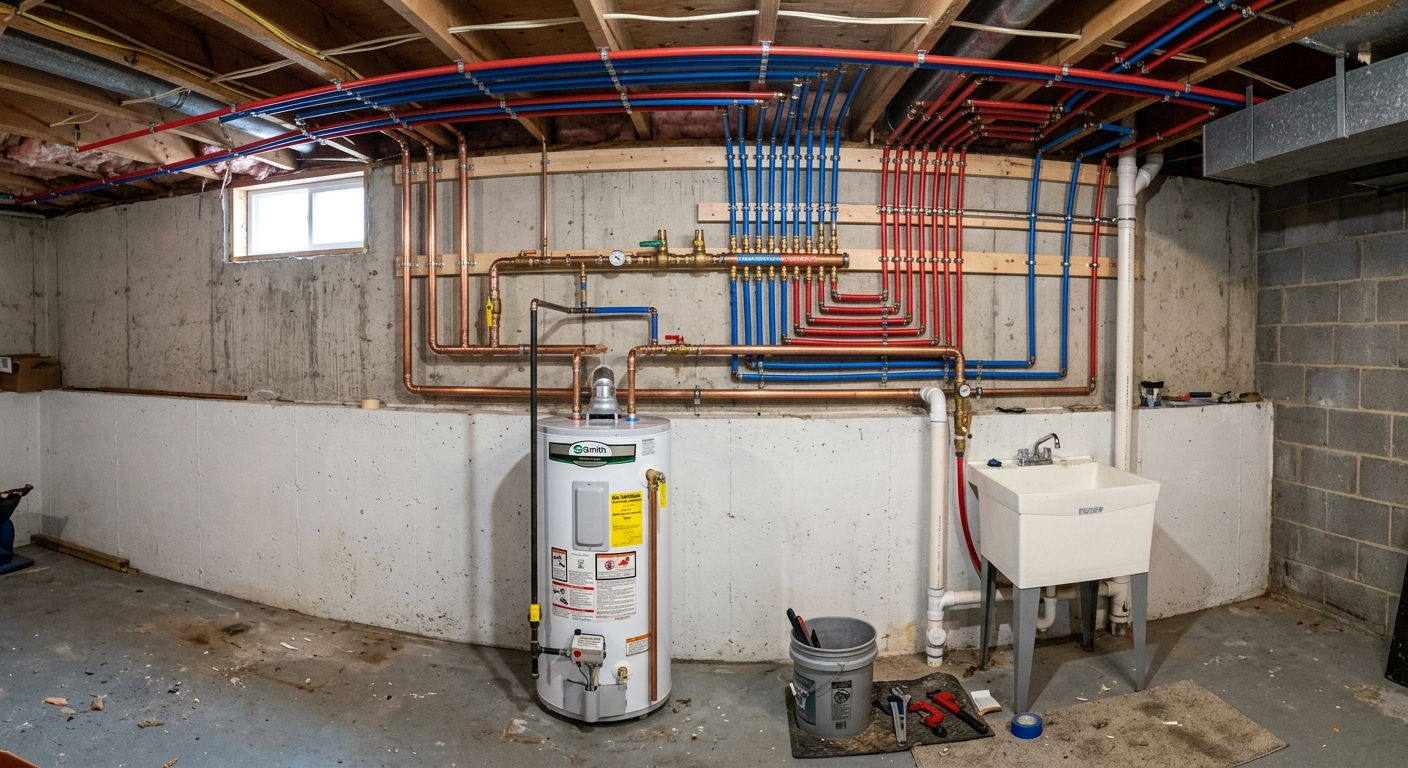
Middletown plumbing prices by job type — 2026
Middletown homeowners face plumbing costs that depend not just on the work itself, but on how urgently it’s needed. Emergency calls—like a burst pipe flooding your finished basement at 2 a.m.—average much higher than scheduled work. The distinction matters for the 75.5% of Middletown households who own, especially since 61.3% of local homes were built before 1980 (U.S. Census Bureau, ACS 2024). That aging stock means many houses, especially those built around the Levittown wave, still run original undersized copper or galvanized pipes. That determines both what fails and what you’ll pay to fix it: emergency fixes cost more, but even a planned upgrade can turn into a premium job if your pipes and walls are tough to reach, like in some partitioned postwar builds.
For routine water heater replacements or planned repipes, scheduling saves you money and lets you pick a slower season. But burst lines, street-to-house leaks, or clogged main drains demand fast response, especially during freeze-thaw cycles that hit this part of Bucks County hard. The table below gives realistic price ranges for typical jobs in a Middletown home. The bands reflect the most common scope and access, not worst-case scenarios—and labor and restoration climb if you get into tile, plaster, or slab foundations.
| Service |
Scope |
Emergency rate |
Standard rate |
| Emergency repair — burst pipe |
locate, open, repair section, restore service |
$650–$1,350 |
$400–$1,350 |
| Water heater replacement (gas, 40–50 gal) |
remove old, install, test, haul away |
$2,100–$3,100 |
$1,350–$3,100 |
| Drain cleaning — main line |
augering or hydro-jet, camera if needed |
$350–$800 |
$200–$500 |
| Sewer line spot repair |
excavate or reline a failed section |
$2,200–$13,500 |
$2,200–$13,500 |
| Whole-house repipe |
replace supply lines throughout, patch and finish |
— |
$3,900–$9,400 |
| Water service line replacement |
street to house, excavation and restoration |
— |
$6,100–$13,500 |
Estimates for a typical Middletown home. Access difficulty and pipe material move these figures more than anything else.
Plumbing systems in Middletown homes
You can tell a lot about Middletown’s plumbing just by looking at what year your house—or your neighbor’s—was built. Over 61% of Middletown’s homes predate 1980, and that puts many in the range where undersized copper, galvanized steel, and sometimes clay-tile sewers were standard. In Levittown, for instance, the mass-built postwar tract homes almost all came with copper supply lines and cast iron or clay drains. If your water turns rusty brown on first flow or pressure drops at more than one fixture, those old pipes are likely reaching the end of their lifespan.
Galvanized supply piping, still found in some pre-1970 homes, is known for corroding from the inside out—leading to leaks, discoloration, and miserable water pressure. On the drain side, original cast iron or clay lines often allow roots to intrude or simply crack after decades of Bucks County freeze-thaw cycles. The water service line (the pipe running from the street to your house) is likely copper if it’s original from the 1950s or later, but some older stretches—especially in scattered pockets across Bucks—might still see lead lines.
Water heaters in these homes are frequently on their second or even third replacement; anything over 15 years old is on borrowed time. For the rare 1980s or newer homes, watch for builder-grade shutoffs, supply lines and, in some windows, polybutylene—those should be replaced proactively. Either way, the era tells you what’s lurking behind the walls and what to budget for when things start giving way.
Licensing and permits for plumbing work in Middletown
Plumbing licensing in Pennsylvania is strictly municipal—there is no statewide master plumbing license, registry, or board for areas outside Philadelphia and Pittsburgh. In Bucks County, towns like Bensalem and Bristol each run their own code offices and set their own requirements for who is allowed to pull plumbing permits. That means you should always ask if your plumber is licensed to work specifically in your municipality; being licensed in one township does not automatically grant the right to work in the next. It’s not enough to hear “licensed and insured”—ask “licensed here in Middletown?”
Permit requirements also differ. In Bensalem, any plumbing work that alters the layout, changes the fixture count, or modifies the water or sewer lines almost always requires a local permit and inspection. Minor like-for-like fixture swaps (such as replacing a faucet or showerhead inside an existing bathroom) often proceed without a permit in some nearby areas like Falls Township. For anything more invasive, especially work in walls or any change to water or sewer lines, expect a permit, a required inspection, and a paper trail.
On other essentials: Pennsylvania law requires any contractor doing over $500 in work to have Home Improvement Contractor (HIC) registration, verifiable at hic.attorneygeneral.gov. For employers, valid workers’ compensation insurance is mandatory, and you can confirm compliance directly at wcais.pa.gov. If your home was built before 1978, federal rules require any work that disturbs painted surfaces to be done by an EPA Lead Renovation, Repair and Painting (RRP) certified contractor—check credentials at certifiedrenovatorsearch.epa.gov.
Spot repairs or whole-house repipe?
One leak in a hidden wall isn’t a crisis, but two or more leaks from the same type of pipe within three years is a pattern—especially in the post‑1950 homes around Levittown, where aging copper or galvanized lines are notorious for repeated failures. If you’re seeing falling pressure throughout the house (not just at one sink), discolored water on startup, or flaking, corroded pipes at exposed joints, you’re not dealing with a one-off. Those are signs the whole system is nearing the end.
For Middletown’s housing, the big decision is spot repairs versus a partial or whole-house repipe. If you’re still on original copper or galvanized, doing piecemeal fixes can mean recurring trouble and wall repairs every time. Partial repipes are sensible when only one branch (like a bathroom stack) has failed. But if polybutylene, known for sudden catastrophic breaks, is anywhere in the system, replace all of it. The most forgotten cost is the patching—if you have old plaster walls, finish work can nearly match your plumbing spend.
On material: PEX is flexible, quicker to install, and far easier on walls and ceilings. Copper is still viable, but costs more, especially if access is tight. Don’t let anyone rush you into a repipe after a single leak unless the pipe material is known problem stock. But in Levittown-era homes, two or more failures mean you’re due.
| Situation |
Recommendation |
Cost |
Reasoning |
| One leak, accessible, modern pipe |
Spot repair |
$400–$1,350 |
Limited, no pattern, low risk of recurrence |
| Two or more leaks in 3 years |
Partial repipe |
$3,900–$6,300 |
Repeated failures, higher risk of hidden issues |
| Galvanized supply, pressure loss |
Full repipe |
$3,900–$9,400 |
Corrosion restricts flow and will worsen |
| Polybutylene anywhere in the house |
Full repipe |
$3,900–$9,400 |
High failure risk due to material defects |
| Cast iron drain with root intrusion |
Camera, then reline or replace |
$2,200–$13,500 |
Roots signal cracks and chronic clogs |
| Suspected lead service line |
Test, then replace the lateral |
$6,100–$13,500 |
Lead is a health hazard, replacement is best |
How to find a good plumber in Middletown
Because licensing in Pennsylvania is municipal, always confirm the plumber you hire is allowed to work in Middletown—a license or permit in Bristol or Bensalem doesn’t carry over. For contracts over $500, check the Home Improvement Contractor registration at hic.attorneygeneral.gov. For workers’ compensation, verify coverage at wcais.pa.gov. Ask to see an insurance certificate naming your home, not just the company’s address.
In Bucks County’s crowded contractor market—especially along the Bensalem–Bristol–Levittown corridor—it’s common to find out-of-area companies that subcontract jobs or leave details vague. Clarify if your plumber brings their own crew or subs out work, and get the full after-hours/emergency call pricing in advance. A reputable company will always provide documentation to justify a repipe or sewer replacement with video or pressure test results, not just a quote.
- Is the plumber licensed for Middletown specifically?
- HIC registration number checks out at hic.attorneygeneral.gov?
- Workers’ compensation verified at wcais.pa.gov?
- Insurance certificate lists your property address?
- Written contract for any job over $500?
- Clear after-hours/emergency pricing?
- Scope of work and warranty spelled out in writing?
- Company uses its own techs, not casual subcontractors?
- No demand for your insurance deductible to be “waived” (it is illegal)
- Justification for major jobs provided (camera or pressure test for repipe/sewer)?
- References from local jobs?
- Lead Renovation (RRP) certification for pre-1978 homes?
Red flags: contractors unable or unwilling to prove HIC registration or insurance; “one-size-fits-all” repipe/sewer quotes with no camera footage; vague labor rates; or companies not disclosing if work is subcontracted. The Bucks County market is dense, so you have the power to choose—don’t settle for excuses.
What a plumbing quote should contain
Plumbing jobs are usually billed either flat rate—one price for the whole job, no matter how long it takes—or time-and-materials, where you pay for hours and parts as the project goes. Flat rate gives price certainty but bakes the risk for surprise problems into the number. Time-and-materials can save money for simple, straightforward fixes but costs can run over on older Middletown homes where every wall hides a possible extra. The real risk is not knowing which model you agreed to; always clarify before hiring.
A decent quote should state: the diagnostic fee (if any) and whether it applies to the final job; exactly what’s to be opened, replaced, and restored; if wall/floor repair is included or extra; if permit and disposal costs are covered; and labor-and-part warranties. For any job over $500, state law requires a written contract. Beware of a “price only” quote with no details about included or excluded restoration—restoring tile, plaster, or finished basements is often the spend you don’t see coming.
| Line item |
What to look for |
Red flag if… |
| Billing model |
flat rate or hourly, stated up front |
unstated |
| Diagnostic fee |
amount, and whether it credits |
vague |
| Scope |
what is opened, repaired and restored |
price with no scope |
| Restoration |
drywall and finish explicitly in or out |
silent |
| Permit |
included and priced |
'not needed' |
| Parts |
brand and model for fixtures |
'standard fixture' |
| Warranty |
labour period stated separately |
parts only |
Tank, tankless or heat pump water heater?
If you’re replacing a water heater in Middletown, you have three practical options: gas tank, electric tank, tankless (on-demand), or heat pump. Each has its pros and cons depending on your home’s infrastructure and priorities.
Standard gas tank heaters are the least expensive to install and fit easily into most layouts, especially homes already set up for gas. They have a typical service life of 8–12 years, but you’ll pay for standby losses every time the burner cycles. Electric tanks avoid venting issues but cost more to operate in Bucks County’s rate environment and last 10–15 years. Tankless gas models don’t run out of hot water and last twice as long (18–25 years), but installation is pricier—often requiring a larger gas line and upgraded vent, which surprises many on older homes. Heat pump water heaters cost more up front but boast the lowest running costs, best suited to homes with a basement or utility room that stays above 50°F; they’ll cool and dehumidify the space around them, which matters if your basement’s tight or finished.
Sizing should be by first-hour rating—how much hot water you can draw at once—not just tank size. Always ask for an expansion tank on a closed system, and make sure a pan and proper drain exist to handle leaks. Most failures come from the tank—not the controls—which is why costlier models sometimes still don’t pay back. In Middletown, with public gas in many neighborhoods but some all-electric pockets, your existing setup will often steer your choice.
| Type |
Installed cost |
Service life |
Operating cost |
Best when |
| Gas tank, 40–50 gal |
$1,350–$3,100 |
8–12 yrs |
moderate |
existing gas, low install cost |
| Electric tank, 40–50 gal |
$1,350–$2,100 |
10–15 yrs |
high |
no gas line, basic hot water needs |
| Gas tankless |
$2,100–$3,100 |
18–25 yrs |
low-moderate |
endless hot water, prepared for extra install cost |
| Heat pump water heater |
$2,100–$3,100 |
13–15 yrs |
lowest |
warm, unconditioned install space and lowest utility bills |
Frequently asked questions — plumbing in Middletown
Are tree roots a common sewer problem in Middletown?
Tree roots in sewer laterals are a regular concern for Middletown and many Bucks County homeowners—especially in postwar neighborhoods with lots of maturing trees and original sewer lines. Many Levittown-era homes have cast iron or even clay-tile sewer lines, and as these pipes age, cracks or loose joints allow roots an easy way in, most often showing up as slow drains or backups after storms. If you haven’t had a camera inspection since moving in, it’s worth considering—catching minor root intrusion early can often be solved by a cleaning in the $200–$500 range, far cheaper than waiting for a massive blockage that requires a spot repair in the $2,200–$13,500 range. Regular maintenance every couple of years can help extend the lifetime of an older sewer lateral in Middletown’s tree-lined streets.
How much does sewer line repair cost in Middletown?
Sewer line spot repair in a typical Middletown home generally runs between $2,200–$13,500, with an average closer to $6,100 for a single accessible section. The final cost depends on whether the pipe is easy to reach in your yard, how deep it runs, and if there are trees or paved surfaces on top. Homes built in the postwar boom often have their original clay or cast iron lines, which can be brittle and prone to root intrusion or shifting after decades of freeze-thaw cycles. A reputable local plumber should provide a camera inspection before quoting a repair. While sticker shock is real, catching a small break early is much less expensive than full replacement or multiple excavations. Always get second opinions for any quote above the low end of the price band.
Should I repipe my Middletown home or keep repairing?
In Middlesex homes, especially those dating back to the 1950s–1970s, the call to repipe or repair comes down to frequency and pipe type. If you’ve had two or more leaks from the same copper or galvanized lines in the last three years, or your water is rusty or pressure is dropping everywhere, it’s time to consider a partial or whole-house repipe. It may feel like a major investment—typically $3,900–$9,400—but repeated spot repairs and wall patches can end up costing more without solving the root problem. The postwar boom built a lot of Middletown homes with plumbing that’s past its life expectancy. Repipe once, restore the walls right, and you won’t be paying again every year for the next decade.
What does drain cleaning cost in Middletown?
Main line drain cleaning in Middletown typically falls in the $200–$500 range for standard service, with after-hours or more involved hydro-jetting jobs pushing the emergency cost to $350–$800. Price depends on access, severity of the clog, and whether a basic auger will do or if camera inspection and hydro-jetting are necessary. As older Bucks County homes age and roots or scale build up, routine cleaning every couple of years isn’t a wasteful spend—it’s often cheaper over time than waiting for a full blockage and possible water damage. Always get a written quote specifying what’s included, and don’t be upsold into costly repairs without evidence from a camera.
How do I prevent frozen pipes in Middletown?
Middletown’s winter lows can dip into the teens, and with a frost depth around 30 inches in Bucks County, protecting your pipes from freezing is a real concern—especially in older homes with little insulation on exterior walls. The best prevention is to insulate any pipes running near exterior walls, basements, or crawl spaces. When a cold snap is coming, let taps drip slightly and keep cabinet doors open to allow warmth in. If your home has had a past burst pipe (which can cost $400–$1,350 for emergency repair), ask a local plumber to review your vulnerable runs. Long-term, sealing air leaks and adding insulation around exposed plumbing pays off not just in peace of mind, but potentially cheaper insurance.
What do I do if sewage is backing up?
Sewage backing up in Middletown is most often a main line clog or, occasionally, a failed sump or ejector in homes with finished basements. Stop using all plumbing immediately—flushing, running washers, or showering will worsen the backup. If safe, check any accessible cleanouts for standing water. The next step is to call a plumber experienced in main drain cleaning and camera inspection; basic drain clearing typically runs $200–$500, but if the issue is deeper or during off-hours, costs climb. Do not run chemical cleaners (they rarely work on full clogs and complicate professional snaking). If sewage has reached finished spaces, ask about sanitation as well as clearing the line.
Who pays to replace a lead service line in Middletown?
In most of Middletown and Bucks County, the homeowner is responsible for the portion of a lead service line that runs from the curb to the house, while the local water authority handles lines on the street side. According to the Bucks County Water & Sewer Authority, about 2,000 lead services still need replacement in the county. Costs typically run $6,100–$13,500, depending on the length and difficulty of excavation. Some utilities or municipalities periodically offer partial rebates or cost-sharing programs, but these are not always available. If you suspect you have a lead line, call the water utility for a test, and if confirmed, prioritize budgeting for replacement as soon as possible for health and insurance reasons.
How do I verify a plumber's licence and insurance?
In Middletown, always confirm that your plumber holds local authorization, since plumbing licensing is handled municipality-by-municipality in Bucks County. Ask the contractor directly: “Are you licensed to work in Middletown Township?” Then check their Home Improvement Contractor (HIC) registration at hic.attorneygeneral.gov—you’ll see if their registration is current and if there have been complaints. For jobs over $500, a written contract is legally required. Workers’ compensation insurance should be authenticated at wcais.pa.gov by searching the business name. Do not hire anyone who refuses to provide an insurance binder listing your address for the coverage period; uncovered accidents are not your risk to carry, regardless of quoted job price—spot repairs alone often run $400–$1,350.
How do I tell what my pipes are made of?
In Middletown, the year your house was built tells you a lot: copper and galvanized were the norm in most homes built before 1980, with occasional stretches of polybutylene in late 1970s and 1980s builds. To check your supply lines, look at exposed pipe near your main shut-off: copper will be reddish-brown and metallic; galvanized is dull, threaded, and attracts a magnet; polybutylene is flexible, gray-blue plastic. Drain lines in older homes often show cast iron (thick, dark, rusty with time) or clay (tan ceramic), with white plastic (PVC) being the modern upgrade. If you’re unsure, a plumber can confirm during a diagnostic visit—typically a small part of a repair ($400–$1,350). Knowing your materials is the first step to planning smart repairs in aging Bucks County housing.