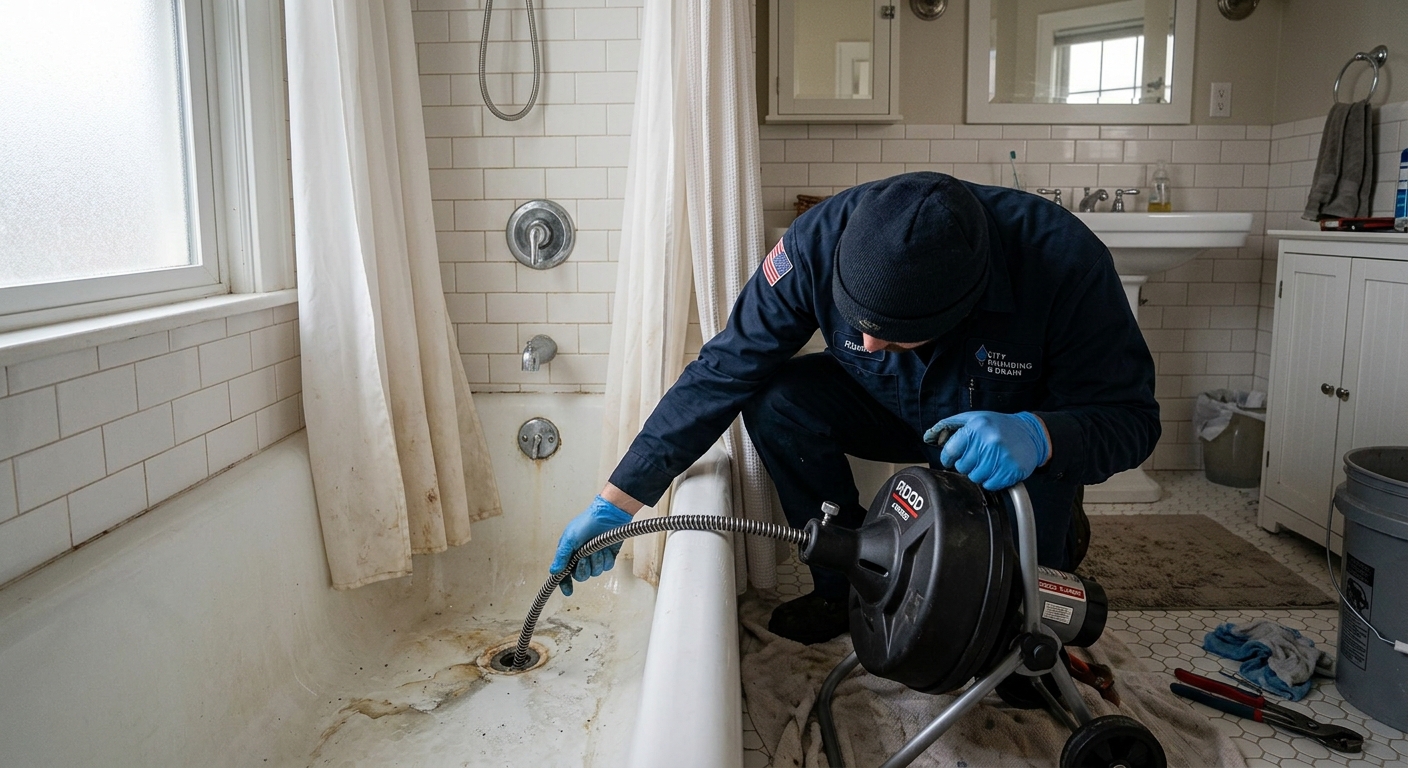
Bedminster plumbing prices by job type — 2026
Bedminster homeowners, most living in single-family homes with a median income of $137,500 (U.S. Census Bureau, ACS 2024), see plumbing bills shaped by their home's age and original pipe material. Much of southeastern Bucks County shares construction patterns with Levittown in Falls Township, where mass-built post-1950 houses lean heavily on aging copper and galvanized pipes now reaching end-of-life. Material and access matter as much as the job itself. An emergency burst pipe fix—on a cold night, after hours—always costs extra. The same technical repair done during a scheduled daytime visit is significantly less expensive. That's why nearly every price you’ll encounter in Bedminster plumbing swings on whether or not your job is truly urgent: emergency rates reflect overtime labor and immediate dispatch, while standard rates let you plan. If your pipes are original galvanized or under-sized copper, you’re likely to feel the pinch with frequent repairs, sometimes pushing a whole-house repipe if leaks multiply or water pressure drops.
| Service |
Scope |
Emergency rate |
Standard rate |
| Emergency repair — burst pipe |
locate, open, repair section, restore service |
$700–$1,400 |
$425–$1,400 |
| Water heater replacement (gas, 40–50 gal) |
remove old, install, test, haul away |
$2,300–$3,300 |
$1,400–$3,300 |
| Drain cleaning — main line |
augering or hydro-jet, camera if needed |
$350–$800 |
$200–$500 |
| Sewer line spot repair |
excavate or reline a failed section |
$2,400–$14,000 |
$2,400–$14,000 |
| Whole-house repipe |
replace supply lines throughout, patch and finish |
- |
$4,200–$10,000 |
| Water service line replacement |
street to house, excavation and restoration |
- |
$6,500–$14,000 |
Estimates for a typical Bedminster home. Access difficulty and pipe material move these figures more than anything else.
Verifying a Bedminster plumber's credentials
Pennsylvania does not issue a statewide plumbing license—each municipality sets its own requirements. In practical terms, that means a plumber licensed to work in Philadelphia or Pittsburgh has no automatic right to pull permits or perform regulated plumbing work in Bedminster or any part of Bucks County. When you ask about licensing, be direct: “Are you authorized to work in this municipality?” The answer must be specific to your township or borough.
For contracts over $500, every plumber must carry a current Pennsylvania Home Improvement Contractor (HIC) registration, issued by the Office of Attorney General. Always check their HIC number at hic.attorneygeneral.gov before signing anything. This registration assures you of written contracts and basic consumer protections under the Home Improvement Consumer Protection Act (HICPA), including a three business-day cancellation right. Confirm that your plumber has a valid insurance certificate listing your address, and check workers’ compensation through the state’s WCAIS portal at wcais.pa.gov, which is mandatory for all employers—even a small crew.
Permits in Bucks County are also local. In Bensalem Township, for example, any job altering water or sewer piping layout or fixture count typically needs a plumbing permit and municipal inspection; basic faucet swaps in Falls Township may not. If you’re unsure, call your township code office before work starts. For homes built before 1978, federal EPA Lead RRP rules apply for any work disturbing paint; check certified renovators at the EPA’s site.
How to find a good plumber in Bedminster
Start your search only with plumbers who hold a valid Pennsylvania Home Improvement Contractor (HIC) registration; verify at hic.attorneygeneral.gov. Given that plumbing licensing is municipal, do not assume a credential in Bensalem or Bristol extends to Bedminster—ask if the crew is permitted to work specifically in your township. Request a certificate of insurance naming your property, not just a generic copy. For workers' compensation, confirm their coverage at wcais.pa.gov. Be wary of companies that send subcontractors instead of their own crews without telling you in advance, as that clouds responsibility for workmanship and insurance.
Emergency dispatch pricing, especially after hours, should be disclosed upfront. Insist on clarity around minimum fees and surcharges before anyone arrives. If you get quoted for extensive work like a whole-house repipe or sewer repair, demand camera footage and a pressure test first—no honest plumber in Bucks County will skip this step in today’s market.
- Verify HIC registration at hic.attorneygeneral.gov
- Ask explicitly if licensed in your specific municipality
- Obtain insurance certificate naming your address
- Check workers’ compensation at wcais.pa.gov
- Confirm if crews are in-house or subcontracted
- Request clarity on emergency/service call fees
- Demand camera footage on any sewer/pipe replacement quote
- Require a written contract for jobs over $500
- Ask about permit requirements for your township
- Seek references from homeowners in Bedminster or nearby Bucks County
- Confirm timeline and scope before starting
- Check for EPA Lead RRP certification in pre-1978 homes
In the dense, highly competitive Philadelphia metro market, any reluctance to provide documentation—or a push for a repipe or sewer dig with no hard evidence—is a major red flag. Reputable plumbers expect to be vetted.
Service line material and drinking water in Bedminster
The Bucks County Water & Sewer Authority supplies public water across much of Bedminster. If you’re concerned about potential lead in your service line, understand where responsibility splits: the utility generally maintains the line up to your curb stop, while you (the homeowner) are on the hook from that point into your house. Bucks County Water & Sewer Authority currently reports about 2,000 known or suspected lead service lines across the county pending prioritized replacement, which means “lead goosenecks” or full-length leads are still present in some Bedminster homes—especially those built before the 1950s.
To check your line, locate where water enters your basement or crawlspace. Gently scratch the pipe with a coin—if it’s soft, silvery grey, and not attracted to a magnet, it’s probably lead. Copper is reddish; galvanized steel is dull grey and will grab a magnet. Note: If only your side is replaced (a “partial replacement”), this can temporarily spike lead levels in water because the connection disrupts protective mineral scale.
The utility’s website typically lists service line material inventories; if you don’t see your address or the status is unclear, call them directly rather than assume. Countywide programs often cover only utility property. If you own a lead lateral, expect a replacement cost between $6,500–$14,000 depending on length and restoration needs. If a lead “spot repair” is all that’s needed, expenses can start at $2,400.
Hardness, treatment and fixture life in Bedminster
Bucks County Water & Sewer Authority, which serves much of Bedminster, publishes an annual water quality report you can request directly. Most Bedminster water is moderately hard, not extreme by national standards, but enough so that scale buildup gradually shortens water heater and fixture life over decades—especially in the many homes with original equipment. If you notice white residue on faucets or short intervals before water heater failure, that’s a sign your water heater and other appliances are working against local hardness.
A softener removes hardness, but the economics in Bedminster often don’t justify the investment for most homeowners. Expect longer water heater life if you flush the tank yearly and don’t overspend on “lifetime” filtering systems unless you have a special need. Whole-house filtration is helpful for sediment or chlorine taste; if your concern is lead or organics, point-of-use filters (on a single tap) are more efficient and cheaper to maintain.
For those on private wells or individual septic systems in the northern Bucks townships, no authority routinely tests your water—it’s wise to have it checked for bacteria, nitrates and heavy metals annually, as published water reports won’t apply. Don’t buy expensive “miracle” filters or conditioners unless you’ve got clear test results showing a real need.
Sewer laterals: the pipe you own and can't see
In most Bucks County municipalities, including Bedminster, homeowners own the sewer lateral from the house all the way to the utility main—sometimes into the street itself. If there’s a problem in this section, whether blockage or collapse, it’s on you to repair.
The first symptom of an issue is usually one slow drain. As clogs move downstream, expect multiple drains to back up, gurgling sounds in fixtures, or raw sewage at the lowest point in the house (like a basement tub or floor drain). Never accept a quote for sewer excavation or replacement without seeing camera footage of the clog, collapse, or root intrusion first—this is standard practice, and any credible local plumber will show it. In this market, excavation is often the most expensive single plumbing job you’ll face, with spot repairs running from $2,400–$14,000.
Levittown and many Bucks County homes built before 1980 may have clay tile laterals prone to root intrusion at joints; others have cast iron that corrodes and cracks around the 50–75 year mark. Trenchless relining is available for some layouts, avoiding yard destruction, but isn’t always possible depending on pipe collapse.
Farther north in Bucks County, be aware that older homes may still rely on individual septic. Septic owners need a different rhythm: pump tanks every 2–4 years, and watch for surfacing water or backups as signs of drainfield failure, which is a bigger problem than a single pipe issue.
Pipe materials in Bedminster homes and how they fail
Plumbing in Bedminster and across Bucks County is a patchwork of eras. Houses built in the first postwar boom—like those in Levittown—used lots of galvanized steel and copper. Here’s how this history shapes what fails today: galvanized pipes corrode from the inside, gradually choking flow and killing pressure long before they start to leak. Copper, the next generation, lasts longer but can form pinhole leaks, especially with aggressive water chemistry, and joints may fail first. Polybutylene, found in some remodels from the late 1970s to 1995, is unreliable—its plastic fittings are prone to sudden failure. PEX has been the standard since the early 2000s, with flexible installations and comparably long life.
On the drain side, pre-1975 cast iron is durable but rusts and occasionally cracks, often at floor penetrations. Clay tile sewer laterals—common in homes before 1980—fail at joints, letting in roots with repeated backups as the warning sign. PVC and ABS, used since the 1970s, are more stable if not crushed or poorly glued.
Want to know what you’ve got? Scratch an exposed line: copper is red, steel is grey and magnetic, lead is silver and very soft. Polybutylene is typically blue or grey plastic, often with clamps—not threaded or soldered. Most homes built before 1960 now have less than a decade of reliable service left on original galvanized; for copper from the 1950s–1970s, start budgeting if pinholes appear regularly. A pipe's color, material and how the joints look—all tell the era and what’s coming next for repair bills.
| Material |
Typical era |
Failure mode |
Service life |
| Galvanized steel supply |
pre-1960 |
internal corrosion, pressure loss |
40–60 yrs |
| Copper supply |
1950s–present |
pinhole leaks, joint failure |
50–70 yrs |
| Polybutylene supply |
late 1970s–1995 |
fitting failure, sudden bursts |
unreliable |
| PEX supply |
2000s–present |
fitting or UV degradation |
40–50 yrs |
| Cast iron drain |
pre-1975 |
corrosion, cracking, scale |
50–75 yrs |
| Clay tile sewer lateral |
pre-1980 |
root intrusion at joints, offset |
50–60 yrs |
| PVC / ABS drain |
1970s–present |
joint separation, crushing |
50+ yrs |
Frequently asked questions — plumbing in Bedminster
How deep do water lines need to be buried in Bedminster?
In Bedminster and throughout southeastern Pennsylvania, water lines are typically buried to a depth of at least 30 inches to avoid freezing—a requirement driven by local frost depth (30 inches) and a winter design temperature of 14 °F. This depth meets the minimum code standard from the Pennsylvania Uniform Construction Code (UCC), which is enforced by local code officials. If you have an older home, your existing service line may be shallower, especially in postwar neighborhoods like Levittown. When replacing a line, reputable local plumbers should always aim for or exceed 30 inches to reduce the risk of freeze-thaw cycling, which is a real issue here. If you need to replace your water service line due to depth or age, the job typically runs $6,500–$14,000 depending on access and restoration scope. Always verify depths with your township inspector during any digging or replacement work.
Is my water line lead?
Many Bedminster homes, especially those built before the 1950s, remain at risk for having lead service lines—Bucks County Water & Sewer Authority acknowledges around 2,000 known or suspected lead lines countywide. To check, look for the main water pipe entering your house. Try the coin scratch test: lead is soft, dull silver, and not magnetic; copper is reddish, steel is grey and grabs a magnet. If your line is lead, don’t assume utility replacement is free—programs often only cover the public section to the curb. Homeowner responsibility picks up from the curb to your house. Replacing your full lead lateral is an investment, typically $6,500–$14,000. Always consult the Authority for up-to-date records—and if in doubt, arrange for a licensed plumber to confirm the material before deciding next steps.
What does repiping a house cost in Bedminster?
Repiping an entire home in Bedminster, most of which are single-family and often built before 1980, is largely a matter of pipe material and access. With many local homes originally fitted with galvanized steel or copper, typical repipe projects cost $4,200–$10,000. The lower end covers smaller single-story houses with easy access; large or multi-story layouts with finished basements, or where patching and restoration are more involved, can run up to the high end. Plumbing companies should always provide a fixed bid after a visual inspection, and if you’re quoted for a full repipe, ask for photos or pressure test results—don’t just take their word if you haven’t had multiple leaks or visible corrosion.
Is a tankless water heater worth it in Bedminster?
While tankless water heaters offer energy savings and endless hot water, their installation in Bedminster isn't always the best value for every homeowner. Most houses here already have standard gas or electric tank models, and water hardness can cause lime scale to build up quickly in tankless units, requiring more maintenance. A traditional 40–50 gallon tank replacement in Bedminster costs $1,400–$3,300, while tankless units often double that installed price. Consider tankless if you have a high hot water demand and space constraints. For many with average household needs, a properly sized tank heater offers better payback, especially if you maintain it well and flush periodically to manage local water conditions. Always request a direct comparison from several plumbers.
Which utility supplies water to Bedminster?
The Bucks County Water & Sewer Authority provides public water service to large portions of Bedminster and surrounding Bucks County communities. Their coverage is broad and includes most of the township, though not every property—some outlying or rural addresses may still use private wells. If your home is on public water, you’re entitled to request an annual water quality report directly from the Authority for transparency on treatment, hardness, and contaminants. For those not covered, private well systems should be tested independently every year, since the utility's sampling won’t reflect your actual water quality. If you ever need a water service line replacement—from the street to your house—the cost generally falls in the $6,500–$14,000 range.
Can I do my own plumbing work in Bedminster?
In Pennsylvania, there is no statewide plumbing license; requirements are set by each municipality. In Bedminster, you should always check with your township code office to know what’s permitted. Small like-for-like jobs (like swapping a faucet) might not need a plumber or a permit, but any bigger work—moving pipes, altering layouts, or replacing water heaters—often does. Even “handy” homeowners should pull a permit and arrange an inspection if the work triggers it locally. Unpermitted plumbing can void homeowners insurance and cause trouble on resale. For work over $500, the Home Improvement Consumer Protection Act (HICPA) applies—a written contract is required, and waiving deductibles is prohibited. As a rule, if the job could flood your basement or leave you without water, call a professional.
Why do plumbers charge a diagnostic fee?
Diagnostic fees in Bedminster—especially for emergency calls—are standard practice. With such a dense, competitive Philadelphia-area market, most reputable plumbers charge to send a licensed tech, inspect the issue, and quote repairs. This fee, which is often in the $425–$1,400 range for emergency leak fixes or burst pipes, offsets time and expertise, particularly if troubleshooting involves removing drywall or using specialty tools. Some plumbers will credit this fee toward the authorized repair, but not all. You should always clarify up front whether the diagnostic charge is “stand-alone” or applied toward the finished bill. Don’t hesitate to ask; in this market, clear pricing is a sign you’re working with a straight shooter, not someone cruising for upcharges.
How do I shut off the water to my house?
Every Bedminster homeowner should know where the main water shutoff is—typically at the point where the line enters your basement or crawlspace. On most homes built after 1950, especially in the Levittown model, look for a ball or gate valve just inside the wall. If you have a street-side curb stop (sometimes in the sidewalk or yard), a plumber can shut off flow there in emergencies. Practice turning off your valve now, before trouble hits: it should stop water flow completely when closed. If you ever face a burst pipe, immediately shut off at this main valve and then call a plumber for emergency repair, which will typically run $700–$1,400 for prompt service. If your valve is stuck or suspect, now’s the time to have it replaced—waiting until a leak can double your costs.
Who pays to replace a lead service line in Bedminster?
In Bedminster, as throughout Bucks County, responsibility for a lead service line is generally split: the Bucks County Water & Sewer Authority covers only the utility-owned portion up to the curb stop, while you own the lateral from the curb to your house. Current countywide replacement programs mainly target public portions—if you discover your side is lead, you as the homeowner are responsible for replacement unless future funding is announced. The project typically costs $6,500–$14,000 based on access and restoration needs. If you’re unsure about assistance or cost share, contact the Authority directly rather than guessing; program eligibility and funding change year over year. Always coordinate any replacement with the utility to avoid unnecessary partial replacements, which can spike lead levels short-term after work is done.